

QUANTUM STRINGS AND RANDOM SURFACES
179
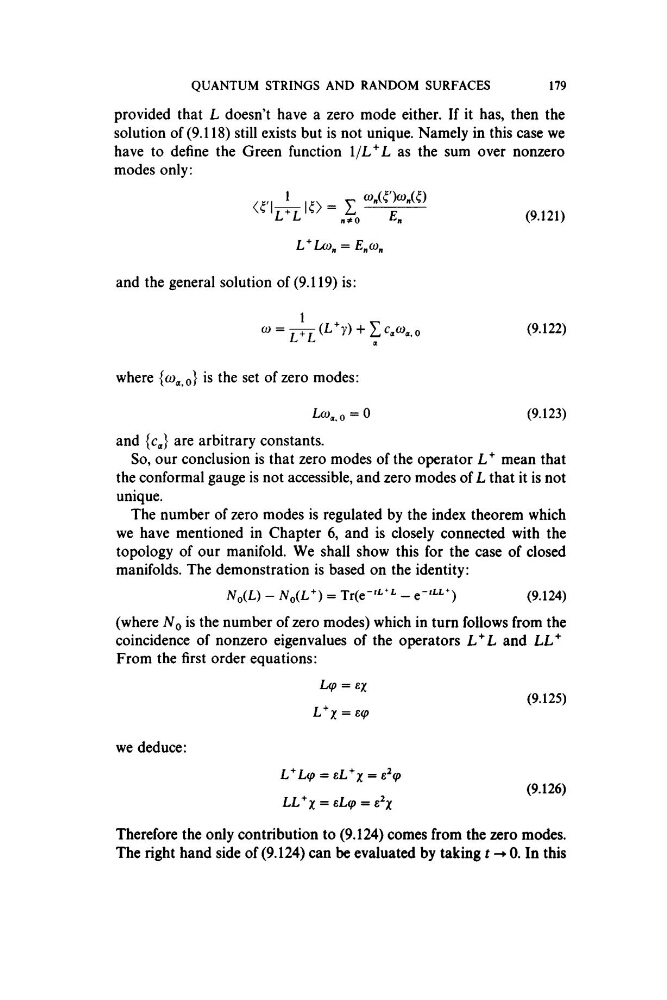
provided that L doesn’t have a zero mode either. If it has, then the
solution of (9.118) still exists but is not unique. Namely in this case we
have to define the Green function 1/L^L as the sum over nonzero
modes only:
L ^L (o „ = E„(o„
(9.121)
and the general solution of (9.119) is:
1
(9.122)
where {co^,o} is the set of zero modes:
Lco,,o = 0
(9.123)
and {c^} are arbitrary constants.
So, our conclusion is that zero modes of the operator
mean that
the conformal gauge is not accessible, and zero modes of L that it is not
unique.
The number of zero modes is regulated by the index theorem which
we have mentioned in Chapter 6, and is closely connected with the
topology of our manifold. We shall show this for the case of closed
manifolds. The demonstration is based on the identity:
No(L) - No(L^) = Tr(e-*^^^ -
(9.124)
(where Nq is the number of zero modes) which in turn follows from the
coincidence of nonzero eigenvalues of the operators L^L and LL^
From the first order equations:
L(p = ex
L^X =
(9.125)
we deduce:
L^L(p = bL^x —
LL^X —
(9.126)
Therefore the only contribution to (9.124) comes from the zero modes.
The right hand side of (9.124) can be evaluated by taking i 0. In this
179
provided that L doesn’t have a zero mode either. If it has, then the
solution of (9.118) still exists but is not unique. Namely in this case we
have to define the Green function 1/L^L as the sum over nonzero
modes only:
L ^L (o „ = E„(o„
(9.121)
and the general solution of (9.119) is:
1
(9.122)
where {co^,o} is the set of zero modes:
Lco,,o = 0
(9.123)
and {c^} are arbitrary constants.
So, our conclusion is that zero modes of the operator
mean that
the conformal gauge is not accessible, and zero modes of L that it is not
unique.
The number of zero modes is regulated by the index theorem which
we have mentioned in Chapter 6, and is closely connected with the
topology of our manifold. We shall show this for the case of closed
manifolds. The demonstration is based on the identity:
No(L) - No(L^) = Tr(e-*^^^ -
(9.124)
(where Nq is the number of zero modes) which in turn follows from the
coincidence of nonzero eigenvalues of the operators L^L and LL^
From the first order equations:
L(p = ex
L^X =
(9.125)
we deduce:
L^L(p = bL^x —
LL^X —
(9.126)
Therefore the only contribution to (9.124) comes from the zero modes.
The right hand side of (9.124) can be evaluated by taking i 0. In this