

THE LARGE N EXPANSION
1 47
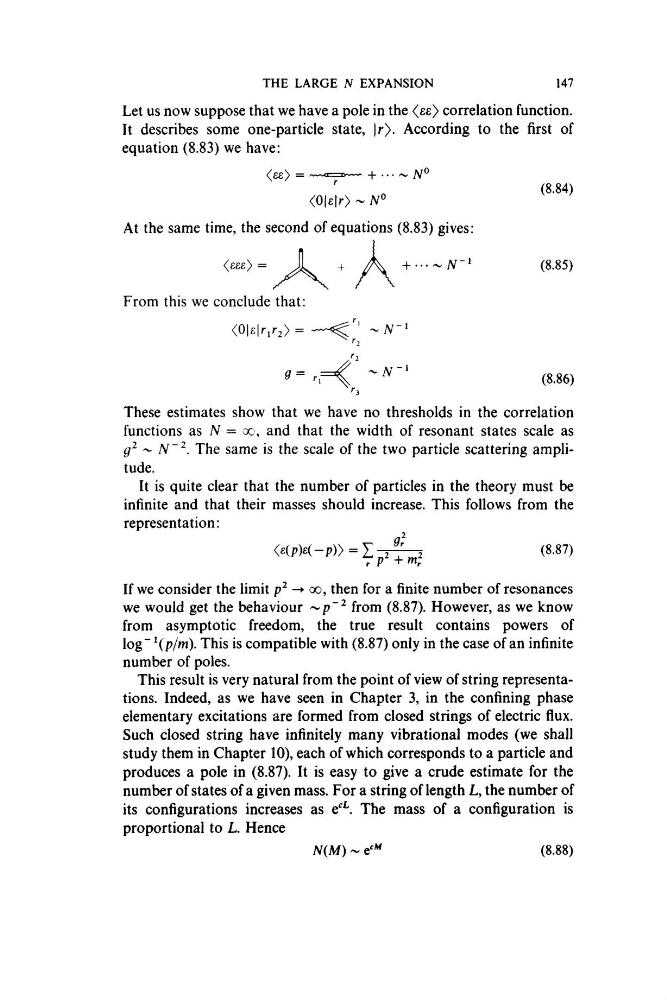
Let us now suppose that we have a pole in the <88> correlation function.
It describes some one-particle state, |r>. According to the first of
equation (8.83) we have:
<££> =
^0
+ ••
<0|£|r> -
At the same time, the second of equations (8.83) gives:
- N-^
(8.84)
(8.85)
■N'
(8.86)
These estimates show that we have no thresholds in the correlation
functions as N = co, and that the width of resonant states scale as
^2 ^ yy-2
same is the scale of the two particle scattering amplitude.
It is quite clear that the number of particles in the theory must be
infinite and that their masses should increase. This follows from the
representation:
_
(8.87)
< £ (p )£ (-p )> = X
2 f " 2
If we consider the limit -► oo, then for a finite number of resonances
we would get the behaviour ^ p "^ from (8.87). However, as we know
from asymptotic freedom, the true result contains powers of
log” ^(p/m). This is compatible with (8.87) only in the case of an infinite
number of poles.
This result is very natural from the point of view of string representations. Indeed, as we have seen in Chapter 3, in the confining phase
elementary excitations are formed from closed strings of electric flux.
Such closed string have infinitely many vibrational modes (we shall
study them in Chapter 10), each of which corresponds to a particle and
produces a pole in (8.87). It is easy to give a crude estimate for the
number of states of a given mass. For a string of length L, the number of
its configurations increases as
The mass of a configuration is
proportional to L. Hence
N ( M ) - e " ^
( 8 . 8 8 )
1 47
Let us now suppose that we have a pole in the <88> correlation function.
It describes some one-particle state, |r>. According to the first of
equation (8.83) we have:
<££> =
^0
+ ••
<0|£|r> -
At the same time, the second of equations (8.83) gives:
- N-^
(8.84)
(8.85)
■N'
(8.86)
These estimates show that we have no thresholds in the correlation
functions as N = co, and that the width of resonant states scale as
^2 ^ yy-2
same is the scale of the two particle scattering amplitude.
It is quite clear that the number of particles in the theory must be
infinite and that their masses should increase. This follows from the
representation:
_
(8.87)
< £ (p )£ (-p )> = X
2 f " 2
If we consider the limit -► oo, then for a finite number of resonances
we would get the behaviour ^ p "^ from (8.87). However, as we know
from asymptotic freedom, the true result contains powers of
log” ^(p/m). This is compatible with (8.87) only in the case of an infinite
number of poles.
This result is very natural from the point of view of string representations. Indeed, as we have seen in Chapter 3, in the confining phase
elementary excitations are formed from closed strings of electric flux.
Such closed string have infinitely many vibrational modes (we shall
study them in Chapter 10), each of which corresponds to a particle and
produces a pole in (8.87). It is easy to give a crude estimate for the
number of states of a given mass. For a string of length L, the number of
its configurations increases as
The mass of a configuration is
proportional to L. Hence
N ( M ) - e " ^
( 8 . 8 8 )