

14 6
GAUGE FIELDS AND STRINGS
where V, £, F are numbers of vertices, edges and faces, and / is the Euler
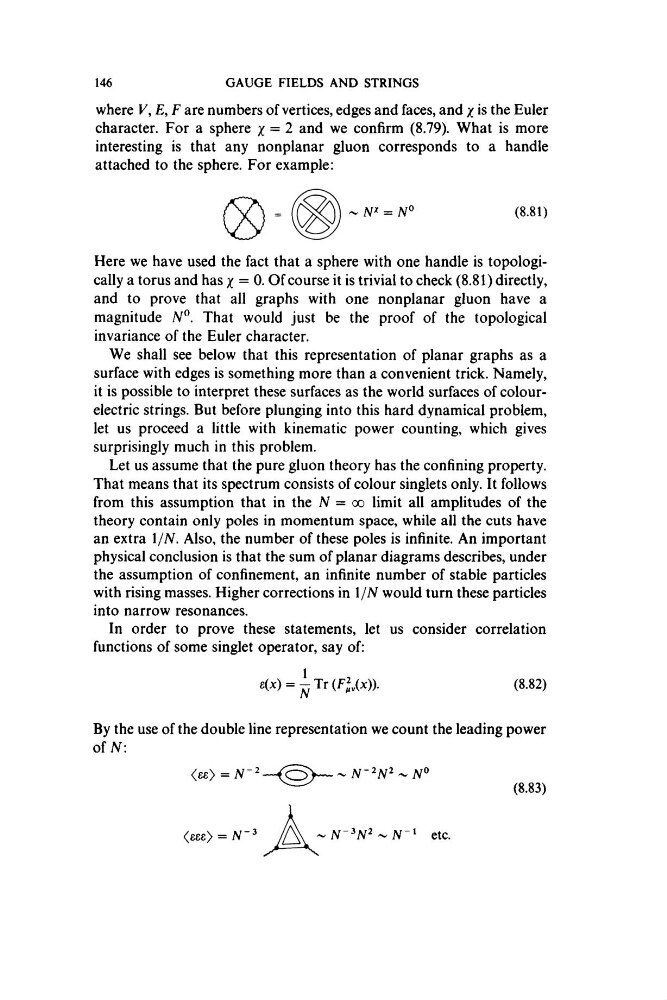
character. For a sphere x = 2 and we confirm (8.79). What is more
interesting is that any nonplanar gluon corresponds to a handle
attached to the sphere. For example:
(8.81)
Here we have used the fact that a sphere with one handle is topologically a torus and has x = 0. Of course it is trivial to check (8.81) directly,
and to prove that all graphs with one nonplanar gluon have a
magnitude N^. That would just be the proof of the topological
invariance of the Euler character.
We shall see below that this representation of planar graphs as a
surface with edges is something more than a convenient trick. Namely,
it is possible to interpret these surfaces as the world surfaces of colourelectric strings. But before plunging into this hard dynamical problem,
let us proceed a little with kinematic power counting, which gives
surprisingly much in this problem.
Let us assume that the pure gluon theory has the confining property.
That means that its spectrum consists of colour singlets only. It follows
from this assumption that in the N = co limit all amplitudes of the
theory contain only poles in momentum space, while all the cuts have
an extra 1/N. Also, the number of these poles is infinite. An important
physical conclusion is that the sum of planar diagrams describes, under
the assumption of confinement, an infinite number of stable particles
with rising masses. Higher corrections in \/N would turn these particles
into narrow resonances.
In order to prove these statements, let us consider correlation
functions of some singlet operator, say of:
£(x) = ^Tr(Fi,(x)).
(8.82)
By the use of the double line representation we count the leading power
of iV;
<«£> =
-----~ N°
(8.83)
<8£8> = N~
Netc.
GAUGE FIELDS AND STRINGS
where V, £, F are numbers of vertices, edges and faces, and / is the Euler
character. For a sphere x = 2 and we confirm (8.79). What is more
interesting is that any nonplanar gluon corresponds to a handle
attached to the sphere. For example:
(8.81)
Here we have used the fact that a sphere with one handle is topologically a torus and has x = 0. Of course it is trivial to check (8.81) directly,
and to prove that all graphs with one nonplanar gluon have a
magnitude N^. That would just be the proof of the topological
invariance of the Euler character.
We shall see below that this representation of planar graphs as a
surface with edges is something more than a convenient trick. Namely,
it is possible to interpret these surfaces as the world surfaces of colourelectric strings. But before plunging into this hard dynamical problem,
let us proceed a little with kinematic power counting, which gives
surprisingly much in this problem.
Let us assume that the pure gluon theory has the confining property.
That means that its spectrum consists of colour singlets only. It follows
from this assumption that in the N = co limit all amplitudes of the
theory contain only poles in momentum space, while all the cuts have
an extra 1/N. Also, the number of these poles is infinite. An important
physical conclusion is that the sum of planar diagrams describes, under
the assumption of confinement, an infinite number of stable particles
with rising masses. Higher corrections in \/N would turn these particles
into narrow resonances.
In order to prove these statements, let us consider correlation
functions of some singlet operator, say of:
£(x) = ^Tr(Fi,(x)).
(8.82)
By the use of the double line representation we count the leading power
of iV;
<«£> =
-----~ N°
(8.83)
<8£8> = N~
Netc.