

THE LARGE N EXPANSION
145
the formula (2.68) of asymptotic freedom. For rescaled coupling it is N~
independent.
Just as before, in spite of the large factor in front of the action, the
naive saddle point approximation does not work owing to the large
number of fields, and the sum over all planar diagrams is needed. To see
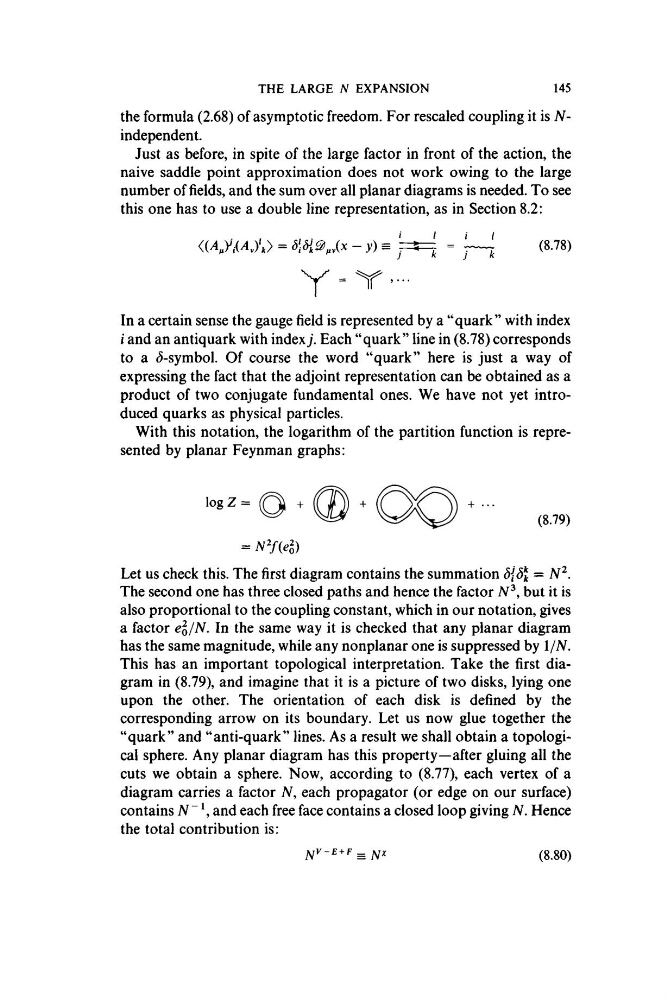
this one has to use a double line representation, as in Section 8.2:
<(A,yMy = s\si^(x - y ) ^
(8.78)
Y - YIn a certain sense the gauge field is represented by a “quark” with index
i and an antiquark with index j. Each “quark” line in (8.78) corresponds
to a ¿-symbol. Of course the word “quark” here is just a way of
expressing the fact that the adjoint representation can be obtained as a
product of two conjugate fundamental ones. We have not yet introduced quarks as physical particles.
With this notation, the logarithm of the partition function is represented by planar Feynman graphs:
lo g Z =
(8.79)
= NY(el)
Let us check this. The first diagram contains the summation Sjö^ = N^.
The second one has three closed paths and hence the factor
but it is
also proportional to the coupling constant, which in our notation, gives
a factor el/N. In the same way it is checked that any planar diagram
has the same magnitude, while any nonplanar one is suppressed by 1/N.
This has an important topological interpretation. Take the first diagram in (8.79), and imagine that it is a picture of two disks, lying one
upon the other. The orientation of each disk is defined by the
corresponding arrow on its boundary. Let us now glue together the
“quark” and “anti-quark” lines. As a result we shall obtain a topological sphere. Any planar diagram has this property—after gluing all the
cuts we obtain a sphere. Now, according to (8.77), each vertex of a
diagram carries a factor A, each propagator (or edge on our surface)
contains iV" \ and each free face contains a closed loop giving N. Hence
the total contribution is:
' =
(8.80)
145
the formula (2.68) of asymptotic freedom. For rescaled coupling it is N~
independent.
Just as before, in spite of the large factor in front of the action, the
naive saddle point approximation does not work owing to the large
number of fields, and the sum over all planar diagrams is needed. To see
this one has to use a double line representation, as in Section 8.2:
<(A,yMy = s\si^(x - y ) ^
(8.78)
Y - YIn a certain sense the gauge field is represented by a “quark” with index
i and an antiquark with index j. Each “quark” line in (8.78) corresponds
to a ¿-symbol. Of course the word “quark” here is just a way of
expressing the fact that the adjoint representation can be obtained as a
product of two conjugate fundamental ones. We have not yet introduced quarks as physical particles.
With this notation, the logarithm of the partition function is represented by planar Feynman graphs:
lo g Z =
(8.79)
= NY(el)
Let us check this. The first diagram contains the summation Sjö^ = N^.
The second one has three closed paths and hence the factor
but it is
also proportional to the coupling constant, which in our notation, gives
a factor el/N. In the same way it is checked that any planar diagram
has the same magnitude, while any nonplanar one is suppressed by 1/N.
This has an important topological interpretation. Take the first diagram in (8.79), and imagine that it is a picture of two disks, lying one
upon the other. The orientation of each disk is defined by the
corresponding arrow on its boundary. Let us now glue together the
“quark” and “anti-quark” lines. As a result we shall obtain a topological sphere. Any planar diagram has this property—after gluing all the
cuts we obtain a sphere. Now, according to (8.77), each vertex of a
diagram carries a factor A, each propagator (or edge on our surface)
contains iV" \ and each free face contains a closed loop giving N. Hence
the total contribution is:
' =
(8.80)