

148
GAUGE FIELDS AND STRINGS
(where N(M) is the number of particles with mass M, and c is some
constant).
In Chapter 10 we shall discuss these things in more detail.
Another important feature of the large N limit concerns the phase
factors {¡/(c). Let us show that the field:
(p(C) = ^ T r ( P exp
A^dx^
(8.89)
has the following decoupling property:!
(cpic.Mc^)} ^
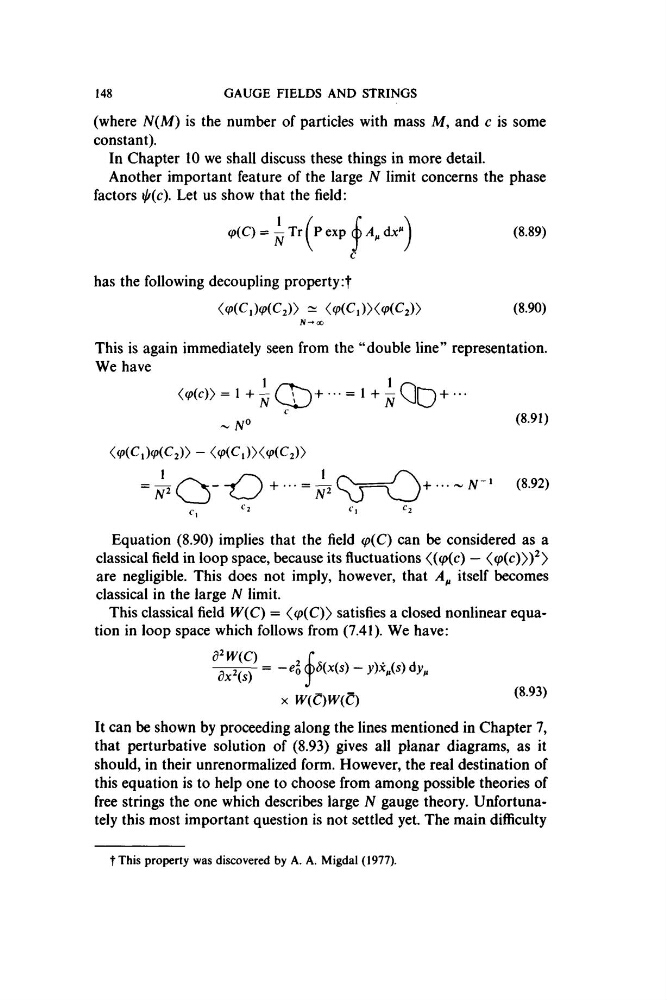
This is again immediately seen from the “double line” representation.
We have
c
< - <.))(C,)><
'N~
(8.91)
(8.92)
Equation (8.90) implies that the field
are negligible. This does not imply, however, that
itself becomes
classical in the large N limit.
This classical field W{C) = <(/>(C)> satisfies a closed nonlinear equation in loop space which follows from (7.41). We have:
d^W(C)
dx^(s)
- e l ^¿(x(s) - y)x^(s) dy^
X W(C)W(C)
(8.93)
It can be shown by proceeding along the lines mentioned in Chapter 7,
that perturbative solution of (8.93) gives all planar diagrams, as it
should, in their unrenormalized form. However, the real destination of
this equation is to help one to choose from among possible theories of
free strings the one which describes large N gauge theory. Unfortunately this most important question is not settled yet. The main difficulty
fThis property was discovered by A. A. Migdal (1977).
GAUGE FIELDS AND STRINGS
(where N(M) is the number of particles with mass M, and c is some
constant).
In Chapter 10 we shall discuss these things in more detail.
Another important feature of the large N limit concerns the phase
factors {¡/(c). Let us show that the field:
(p(C) = ^ T r ( P exp
A^dx^
(8.89)
has the following decoupling property:!
(cpic.Mc^)} ^
This is again immediately seen from the “double line” representation.
We have
c
<
'N~
(8.91)
(8.92)
Equation (8.90) implies that the field
are negligible. This does not imply, however, that
itself becomes
classical in the large N limit.
This classical field W{C) = <(/>(C)> satisfies a closed nonlinear equation in loop space which follows from (7.41). We have:
d^W(C)
dx^(s)
- e l ^¿(x(s) - y)x^(s) dy^
X W(C)W(C)
(8.93)
It can be shown by proceeding along the lines mentioned in Chapter 7,
that perturbative solution of (8.93) gives all planar diagrams, as it
should, in their unrenormalized form. However, the real destination of
this equation is to help one to choose from among possible theories of
free strings the one which describes large N gauge theory. Unfortunately this most important question is not settled yet. The main difficulty
fThis property was discovered by A. A. Migdal (1977).