

THE LARGE N EXPANSION
141
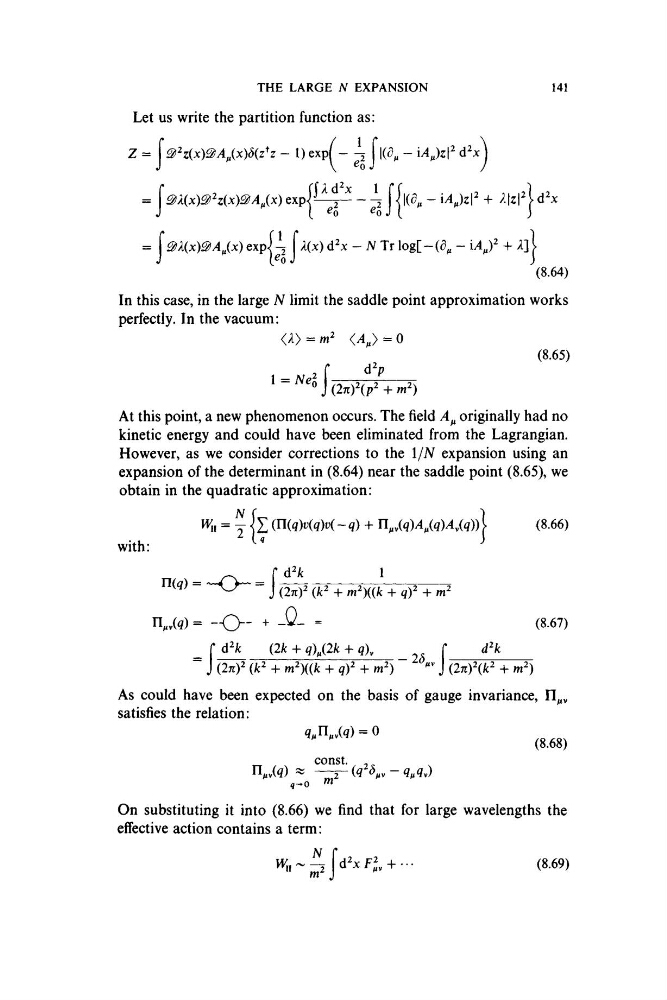
Let us write the partition function as:
Z = J* ^^z{x)SiA^{x)ô(z^z - 1) Qxpi^À(x)^^z{x)S>A (x) exp
j X d^x 1
^0
\{d^-iA^)z\^ + X\z\^\d^x
i -
= j ^/l(x)@^^(x)exp.j^ X{x) d^x — N Tr log[ —(0 — iA + A]
(8.64)
In this case, in the large N limit the saddle point approximation works
perfectly. In the vacuum:
= m^ < V = 0
(8.65)
f
^ J { 2 n )\p ^ + m^)
At this point, a new phenomenon occurs. The field A^ originally had no
kinetic energy and could have been eliminated from the Lagrangian.
However, as we consider corrections to the 1/N expansion using an
expansion of the determinant in (8.64) near the saddle point (8.65), we
obtain in the quadratic approximation:
with:
r d^k
( 8.66)
n(i) - ~ 0 - - J
^ m^)((k + qf +
n,.(4) = - O - +
=
d^k
{2k + q)„{2k + q),
. „ f
d^k
(8.67)
(2kY (k^ + m^){{k + q)^ + m^)
20„
i (2nY(k^ + m^)
As could have been expected on the basis of gauge invariance,
satisfies the relation:
q^^^Àq) = fi
(8.68)
const.
4-0 m
On substituting it into (8.66) we find that for large wavelengths the
effective action contains a term:
N
d^x F l + --(8.69)
141
Let us write the partition function as:
Z = J* ^^z{x)SiA^{x)ô(z^z - 1) Qxpi^À(x)^^z{x)S>A (x) exp
j X d^x 1
^0
\{d^-iA^)z\^ + X\z\^\d^x
i -
= j ^/l(x)@^^(x)exp.j^ X{x) d^x — N Tr log[ —(0 — iA + A]
(8.64)
In this case, in the large N limit the saddle point approximation works
perfectly. In the vacuum:
= m^ < V = 0
(8.65)
f
^ J { 2 n )\p ^ + m^)
At this point, a new phenomenon occurs. The field A^ originally had no
kinetic energy and could have been eliminated from the Lagrangian.
However, as we consider corrections to the 1/N expansion using an
expansion of the determinant in (8.64) near the saddle point (8.65), we
obtain in the quadratic approximation:
with:
r d^k
( 8.66)
n(i) - ~ 0 - - J
^ m^)((k + qf +
n,.(4) = - O - +
=
d^k
{2k + q)„{2k + q),
. „ f
d^k
(8.67)
(2kY (k^ + m^){{k + q)^ + m^)
20„
i (2nY(k^ + m^)
As could have been expected on the basis of gauge invariance,
satisfies the relation:
q^^^Àq) = fi
(8.68)
const.
4-0 m
On substituting it into (8.66) we find that for large wavelengths the
effective action contains a term:
N
d^x F l + --(8.69)