

142
GAUGE FIELDS AND STRINGS
This shows that, owing to quantum effects, the system acquires a real
electromagnetic field, which actually was not present in the original
lagrangian. The z-field has a charge proportional to m^/N. Since the
Coulomb energy for ^ = 2 is infrared infinite, one expects that the
quanta of the ^-field will be confined by forming neutral pairs, like ZiZj.
It is possible to investigate the spectrum using the Shrödinger equation
with a Coulomb potential, but we shall not dwell on this. Instead, we
shall study topological effects in the large N limit. First of all, let us
consider the averge fluctuations of the topological charge given by:
(8.70)
As we have discussed before, it is exactly this quantity which is relevant
for the resolution of the [/(l)-problem in QCD. Also, (8.70) implies that
the ground state energy is 0-dependent for the action Sq = S iOq.
Namely, we have:
de^
(8.71)
This implies that strong CP violation, due to the 0-term, is present in
this model. To show this, let us note that the 0-term is represented in
Feynman diagrams by a photon disappearing into the vacuum with the
amplitude
Since the photon propagator has a pole at = 0,
this process contributes to the vacuum energy, as was demonstrated in
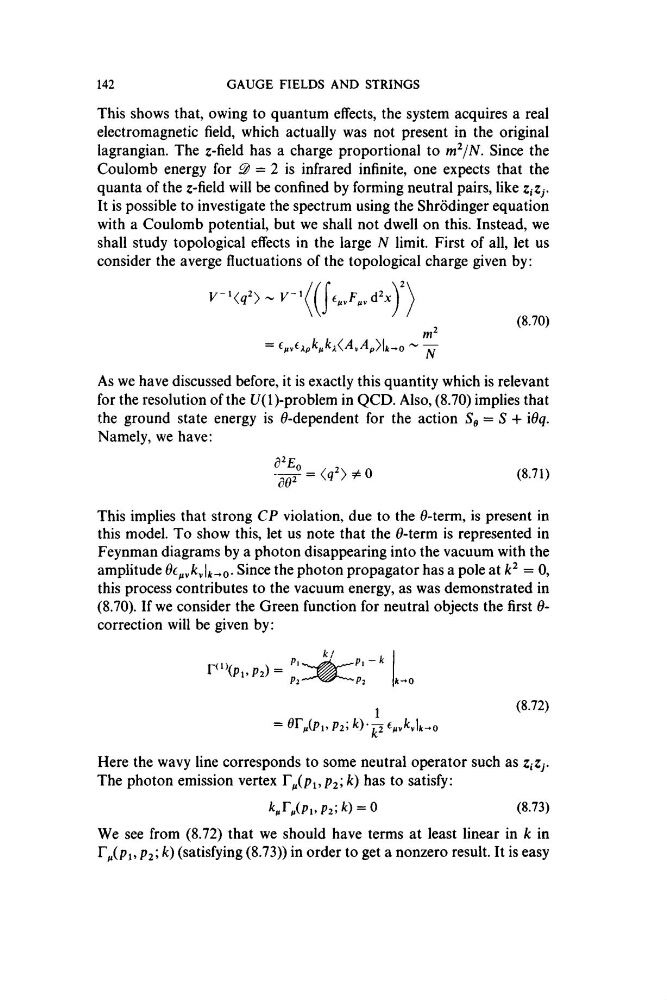
(8.70). If we consider the Green function for neutral objects the first 0correction will be given by:
k/
Pi
Pi-k
Pi
1
k^O
(8.72)
= 0r^(pi,p2;^)-p^^v^vlfc-o
Here the wavy line corresponds to some neutral operator such as ZiZj.
The photon emission vertex r^(p i,p2i^) has to satisfy:
k^r^(PvP2‘ ^k) = 0
(8.73)
We see from (8.72) that we should have terms at least linear in k in
r^(Pi, P2; k) (satisfying (8.73)) in order to get a nonzero result. It is easy
GAUGE FIELDS AND STRINGS
This shows that, owing to quantum effects, the system acquires a real
electromagnetic field, which actually was not present in the original
lagrangian. The z-field has a charge proportional to m^/N. Since the
Coulomb energy for ^ = 2 is infrared infinite, one expects that the
quanta of the ^-field will be confined by forming neutral pairs, like ZiZj.
It is possible to investigate the spectrum using the Shrödinger equation
with a Coulomb potential, but we shall not dwell on this. Instead, we
shall study topological effects in the large N limit. First of all, let us
consider the averge fluctuations of the topological charge given by:
(8.70)
As we have discussed before, it is exactly this quantity which is relevant
for the resolution of the [/(l)-problem in QCD. Also, (8.70) implies that
the ground state energy is 0-dependent for the action Sq = S iOq.
Namely, we have:
de^
(8.71)
This implies that strong CP violation, due to the 0-term, is present in
this model. To show this, let us note that the 0-term is represented in
Feynman diagrams by a photon disappearing into the vacuum with the
amplitude
Since the photon propagator has a pole at = 0,
this process contributes to the vacuum energy, as was demonstrated in
(8.70). If we consider the Green function for neutral objects the first 0correction will be given by:
k/
Pi
Pi-k
Pi
1
k^O
(8.72)
= 0r^(pi,p2;^)-p^^v^vlfc-o
Here the wavy line corresponds to some neutral operator such as ZiZj.
The photon emission vertex r^(p i,p2i^) has to satisfy:
k^r^(PvP2‘ ^k) = 0
(8.73)
We see from (8.72) that we should have terms at least linear in k in
r^(Pi, P2; k) (satisfying (8.73)) in order to get a nonzero result. It is easy