

134
GAUGE FIELDS AND STRINGS
The other way to express the same thing is to notice that after
integrating out high frequencies of our field we obtain an effective
action for block spins, which are normalized differently from the
original ones.
To sum up, after proper renormalizations, the 1/N expansion is
perfectly defined. Its main advantage is that it explicitly describes
continuum theory in the correct phase. In principle, there could be a
phase transitions as we decrease N, but in the case of the /i-field this
does not happen. In the large N limit, the ^ = 2 /i-field appeared to be a
theory of free massive particles. The scattering amplitudes, which are
easily computed (see the next chapter), are of the order 1/N.
Unfortunately, this simple picture is not true, as far as principal chiral
fields and ^ = 4 gauge fields are concerned. The first indication of the
trouble comes from the formula (2.35) for the correlation function of the
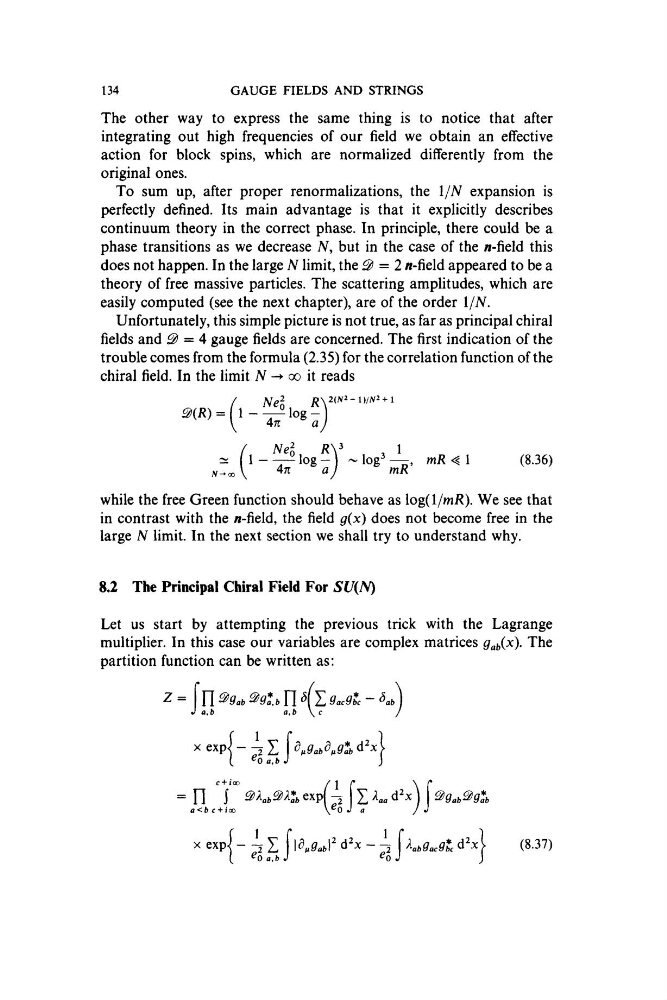
chiral field. In the limit N -► oo it reads
.
Nel
W = | l - ^ l o g -
1
Nel
-j- log
4n
a ,
, 1
log"
mR<^\
(8.36)
mR
while the free Green function should behave as log(l/mR). We see that
in contrast with the H-field, the field g(x) does not become free in the
large N limit. In the next section we shall try to understand why.
8.2 The Principal Chiral Field For SU{N)
Let us start by attempting the previous trick with the Lagrange
multiplier. In this case our variables are complex matrices ^«^(x). The
partition function can be written as:
z = i n
i , n z dac9kc - ¿a
J a,b
a,b \ c
X e x p j - 4 Z I
I ^0 a,b J
= n i
exp( ^ X
] Qlgab^g*t
X exp
^ab9acgt X
(8.37)
GAUGE FIELDS AND STRINGS
The other way to express the same thing is to notice that after
integrating out high frequencies of our field we obtain an effective
action for block spins, which are normalized differently from the
original ones.
To sum up, after proper renormalizations, the 1/N expansion is
perfectly defined. Its main advantage is that it explicitly describes
continuum theory in the correct phase. In principle, there could be a
phase transitions as we decrease N, but in the case of the /i-field this
does not happen. In the large N limit, the ^ = 2 /i-field appeared to be a
theory of free massive particles. The scattering amplitudes, which are
easily computed (see the next chapter), are of the order 1/N.
Unfortunately, this simple picture is not true, as far as principal chiral
fields and ^ = 4 gauge fields are concerned. The first indication of the
trouble comes from the formula (2.35) for the correlation function of the
chiral field. In the limit N -► oo it reads
.
Nel
W = | l - ^ l o g -
1
Nel
-j- log
4n
a ,
, 1
log"
mR<^\
(8.36)
mR
while the free Green function should behave as log(l/mR). We see that
in contrast with the H-field, the field g(x) does not become free in the
large N limit. In the next section we shall try to understand why.
8.2 The Principal Chiral Field For SU{N)
Let us start by attempting the previous trick with the Lagrange
multiplier. In this case our variables are complex matrices ^«^(x). The
partition function can be written as:
z = i n
i , n z dac9kc - ¿a
J a,b
a,b \ c
X e x p j - 4 Z I
I ^0 a,b J
= n i
exp( ^ X
] Qlgab^g*t
X exp
^ab9acgt X
(8.37)