

THE LARGE N EXPANSION
133
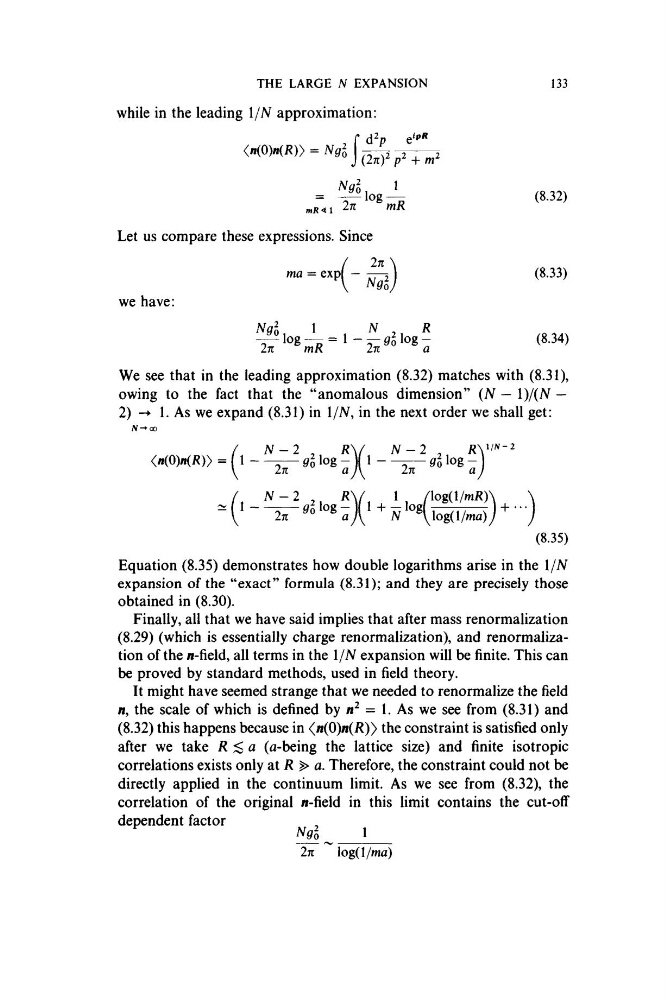
while in the leading l/N approximation:
r
<«(0)«(R)>
JpR
■Ngi
Ngl
(Inf
2n “’8 ^
Let us compare these expressions. Since
2n
Ngi
we have:
ma = exp
Ngl.
1
N R
I - — g l\o g -
2n
mR
2n
a
(8.32)
(8.33)
(8.34)
We see that in the leading approximation (8.32) matches with (8.31),
owing to the fact that the “anomalous dimension” (N — \)/(N —
2)
1. As we expand (8.31) in l/N, in the next order we shall get:
.
N - 2 ,
R \/
N
= ( 1 ----- gl log - )( 1 -
2n
a
2 ,
.
11 *
1
Zlog(VmR)\
(8.35)
Equation (8.35) demonstrates how double logarithms arise in the l/N
expansion of the “exact” formula (8.31); and they are precisely those
obtained in (8.30).
Finally, all that we have said implies that after mass renormalization
(8.29) (which is essentially charge renormalization), and renormalization of the /i-field, all terms in the l/N expansion will be finite. This can
be proved by standard methods, used in field theory.
It might have seemed strange that we needed to renormalize the field
/I, the scale of which is defined by
= 1. As we see from (8.31) and
(8.32) this happens because in {n(0)n{R)} the constraint is satisfied only
after we take R < a (a-being the lattice size) and finite isotropic
correlations exists only ^iRP a. Therefore, the constraint could not be
directly applied in the continuum limit. As we see from (8.32), the
correlation of the original /i-field in this limit contains the cut-off
dependent factor
Ngl
1
2n
log(l/ma)
133
while in the leading l/N approximation:
r
<«(0)«(R)>
JpR
■Ngi
Ngl
(Inf
2n “’8 ^
Let us compare these expressions. Since
2n
Ngi
we have:
ma = exp
Ngl.
1
N R
I - — g l\o g -
2n
mR
2n
a
(8.32)
(8.33)
(8.34)
We see that in the leading approximation (8.32) matches with (8.31),
owing to the fact that the “anomalous dimension” (N — \)/(N —
2)
1. As we expand (8.31) in l/N, in the next order we shall get:
.
N - 2 ,
R \/
N
= ( 1 ----- gl log - )( 1 -
2n
a
2 ,
.
11 *
1
Zlog(VmR)\
(8.35)
Equation (8.35) demonstrates how double logarithms arise in the l/N
expansion of the “exact” formula (8.31); and they are precisely those
obtained in (8.30).
Finally, all that we have said implies that after mass renormalization
(8.29) (which is essentially charge renormalization), and renormalization of the /i-field, all terms in the l/N expansion will be finite. This can
be proved by standard methods, used in field theory.
It might have seemed strange that we needed to renormalize the field
/I, the scale of which is defined by
= 1. As we see from (8.31) and
(8.32) this happens because in {n(0)n{R)} the constraint is satisfied only
after we take R < a (a-being the lattice size) and finite isotropic
correlations exists only ^iRP a. Therefore, the constraint could not be
directly applied in the continuum limit. As we see from (8.32), the
correlation of the original /i-field in this limit contains the cut-off
dependent factor
Ngl
1
2n
log(l/ma)