

132
GAUGE FIELDS AND STRINGS
this large vacuum energy we have finite angular excitations, labelled by
angular momentum. In the limit ^ oo we have to subtract an infinite
constant from the ground state energy, and after that the theory will be
finite.
Returning to our problem we are led to expect that power divergences caused by (8.22) will be removed if we renormalize the mass of
elementary excitations. A convenient procedure is the following. Let us
introduce a quantity:
m^ = G"^(p = 0)
(8.27)
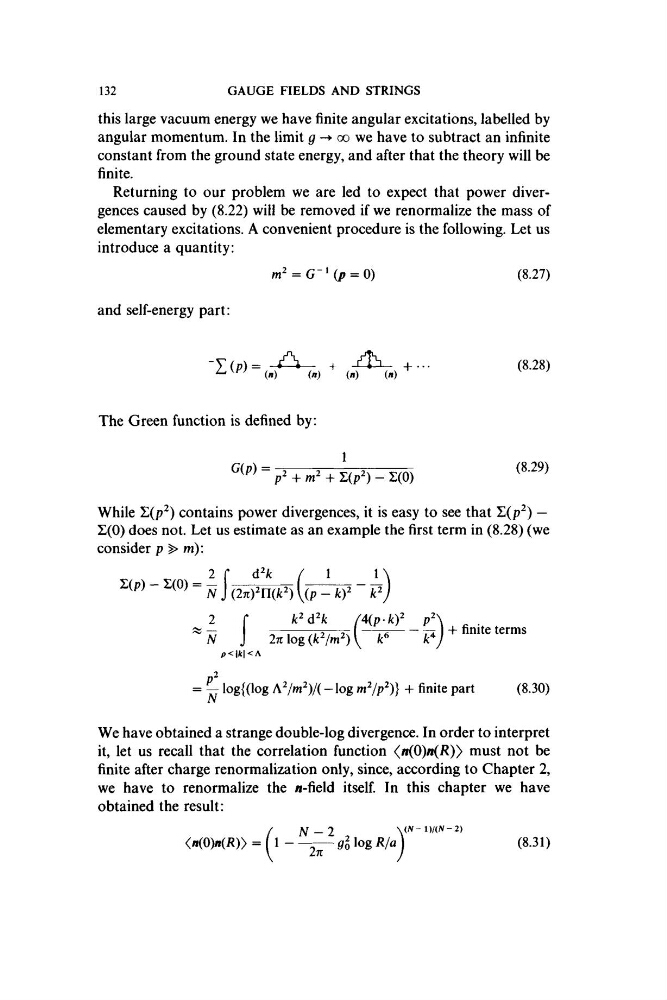
and self-energy part:
^
(«)
(n)
(n)
(If) ^
(8.28)
The Green function is defined by :
G{p) =
1
p" -f m" + S(p") - S(0)
(8.29)
While Z(p^) contains power divergences, it is easy to see that £(p^) —
Z(0) does not. Let us estimate as an example the first term in (8.28) (we
consider p > m):
2 C d^k
/
I
1 \
2(p) - 2(0) - - J
“ p j
r
M(ph
J
1 rr
I
2
N
p<|fc|
- 7T + fii^he terms
2n log (k^/m^) \ k^
k^ ^
= ^ log{(log A^lm^)/( - log m^/p^)} -h finite part
(8.30)
We have obtained a strange double-log divergence. In order to interpret
it, let us recall that the correlation function must not be
finite after charge renormalization only, since, according to Chapter 2,
we have to renormalize the H-field itself. In this chapter we have
obtained the result:
N - 2
\(iv-i)/(iv-2)
= ( 1 -
gl logR/a\
2n
(8.31)
GAUGE FIELDS AND STRINGS
this large vacuum energy we have finite angular excitations, labelled by
angular momentum. In the limit ^ oo we have to subtract an infinite
constant from the ground state energy, and after that the theory will be
finite.
Returning to our problem we are led to expect that power divergences caused by (8.22) will be removed if we renormalize the mass of
elementary excitations. A convenient procedure is the following. Let us
introduce a quantity:
m^ = G"^(p = 0)
(8.27)
and self-energy part:
^
(«)
(n)
(n)
(If) ^
(8.28)
The Green function is defined by :
G{p) =
1
p" -f m" + S(p") - S(0)
(8.29)
While Z(p^) contains power divergences, it is easy to see that £(p^) —
Z(0) does not. Let us estimate as an example the first term in (8.28) (we
consider p > m):
2 C d^k
/
I
1 \
2(p) - 2(0) - - J
“ p j
r
M(ph
J
1 rr
I
2
N
p<|fc|
- 7T + fii^he terms
2n log (k^/m^) \ k^
k^ ^
= ^ log{(log A^lm^)/( - log m^/p^)} -h finite part
(8.30)
We have obtained a strange double-log divergence. In order to interpret
it, let us recall that the correlation function
finite after charge renormalization only, since, according to Chapter 2,
we have to renormalize the H-field itself. In this chapter we have
obtained the result:
N - 2
\(iv-i)/(iv-2)
gl logR/a\
2n
(8.31)