

THE LARGE N EXPANSION
131
The second term in (8.21) comes from the fluctuations of the Lagrange
multiplier.
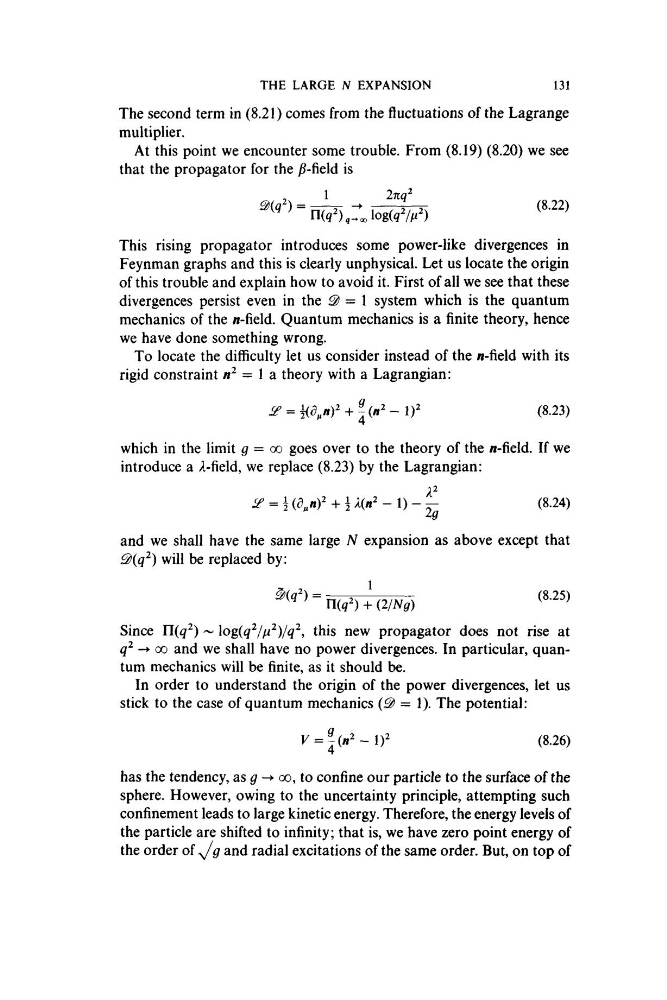
At this point we encounter some trouble. From (8.19) (8.20) we see
that the propagator for the j9-field is
^
2nq^
9{q^) =
(8.22)
This rising propagator introduces some power-like divergences in
Feynman graphs and this is clearly unphysical. Let us locate the origin
of this trouble and explain how to avoid it. First of all we see that these
divergences persist even in the ^ = 1 system which is the quantum
mechanics of the /i-field. Quantum mechanics is a finite theory, hence
we have done something wrong.
To locate the difficulty let us consider instead of the w-field with its
rigid constraint /i^ = 1 a theory with a Lagrangian:
(8.23)
which in the limit g = oo goes over to the theory of the n-field. If we
introduce a A-field, we replace (8.23) by the Lagrangian:
P
1 ) - ^
(8.24)
and we shall have the same large N expansion as above except that
&(q^) will be replaced by:
^(q^) =
1
n{q^) + (2/Ng)
(8.25)
Since n(q^) ^ ^og(q^/g^)/q^, this new propagator does not rise at
q^ C O and we shall have no power divergences. In particular, quantum mechanics will be finite, as it should be.
In order to understand the origin of the power divergences, let us
stick to the case of quantum mechanics ( ^ = 1). The potential:
v = ~ ( P - \y
(8.26)
has the tendency, as g co, to confine our particle to the surface of the
sphere. However, owing to the uncertainty principle, attempting such
confinement leads to large kinetic energy. Therefore, the energy levels of
the particle are shifted to infinity; that is, we have zero point energy of
the order of yjg and radial excitations of the same order. But, on top of
131
The second term in (8.21) comes from the fluctuations of the Lagrange
multiplier.
At this point we encounter some trouble. From (8.19) (8.20) we see
that the propagator for the j9-field is
^
2nq^
9{q^) =
(8.22)
This rising propagator introduces some power-like divergences in
Feynman graphs and this is clearly unphysical. Let us locate the origin
of this trouble and explain how to avoid it. First of all we see that these
divergences persist even in the ^ = 1 system which is the quantum
mechanics of the /i-field. Quantum mechanics is a finite theory, hence
we have done something wrong.
To locate the difficulty let us consider instead of the w-field with its
rigid constraint /i^ = 1 a theory with a Lagrangian:
(8.23)
which in the limit g = oo goes over to the theory of the n-field. If we
introduce a A-field, we replace (8.23) by the Lagrangian:
P
1 ) - ^
(8.24)
and we shall have the same large N expansion as above except that
&(q^) will be replaced by:
^(q^) =
1
n{q^) + (2/Ng)
(8.25)
Since n(q^) ^ ^og(q^/g^)/q^, this new propagator does not rise at
q^ C O and we shall have no power divergences. In particular, quantum mechanics will be finite, as it should be.
In order to understand the origin of the power divergences, let us
stick to the case of quantum mechanics ( ^ = 1). The potential:
v = ~ ( P - \y
(8.26)
has the tendency, as g co, to confine our particle to the surface of the
sphere. However, owing to the uncertainty principle, attempting such
confinement leads to large kinetic energy. Therefore, the energy levels of
the particle are shifted to infinity; that is, we have zero point energy of
the order of yjg and radial excitations of the same order. But, on top of