

THE LARGE N EXPANSION
135
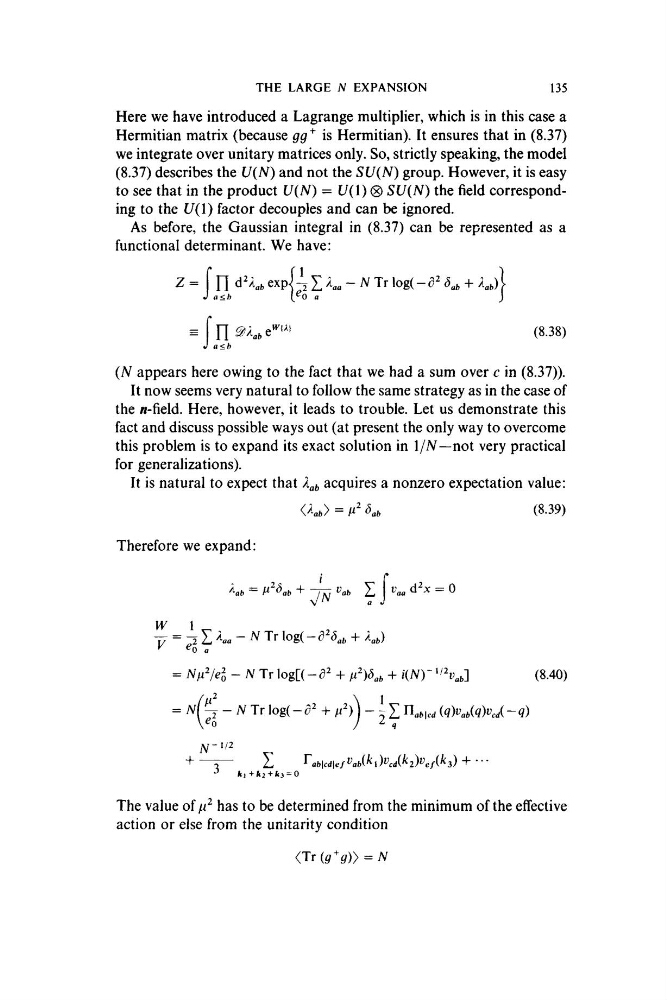
Here we have introduced a Lagrange multiplier, which is in this case a
Hermitian matrix (because gg'^ is Hermitian). It ensures that in (8.37)
we integrate over unitary matrices only. So, strictly speaking, the model
(8.37) describes the U{N) and not the SU(N) group. However, it is easy
to see that in the product U(N) = U(\)® SU(N) the field corresponding to the (7(1) factor decouples and can be ignored.
As before, the Gaussian integral in (8.37) can be represented as a
functional determinant. We have:
n
e x p j^ Z
- N Tr lo g (-a ^
+ A J
n e
(8.38)
(N appears here owing to the fact that we had a sum over c in (8.37)).
It now seems very natural to follow the same strategy as in the case of
the /i-field. Here, however, it leads to trouble. Let us demonstrate this
fact and discuss possible ways out (at present the only way to overcome
this problem is to expand its exact solution in 1/N—not very practical
for generalizations).
It is natural to expect that
acquires a nonzero expectation value:
< /,,> =
(8.39)
Therefore we expand:
^ab =
+
d^x = 0
W
1
E
- A Tr
+ A j
= Ng^jel -N ix \ogl(-d^ +
+ i{Ny
,.2
X
1 ^
=
-A T r \og(-d^ + g^)
V ^0
(8.40)
,'L ^ a l,\cd (Q )V a b iQ )V cA ~ Q )
N
- 1/2
ki + k2 + ky — 0
^ a b \ c d \e f ^ab
The value of has to be determined from the minimum of the effective
action or else from the unitarity condition
135
Here we have introduced a Lagrange multiplier, which is in this case a
Hermitian matrix (because gg'^ is Hermitian). It ensures that in (8.37)
we integrate over unitary matrices only. So, strictly speaking, the model
(8.37) describes the U{N) and not the SU(N) group. However, it is easy
to see that in the product U(N) = U(\)® SU(N) the field corresponding to the (7(1) factor decouples and can be ignored.
As before, the Gaussian integral in (8.37) can be represented as a
functional determinant. We have:
n
e x p j^ Z
- N Tr lo g (-a ^
+ A J
n e
(8.38)
(N appears here owing to the fact that we had a sum over c in (8.37)).
It now seems very natural to follow the same strategy as in the case of
the /i-field. Here, however, it leads to trouble. Let us demonstrate this
fact and discuss possible ways out (at present the only way to overcome
this problem is to expand its exact solution in 1/N—not very practical
for generalizations).
It is natural to expect that
acquires a nonzero expectation value:
< /,,> =
(8.39)
Therefore we expand:
^ab =
+
d^x = 0
W
1
E
- A Tr
+ A j
= Ng^jel -N ix \ogl(-d^ +
+ i{Ny
,.2
X
1 ^
=
-A T r \og(-d^ + g^)
V ^0
(8.40)
,'L ^ a l,\cd (Q )V a b iQ )V cA ~ Q )
N
- 1/2
ki + k2 + ky — 0
^ a b \ c d \e f ^ab
The value of has to be determined from the minimum of the effective
action or else from the unitarity condition