

THE LARGE N EXPANSION
127
or else can be checked from (8.4). The meaning of equation (8.5)
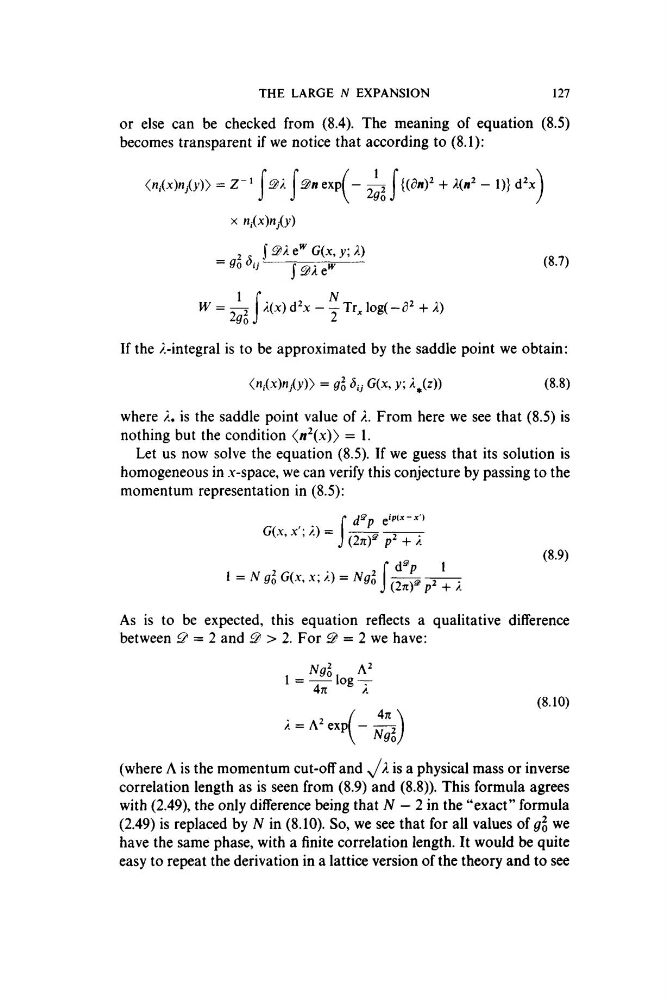
becomes transparent if we notice that according to (8.1 ):
{(5«)^ +
— 1)}
= 3o ^ij
2So J
X niix)tij{y)
j
e'*' G(x, y; A)
A(x) d^x — y Tr^ log( — d^ + X)
(8.7)
If the /-integral is to be approximated by the saddle point we obtain:
= gl <5y G(x, y; /^(z))
(8.8)
where /, is the saddle point value of /. From here we see that (8.5) is
nothing but the condition = 1 .
Let us now solve the equation (8.5). If we guess that its solution is
homogeneous in x-space, we can verify this conjecture by passing to the
momentum representation in (8.5):
d^p e''’'*"*'*
G(x, x'; /) =
\ = N gl G(x, x; /) = Ngl |
{2nf
d®p 1
(8.9)
(27t)® p^ + X
As is to be expected, this equation reflects a qualitative difference
between S’ = 2 and S > 2. For S ’ = 2 we have:
, Ngl
1 = ^
log —
4n
A
A =
expj —
47T
( 8.10)
(where A is the momentum cut-off and
is a physical mass or inverse
correlation length as is seen from (8.9) and (8.8)). This formula agrees
with (2.49), the only difference being that A T — 2 in the “exact” formula
(2.49) is replaced by N in (8.10). So, we see that for all values of gl we
have the same phase, with a finite correlation length. It would be quite
easy to repeat the derivation in a lattice version of the theory and to see
127
or else can be checked from (8.4). The meaning of equation (8.5)
becomes transparent if we notice that according to (8.1 ):
{(5«)^ +
— 1)}
= 3o ^ij
2So J
X niix)tij{y)
j
e'*' G(x, y; A)
A(x) d^x — y Tr^ log( — d^ + X)
(8.7)
If the /-integral is to be approximated by the saddle point we obtain:
(8.8)
where /, is the saddle point value of /. From here we see that (8.5) is
nothing but the condition
Let us now solve the equation (8.5). If we guess that its solution is
homogeneous in x-space, we can verify this conjecture by passing to the
momentum representation in (8.5):
d^p e''’'*"*'*
G(x, x'; /) =
\ = N gl G(x, x; /) = Ngl |
{2nf
d®p 1
(8.9)
(27t)® p^ + X
As is to be expected, this equation reflects a qualitative difference
between S’ = 2 and S > 2. For S ’ = 2 we have:
, Ngl
1 = ^
log —
4n
A
A =
expj —
47T
( 8.10)
(where A is the momentum cut-off and
is a physical mass or inverse
correlation length as is seen from (8.9) and (8.8)). This formula agrees
with (2.49), the only difference being that A T — 2 in the “exact” formula
(2.49) is replaced by N in (8.10). So, we see that for all values of gl we
have the same phase, with a finite correlation length. It would be quite
easy to repeat the derivation in a lattice version of the theory and to see