

126
GAUGE FIELDS AND STRINGS
(The functions A(x) in (8.2) and (8.1) differ by an irrelevant factor
1/2 ^0•) We have called the field A(x) a “Lagrange multiplier” since in
the classical limit, when we have to minimize the 0{N) action with the
constraint
= 1 , it is just that.
The representation (8.1) is convenient, since the integral over n is
Gaussian and can be performed in a standard fashion. We have:
^ /( x ) exp
N
^ j x (x ) d'x - y log det I I - a' + A(x)|| y (8.3)
where N is the number of components of the field n. The factor N
appears in (8.3) since each component enters independently in (8.1).
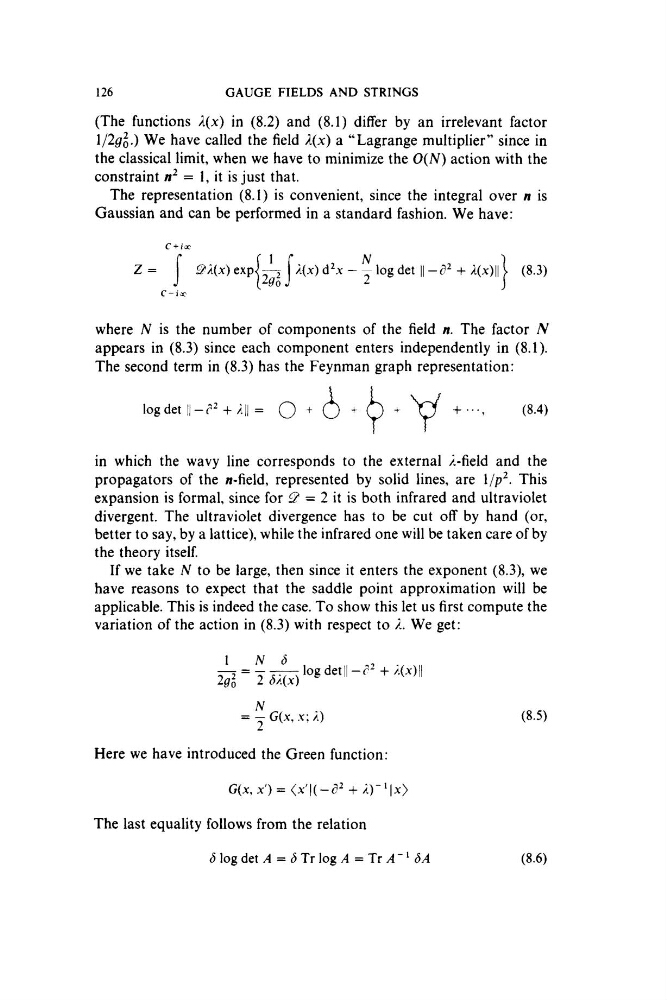
The second term in (8.3) has the Feynman graph representation:
log det
+ /|| = O
6 * * Y + ■
(8.4)
in which the wavy line corresponds to the external /-field and the
propagators of the /i-field, represented by solid lines, are 1/p^. This
expansion is formal, since for ^ = 2 it is both infrared and ultraviolet
divergent. The ultraviolet divergence has to be cut off by hand (or,
better to say, by a lattice), while the infrared one will be taken care of by
the theory itself.
If we take N to be large, then since it enters the exponent (8.3), we
have reasons to expect that the saddle point approximation will be
applicable. This is indeed the case. To show this let us first compute the
variation of the action in (8.3) with respect to /. We get:
1
2fiio
N d
2 ¿/t(x)
N
log d e tll-i^ + ;.(x)||
= — G(x, x; a )
Here we have introduced the Green function:
G(x, x') =
+ A)~‘ lx}
The last equality follows from the relation
^ log det .4 = ^ Tr log A = Tr
‘ 3A
(8.5)
(8.6)
GAUGE FIELDS AND STRINGS
(The functions A(x) in (8.2) and (8.1) differ by an irrelevant factor
1/2 ^0•) We have called the field A(x) a “Lagrange multiplier” since in
the classical limit, when we have to minimize the 0{N) action with the
constraint
= 1 , it is just that.
The representation (8.1) is convenient, since the integral over n is
Gaussian and can be performed in a standard fashion. We have:
^ /( x ) exp
N
^ j x (x ) d'x - y log det I I - a' + A(x)|| y (8.3)
where N is the number of components of the field n. The factor N
appears in (8.3) since each component enters independently in (8.1).
The second term in (8.3) has the Feynman graph representation:
log det
+ /|| = O
6 * * Y + ■
(8.4)
in which the wavy line corresponds to the external /-field and the
propagators of the /i-field, represented by solid lines, are 1/p^. This
expansion is formal, since for ^ = 2 it is both infrared and ultraviolet
divergent. The ultraviolet divergence has to be cut off by hand (or,
better to say, by a lattice), while the infrared one will be taken care of by
the theory itself.
If we take N to be large, then since it enters the exponent (8.3), we
have reasons to expect that the saddle point approximation will be
applicable. This is indeed the case. To show this let us first compute the
variation of the action in (8.3) with respect to /. We get:
1
2fiio
N d
2 ¿/t(x)
N
log d e tll-i^ + ;.(x)||
= — G(x, x; a )
Here we have introduced the Green function:
G(x, x') =
+ A)~‘ lx}
The last equality follows from the relation
^ log det .4 = ^ Tr log A = Tr
‘ 3A
(8.5)
(8.6)