

CHAPTER 8
The Large
Expansion
The number N is the only free parameter both in chiral and gauge
theories, because in the continuum limit the coupling constant disappears through dimensional transmutation (remember that the strong
coupling expansion referred to the lattice theory and does not give a
continuum theory in any finite order). It is very tempting therefore to
try to make a Ì/N expansion. This will be done in this chapter. As
before, our main intention will be to improve our qualitative understanding of dynamics by means of this approximation.
8.1 0 (N ) (T-Model
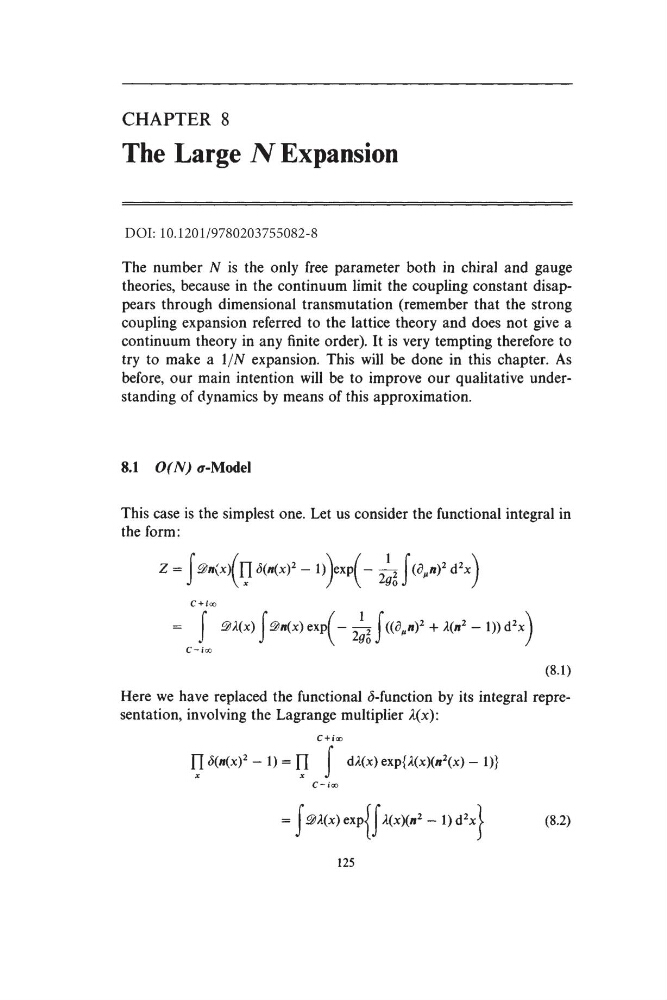
This case is the simplest one. Let us consider the functional integral in
the form:
^ n { x ) ^ S(n(x)^ - l)^ ex p ^ - ^ | (d^nf
^n{x) exp( - ^ I
- 1)) d^xj
(8.1)
C T I
= J
m(x)
Here we have replaced the functional ¿-function by its integral representation, involving the Lagrange multiplier A(x):
X
J
C — ioo
n <5(«(x)^ - 1 ) = f]
X
X
= J*^A(x) exp
d>l(x) exp{>i(x)(/i^(x) — 1)}
A(x)(n^ — 1) d ^ x|
(8.2)
125
DOI: 10.1201/9780203755082-8
The Large
Expansion
The number N is the only free parameter both in chiral and gauge
theories, because in the continuum limit the coupling constant disappears through dimensional transmutation (remember that the strong
coupling expansion referred to the lattice theory and does not give a
continuum theory in any finite order). It is very tempting therefore to
try to make a Ì/N expansion. This will be done in this chapter. As
before, our main intention will be to improve our qualitative understanding of dynamics by means of this approximation.
8.1 0 (N ) (T-Model
This case is the simplest one. Let us consider the functional integral in
the form:
^ n { x ) ^ S(n(x)^ - l)^ ex p ^ - ^ | (d^nf
^n{x) exp( - ^ I
- 1)) d^xj
(8.1)
C T I
= J
m(x)
Here we have replaced the functional ¿-function by its integral representation, involving the Lagrange multiplier A(x):
X
J
C — ioo
n <5(«(x)^ - 1 ) = f]
X
X
= J*^A(x) exp
d>l(x) exp{>i(x)(/i^(x) — 1)}
A(x)(n^ — 1) d ^ x|
(8.2)
125
DOI: 10.1201/9780203755082-8