

12 2
GAUGE FIELDS AND STRINGS
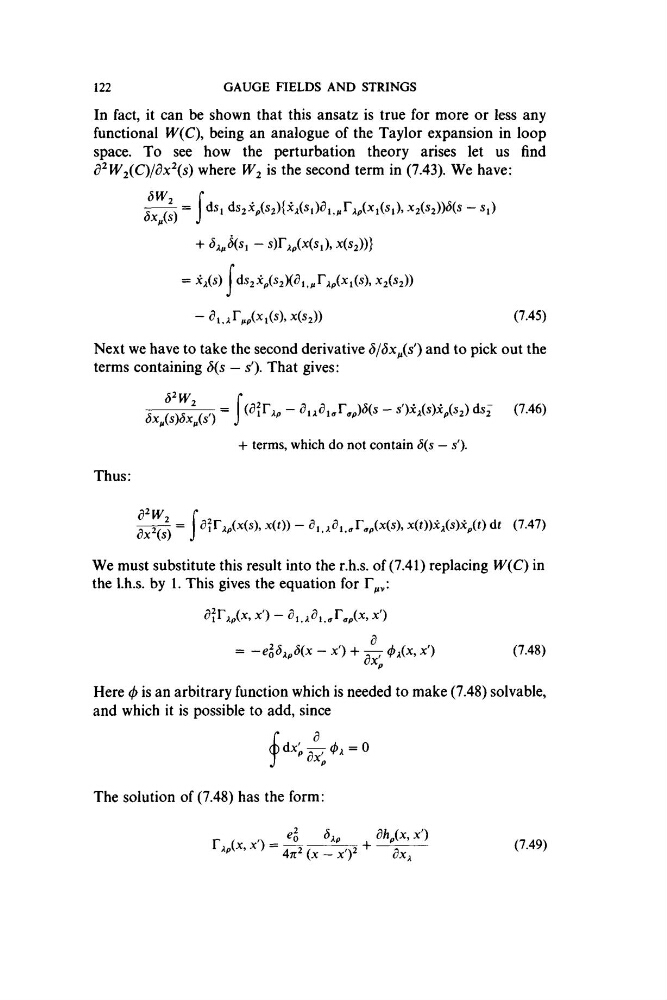
In fact, it can be shown that this ansatz is true for more or less any
functional W{C\ being an analogue of the Taylor expansion in loop
space. To see how the perturbation theory arises let us find
d^W2{C)/dx\s) where W2 is the second term in (7.43). We have:
6W
f
= J ds, ds2 x / s 2 ){x ^ (s ,)a ,„ r;i/x ,(s ,), X jiS jM s - s,)
+
- s)r2p(x(Si), x(S2»}
=
J d S jX ^ iS jX ^ i.^ r ^ p iX iC s ), X2(S2))
- 5 i,A r ,,( x ,{ s ) ,x ( s 2 ) )
(7.45)
Next we have to take the second derivative <5/<5x^(s') and to pick out the
terms containing 6{s — s'). That gives:
3x^(s)Sx^(s')
- s')Us)x,(s2) ds2
(7.46)
-h terms, which do not contain S(s — s').
Thus:
d^W2
dx^(s)
=
j e ? r 2 , ( x ( s ) , X ( 0 ) - 5 , , 2 5 i . , r , , ( x ( s ) , X ( 0 ) X 2 ( S ) X , ( 0 di (7.47)
We must substitute this result into the r.h.s. of (7.41) replacing W(C) in
the l.h.s. by 1. This gives the equation for T^^:
x') - 5i,2^i,„r,p(x, x')
=
^
x')
(7.48)
Here < /> is an arbitrary function which is needed to make (7.48) solvable,
and which it is possible to add, since
The solution of (7.48) has the form:
^0 ^Ap
aiip(x, x')
5x,
(7.49)
GAUGE FIELDS AND STRINGS
In fact, it can be shown that this ansatz is true for more or less any
functional W{C\ being an analogue of the Taylor expansion in loop
space. To see how the perturbation theory arises let us find
d^W2{C)/dx\s) where W2 is the second term in (7.43). We have:
6W
f
= J ds, ds2 x / s 2 ){x ^ (s ,)a ,„ r;i/x ,(s ,), X jiS jM s - s,)
+
- s)r2p(x(Si), x(S2»}
=
J d S jX ^ iS jX ^ i.^ r ^ p iX iC s ), X2(S2))
- 5 i,A r ,,( x ,{ s ) ,x ( s 2 ) )
(7.45)
Next we have to take the second derivative <5/<5x^(s') and to pick out the
terms containing 6{s — s'). That gives:
3x^(s)Sx^(s')
- s')Us)x,(s2) ds2
(7.46)
-h terms, which do not contain S(s — s').
Thus:
d^W2
dx^(s)
=
j e ? r 2 , ( x ( s ) , X ( 0 ) - 5 , , 2 5 i . , r , , ( x ( s ) , X ( 0 ) X 2 ( S ) X , ( 0 di (7.47)
We must substitute this result into the r.h.s. of (7.41) replacing W(C) in
the l.h.s. by 1. This gives the equation for T^^:
x') - 5i,2^i,„r,p(x, x')
=
^
x')
(7.48)
Here < /> is an arbitrary function which is needed to make (7.48) solvable,
and which it is possible to add, since
The solution of (7.48) has the form:
^0 ^Ap
aiip(x, x')
5x,
(7.49)