

ANALOGIES BETWEEN GAUGE AND CHIRAL FIELDS
Substitution of (7.40) into (7.36) gives
121
dx^{s)
1
= - el
S(x(s) -
W(C)W(C) - ~ W(Q C)
dy^ (7.41)
which is the first equation in the Schwinger-like chain.
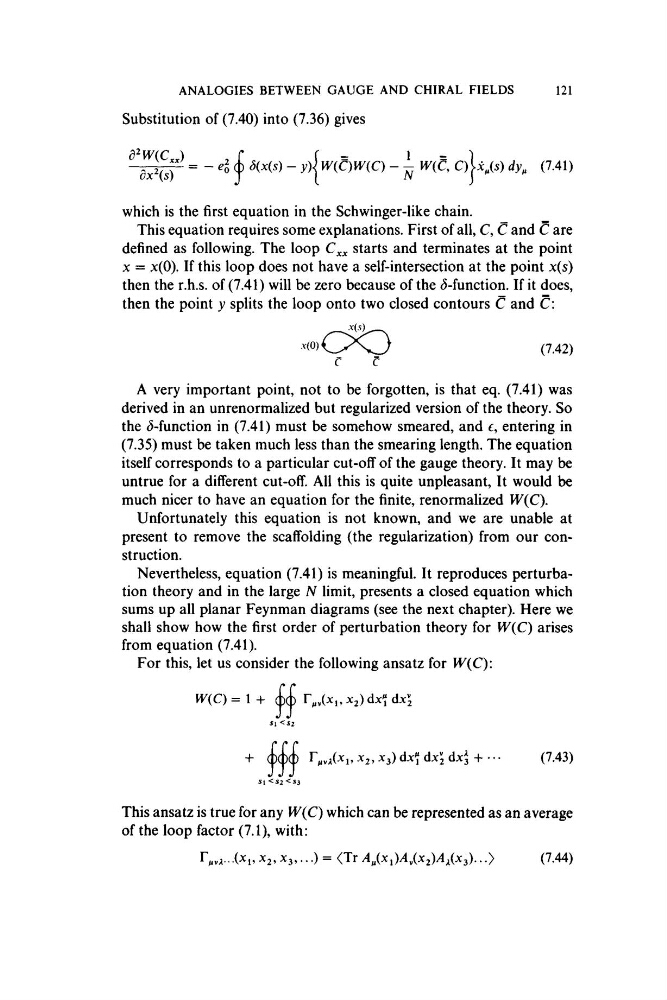
This equation requires some explanations. First of all, C, C and C are
defined as following. The loop
starts and terminates at the point
X = x(0). If this loop does not have a self-intersection at the point x{s)
then the r.h.s. of (7.41) will be zero because of the ¿-function. If it does,
then the point y splits the loop onto two closed contours C and C:
CO
(7.42)
A very important point, not to be forgotten, is that eq. (7.41) was
derived in an unrenormalized but regularized version of the theory. So
the ¿-function in (7.41) must be somehow smeared, and £, entering in
(7.35) must be taken much less than the smearing length. The equation
itself corresponds to a particular cut-off of the gauge theory. It may be
untrue for a different cut-off. All this is quite unpleasant. It would be
much nicer to have an equation for the finite, renormalized W{C).
Unfortunately this equation is not known, and we are unable at
present to remove the scaffolding (the regularization) from our construction.
Nevertheless, equation (7.41) is meaningful. It reproduces perturbation theory and in the large N limit, presents a closed equation which
sums up all planar Feynman diagrams (see the next chapter). Here we
shall show how the first order of perturbation theory for W(C) arises
from equation (7.41).
For this, let us consider the following ansatz for W(C):
m c) = 1 + ( t f r ,,( x i, x^) dxï dxl
-f
^2» ^3) dxï dx^ dx^ +
(7.43)
This ansatz is true for any W{C) which can be represented as an average
of the loop factor (7.1), with:
• (^1. X2, X3,...) =
(7.44)
Substitution of (7.40) into (7.36) gives
121
dx^{s)
1
= - el
S(x(s) -
W(C)W(C) - ~ W(Q C)
dy^ (7.41)
which is the first equation in the Schwinger-like chain.
This equation requires some explanations. First of all, C, C and C are
defined as following. The loop
starts and terminates at the point
X = x(0). If this loop does not have a self-intersection at the point x{s)
then the r.h.s. of (7.41) will be zero because of the ¿-function. If it does,
then the point y splits the loop onto two closed contours C and C:
CO
(7.42)
A very important point, not to be forgotten, is that eq. (7.41) was
derived in an unrenormalized but regularized version of the theory. So
the ¿-function in (7.41) must be somehow smeared, and £, entering in
(7.35) must be taken much less than the smearing length. The equation
itself corresponds to a particular cut-off of the gauge theory. It may be
untrue for a different cut-off. All this is quite unpleasant. It would be
much nicer to have an equation for the finite, renormalized W{C).
Unfortunately this equation is not known, and we are unable at
present to remove the scaffolding (the regularization) from our construction.
Nevertheless, equation (7.41) is meaningful. It reproduces perturbation theory and in the large N limit, presents a closed equation which
sums up all planar Feynman diagrams (see the next chapter). Here we
shall show how the first order of perturbation theory for W(C) arises
from equation (7.41).
For this, let us consider the following ansatz for W(C):
m c) = 1 + ( t f r ,,( x i, x^) dxï dxl
-f
^2» ^3) dxï dx^ dx^ +
(7.43)
This ansatz is true for any W{C) which can be represented as an average
of the loop factor (7.1), with:
• (^1. X2, X3,...) =
(7.44)