

ANALOGIES BETWEEN GAUGE AND CHIRAL FIELDS
123
where is arbitrary. This arbitrariness does not appear in H^2 ( 0 itself
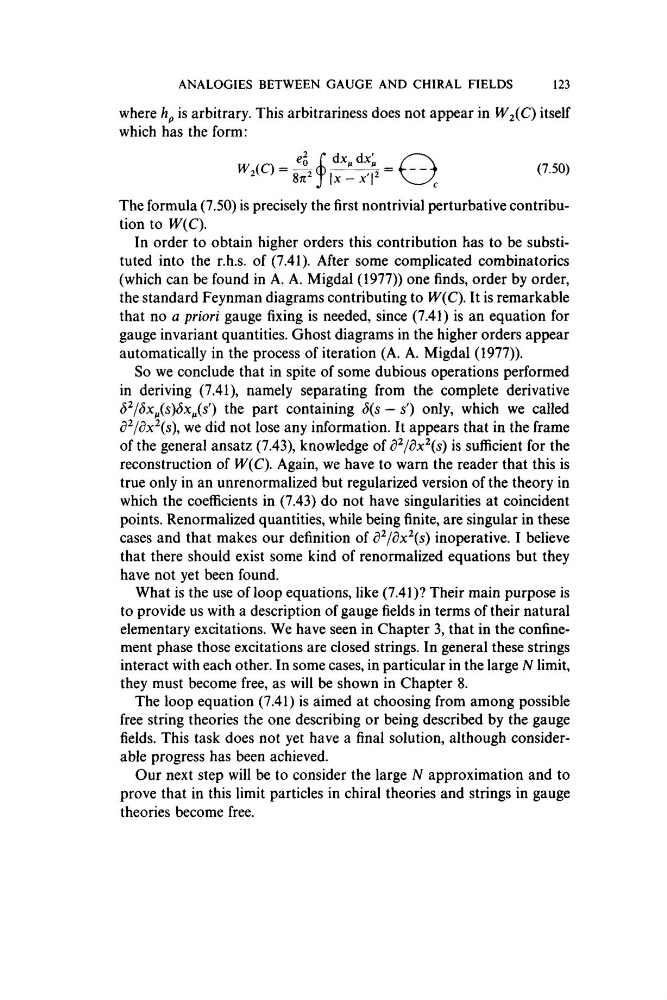
which has the form:
^0
dx^ dx;
e
(7.50)
The formula (7.50) is precisely the first nontrivial perturbative contribution to W(C).
In order to obtain higher orders this contribution has to be substituted into the r.h.s. of (7.41). After some complicated combinatorics
(which can be found in A. A. Migdal (1977)) one finds, order by order,
the standard Feynman diagrams contributing to W(C). It is remarkable
that no a priori gauge fixing is needed, since (7.41) is an equation for
gauge invariant quantities. Ghost diagrams in the higher orders appear
automatically in the process of iteration (A. A. Migdal (1977)).
So we conclude that in spite of some dubious operations performed
in deriving (7.41), namely separating from the complete derivative
S^/Sx^(s)dx^(s') the part containing ¿(s — s') only, which we called
d^jdx^{s\ we did not lose any information. It appears that in the frame
of the general ansatz (7.43), knowledge of d^!dx^{s) is sufficient for the
reconstruction of W{C). Again, we have to warn the reader that this is
true only in an unrenormalized but regularized version of the theory in
which the coefficients in (7.43) do not have singularities at coincident
points. Renormalized quantities, while being finite, are singular in these
cases and that makes our definition of 5^/5x^(s) inoperative. I believe
that there should exist some kind of renormalized equations but they
have not yet been found.
What is the use of loop equations, like (7.41)? Their main purpose is
to provide us with a description of gauge fields in terms of their natural
elementary excitations. We have seen in Chapter 3, that in the confinement phase those excitations are closed strings. In general these strings
interact with each other. In some cases, in particular in the large N limit,
they must become free, as will be shown in Chapter 8.
The loop equation (7.41) is aimed at choosing from among possible
free string theories the one describing or being described by the gauge
fields. This task does not yet have a final solution, although considerable progress has been achieved.
Our next step will be to consider the large N approximation and to
prove that in this limit particles in chiral theories and strings in gauge
theories become free.
123
where is arbitrary. This arbitrariness does not appear in H^2 ( 0 itself
which has the form:
^0
dx^ dx;
e
(7.50)
The formula (7.50) is precisely the first nontrivial perturbative contribution to W(C).
In order to obtain higher orders this contribution has to be substituted into the r.h.s. of (7.41). After some complicated combinatorics
(which can be found in A. A. Migdal (1977)) one finds, order by order,
the standard Feynman diagrams contributing to W(C). It is remarkable
that no a priori gauge fixing is needed, since (7.41) is an equation for
gauge invariant quantities. Ghost diagrams in the higher orders appear
automatically in the process of iteration (A. A. Migdal (1977)).
So we conclude that in spite of some dubious operations performed
in deriving (7.41), namely separating from the complete derivative
S^/Sx^(s)dx^(s') the part containing ¿(s — s') only, which we called
d^jdx^{s\ we did not lose any information. It appears that in the frame
of the general ansatz (7.43), knowledge of d^!dx^{s) is sufficient for the
reconstruction of W{C). Again, we have to warn the reader that this is
true only in an unrenormalized but regularized version of the theory in
which the coefficients in (7.43) do not have singularities at coincident
points. Renormalized quantities, while being finite, are singular in these
cases and that makes our definition of 5^/5x^(s) inoperative. I believe
that there should exist some kind of renormalized equations but they
have not yet been found.
What is the use of loop equations, like (7.41)? Their main purpose is
to provide us with a description of gauge fields in terms of their natural
elementary excitations. We have seen in Chapter 3, that in the confinement phase those excitations are closed strings. In general these strings
interact with each other. In some cases, in particular in the large N limit,
they must become free, as will be shown in Chapter 8.
The loop equation (7.41) is aimed at choosing from among possible
free string theories the one describing or being described by the gauge
fields. This task does not yet have a final solution, although considerable progress has been achieved.
Our next step will be to consider the large N approximation and to
prove that in this limit particles in chiral theories and strings in gauge
theories become free.