

114
GAUGE FIELDS AND STRINGS
We see that the phase factor T(C) is an important object for
diflFerential geometry. On the other hand it has a well-defined physical
meaning. Let us consider a quantum particle moving in the external
gauge field y4^. For
= 0 the transition amplitude from x to y is given
by a functional integral over trajectories, connecting x and y, each
entering with the weight
(Sq being the classical action for a free
particle on the trajectory). It is not difficult to show, that as we switch
on
the amplitude becomes
integrated over all trajectories
C^y. If our particle moves along a classical trajectory in space-time (but
has quantized colour) then
defines its transition amplitude. This
conforms with what we said about 'F in Chapter 4.
The natural intention, which stems from both the mathematical and
the physical importance of the phase factor, is to attempt to reformulate
gauge theory in their terms.
As a first step, let us derive classical equations of motion. In the
lattice version with the action
(7.11)
we can obtain classical equations of motion by taking a variation:
= co„B
xa
^ x x ^ x a
ÔB-J =
(7.12)
(here
is an arbitrary element of the Lie algebra of G, while
is an
element of G itself). The classical equations of motion are:
^5
doj^
= 0
(7.13)
Their explicit form has a useful graphical representation. To find it let
us consider at first the variation of the first factor,
in (7.11). We
have:
x,a ,fi
= I Tr(co,
x,a,P
(7.14)
D '
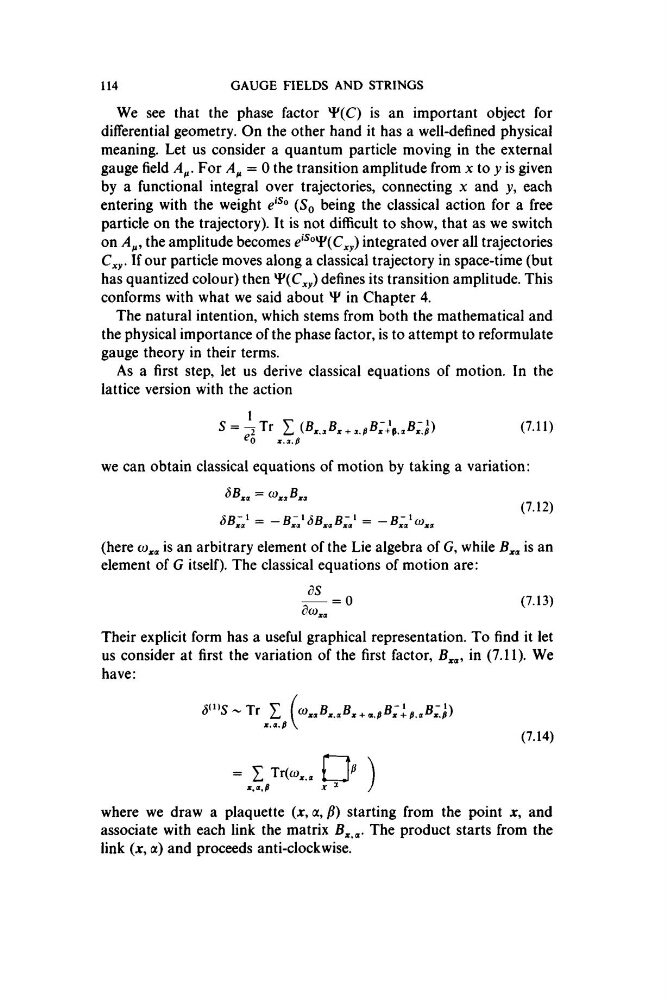
where we draw a plaquette (x, a, jS) starting from the point x, and
associate with each link the matrix
The product starts from the
link (x, a) and proceeds anti-clockwise.
GAUGE FIELDS AND STRINGS
We see that the phase factor T(C) is an important object for
diflFerential geometry. On the other hand it has a well-defined physical
meaning. Let us consider a quantum particle moving in the external
gauge field y4^. For
= 0 the transition amplitude from x to y is given
by a functional integral over trajectories, connecting x and y, each
entering with the weight
(Sq being the classical action for a free
particle on the trajectory). It is not difficult to show, that as we switch
on
the amplitude becomes
integrated over all trajectories
C^y. If our particle moves along a classical trajectory in space-time (but
has quantized colour) then
defines its transition amplitude. This
conforms with what we said about 'F in Chapter 4.
The natural intention, which stems from both the mathematical and
the physical importance of the phase factor, is to attempt to reformulate
gauge theory in their terms.
As a first step, let us derive classical equations of motion. In the
lattice version with the action
(7.11)
we can obtain classical equations of motion by taking a variation:
= co„B
xa
^ x x ^ x a
ÔB-J =
(7.12)
(here
is an arbitrary element of the Lie algebra of G, while
is an
element of G itself). The classical equations of motion are:
^5
doj^
= 0
(7.13)
Their explicit form has a useful graphical representation. To find it let
us consider at first the variation of the first factor,
in (7.11). We
have:
x,a ,fi
= I Tr(co,
x,a,P
(7.14)
D '
where we draw a plaquette (x, a, jS) starting from the point x, and
associate with each link the matrix
The product starts from the
link (x, a) and proceeds anti-clockwise.