

ANALOGIES BETWEEN GAUGE AND CHIRAL FIELDS
In the seco n d term
Tr X
X, at, P
xct ' ^ x -Fa,/?
+ (t,P ^ x
115
(7.15)
we shall change jc + a -► jc, (a ?± jS) and use cyclic invariance of the trace
so as to have co in the first place. We perform similar transformations
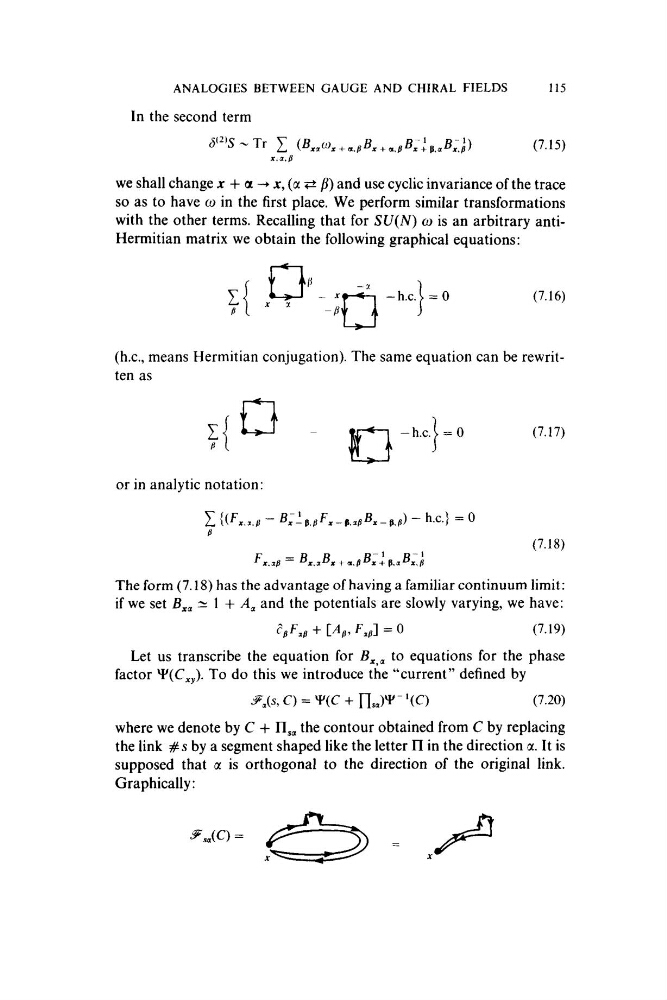
with the other terms. Recalling that for SU(N) co is an arbitrary antiHermitian matrix we obtain the following graphical equations:
I
D ' — X
— a
D
- h . c . y = o
(7.16)
(h.c., means Hermitian conjugation). The same equation can be rewritten as
D r
- h . c . > = 0
(7.17)
or in analytic notation:
I
-
x-p,a^^x-p./s) ~ fi-C.J
x,a^ • ^ x , a ^ x + a, /Î ^ x + p, a ^ x ,
(7.18)
The form (7.18) has the advantage of having a familiar continuum limit:
if we set
^ \
and the potentials are slowly varying, we have:
+
= 0
(7.19)
Let us transcribe the equation for
to equations for the phase
factor 'T(C^y). To do this we introduce the “current” defined by
^ ,(s, C) =
+ U sx)^~\Q
(7.20)
where we denote by C -h
the contour obtained from C by replacing
the link # s by a segment shaped like the letter 11 in the direction a. It is
supposed that a is orthogonal to the direction of the original link.
Graphically:
^ JC ) =
In the seco n d term
Tr X
X, at, P
xct ' ^ x -Fa,/?
+ (t,P ^ x
115
(7.15)
we shall change jc + a -► jc, (a ?± jS) and use cyclic invariance of the trace
so as to have co in the first place. We perform similar transformations
with the other terms. Recalling that for SU(N) co is an arbitrary antiHermitian matrix we obtain the following graphical equations:
I
D ' — X
— a
D
- h . c . y = o
(7.16)
(h.c., means Hermitian conjugation). The same equation can be rewritten as
D r
- h . c . > = 0
(7.17)
or in analytic notation:
I
-
x-p,a^^x-p./s) ~ fi-C.J
x,a^ • ^ x , a ^ x + a, /Î ^ x + p, a ^ x ,
(7.18)
The form (7.18) has the advantage of having a familiar continuum limit:
if we set
^ \
and the potentials are slowly varying, we have:
+
= 0
(7.19)
Let us transcribe the equation for
to equations for the phase
factor 'T(C^y). To do this we introduce the “current” defined by
^ ,(s, C) =
+ U sx)^~\Q
(7.20)
where we denote by C -h
the contour obtained from C by replacing
the link # s by a segment shaped like the letter 11 in the direction a. It is
supposed that a is orthogonal to the direction of the original link.
Graphically:
^ JC ) =