

106
GAUGE FIELDS AND STRINGS
and we have to consider the absolute value of the particle creation
amplitude, described by
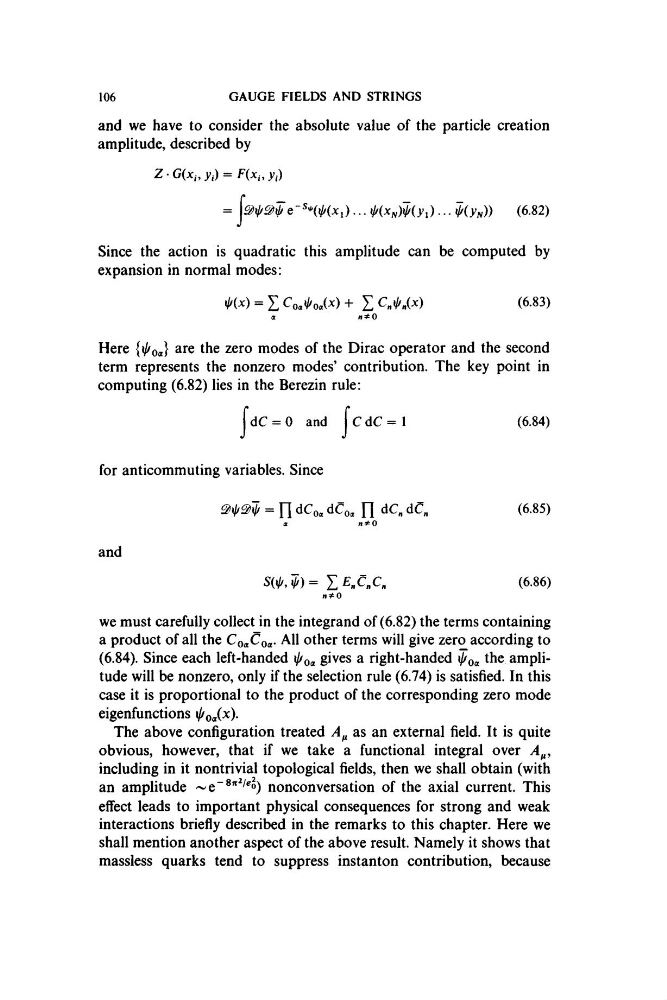
2 • G{Xi, y.) = F(x„ y,.)
W
(6.82)
Since the action is quadratic this amplitude can be computed by
expansion in normal modes:
Ipix) = X Co^lpo^ix) + X
(6.83)
Here {lAo«} ^^e the zero modes of the Dirac operator and the second
term represents the nonzero modes’ contribution. The key point in
computing (6.82) lies in the Berezin rule:
i
dC = 0 and
CdC= 1
(6.84)
for anticommuting variables. Since
(6.85)
and
^E„C„C„
n ^ 0
(6.86)
we must carefully collect in the integrand of (6.82) the terms containing
a product of all the Cq^^Cq^. All other terms will give zero according to
(6.84). Since each left-handed i/^o«
a right-handed i/^oa l^he amplitude will be nonzero, only if the selection rule (6.74) is satisfied. In this
case it is proportional to the product of the corresponding zero mode
eigenfunctions i^oa(^)The above configuration treated
as an external field. It is quite
obvious, however, that if we take a functional integral over
including in it nontrivial topological fields, then we shall obtain (with
an amplitude
nonconversation of the axial current. This
effect leads to important physical consequences for strong and weak
interactions briefly described in the remarks to this chapter. Here we
shall mention another aspect of the above result. Namely it shows that
massless quarks tend to suppress instanton contribution, because
GAUGE FIELDS AND STRINGS
and we have to consider the absolute value of the particle creation
amplitude, described by
2 • G{Xi, y.) = F(x„ y,.)
W
(6.82)
Since the action is quadratic this amplitude can be computed by
expansion in normal modes:
Ipix) = X Co^lpo^ix) + X
(6.83)
Here {lAo«} ^^e the zero modes of the Dirac operator and the second
term represents the nonzero modes’ contribution. The key point in
computing (6.82) lies in the Berezin rule:
i
dC = 0 and
CdC= 1
(6.84)
for anticommuting variables. Since
(6.85)
and
^E„C„C„
n ^ 0
(6.86)
we must carefully collect in the integrand of (6.82) the terms containing
a product of all the Cq^^Cq^. All other terms will give zero according to
(6.84). Since each left-handed i/^o«
a right-handed i/^oa l^he amplitude will be nonzero, only if the selection rule (6.74) is satisfied. In this
case it is proportional to the product of the corresponding zero mode
eigenfunctions i^oa(^)The above configuration treated
as an external field. It is quite
obvious, however, that if we take a functional integral over
including in it nontrivial topological fields, then we shall obtain (with
an amplitude
nonconversation of the axial current. This
effect leads to important physical consequences for strong and weak
interactions briefly described in the remarks to this chapter. Here we
shall mention another aspect of the above result. Namely it shows that
massless quarks tend to suppress instanton contribution, because