

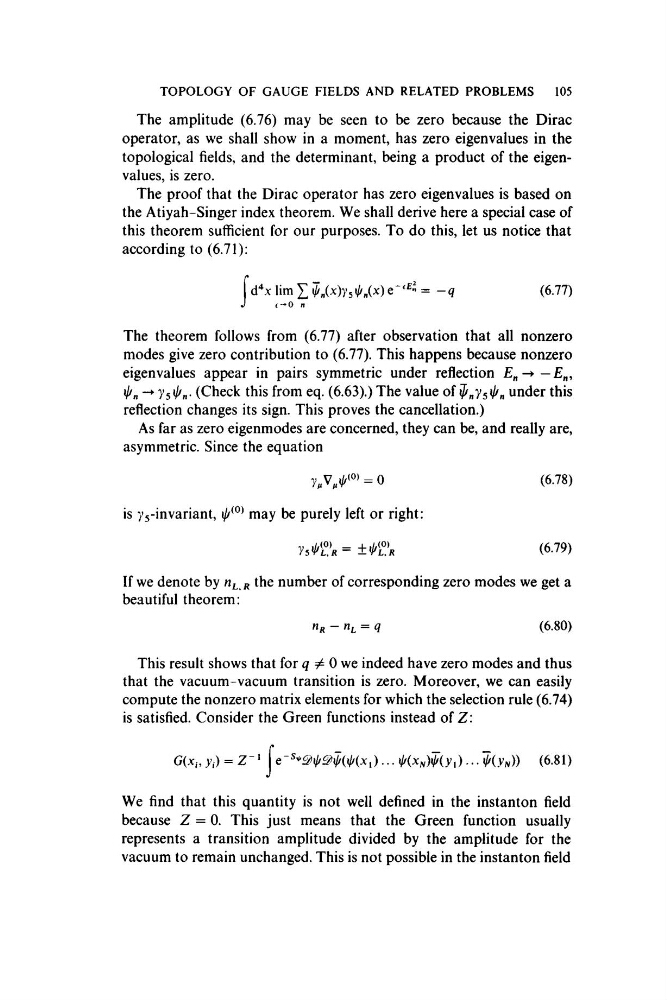
The amplitude (6.76) may be seen to be zero because the Dirac
operator, as we shall show in a moment, has zero eigenvalues in the
topological fields, and the determinant, being a product of the eigenvalues, is zero.
The proof that the Dirac operator has zero eigenvalues is based on
the Atiyah-Singer index theorem. We shall derive here a special case of
this theorem sufficient for our purposes. To do this, let us notice that
according to (6.71):
TOPOLOGY OF GAUGE FIELDS AND RELATED PROBLEMS
105
Urn ^
e
i ->0 n
(6.77)
The theorem follows from (6.77) after observation that all nonzero
modes give zero contribution to (6.77). This happens because nonzero
eigenvalues appear in pairs symmetric under reflection
ij/n -^ys^n- (Check this from eq. (6.63).) The value of ij/nys^n under this
reflection changes its sign. This proves the cancellation.)
As far as zero eigenmodes are concerned, they can be, and really are,
asymmetric. Since the equation
(6.78)
is 75-invariant,
may be purely left or right:
y5^i%=±K^R
(6.79)
If we denote by
the number of corresponding zero modes we get a
beautiful theorem:
(6.80)
This result shows that for ^ 0 we indeed have zero modes and thus
that the vacuum-vacuum transition is zero. Moreover, we can easily
compute the nonzero matrix elements for which the selection rule (6.74)
is satisfied. Consider the Green functions instead of Z:
G(x,,y,) = Z-^ e
(6.81)
We find that this quantity is not well defined in the instanton field
because Z = 0. This just means that the Green function usually
represents a transition amplitude divided by the amplitude for the
vacuum to remain unchanged. This is not possible in the instanton field
operator, as we shall show in a moment, has zero eigenvalues in the
topological fields, and the determinant, being a product of the eigenvalues, is zero.
The proof that the Dirac operator has zero eigenvalues is based on
the Atiyah-Singer index theorem. We shall derive here a special case of
this theorem sufficient for our purposes. To do this, let us notice that
according to (6.71):
TOPOLOGY OF GAUGE FIELDS AND RELATED PROBLEMS
105
Urn ^
e
i ->0 n
(6.77)
The theorem follows from (6.77) after observation that all nonzero
modes give zero contribution to (6.77). This happens because nonzero
eigenvalues appear in pairs symmetric under reflection
ij/n -^ys^n- (Check this from eq. (6.63).) The value of ij/nys^n under this
reflection changes its sign. This proves the cancellation.)
As far as zero eigenmodes are concerned, they can be, and really are,
asymmetric. Since the equation
(6.78)
is 75-invariant,
may be purely left or right:
y5^i%=±K^R
(6.79)
If we denote by
the number of corresponding zero modes we get a
beautiful theorem:
(6.80)
This result shows that for ^ 0 we indeed have zero modes and thus
that the vacuum-vacuum transition is zero. Moreover, we can easily
compute the nonzero matrix elements for which the selection rule (6.74)
is satisfied. Consider the Green functions instead of Z:
G(x,,y,) = Z-^ e
(6.81)
We find that this quantity is not well defined in the instanton field
because Z = 0. This just means that the Green function usually
represents a transition amplitude divided by the amplitude for the
vacuum to remain unchanged. This is not possible in the instanton field