

Z[A] = 0 in the instanton field. If we consider instanton-anti-instanton
configurations then their contribution will be nonzero, due to the fact
that the total topological charge is zero. But the effective action U(R^2\
where K12 is the distance between our objects, must have the property
TOPOLOGY OF GAUGE FIELDS AND RELATED PROBLEMS
107
U(R,2),
00
(6.87)
This means, that exchange of a massless fermion pair leads to longrange forces between instantons and anti-instantons. The result of this
may have several alternative consequences. The first one is that since
(6.87) implies quenching of large fluctuations in the presence of massless
fermions, the system looses the confining property and we would end up
with massless gauge fields together with fermions. This option seems
highly improbable to me on the basis of some analogies and some
model considerations. However, I am not aware of any strict statements
permitting us to reject it.
The second possibility, which in my opinion is realized in the theory,
is the following. Due to the strong binding force between fermions the
chiral symmetry gets spontaneously broken and as a result the fermions
acquire a mass. After that has happened, the long range force between
instantons and anti-instantons disappears, being screened by the fermionic mass term in the effective lagrangian. The only remaining effect
of anomalous non-conservation will consist of giving a mass to the
corresponding Goldstone boson.
There is also another improbable option, namely that instantons get
confined but some other type of large fluctuations, not suppressed by
fermions, disorder the system.
Unfortunately, at present we are unable to make a decisive choice
between the options.
Let us discuss another qualitative phenomenon, arising because of
the instantons. The Lagrangian density for Yang-Mills fields is conventionally taken to be (l/4^o) Tr(F^^). The standard reason for this choice
is that this is the only invariant expression of dimension 4. Any higher
invariant terms like
will be irrelevant in the infrared region
and can be omitted. This reason overlooks another invariant expression, Tr
*F^y, on the basis that it is a total divergence, which has no
influence on the equations of motion. But, as we already know,
instantons activate this total divergence. Therefore the most general
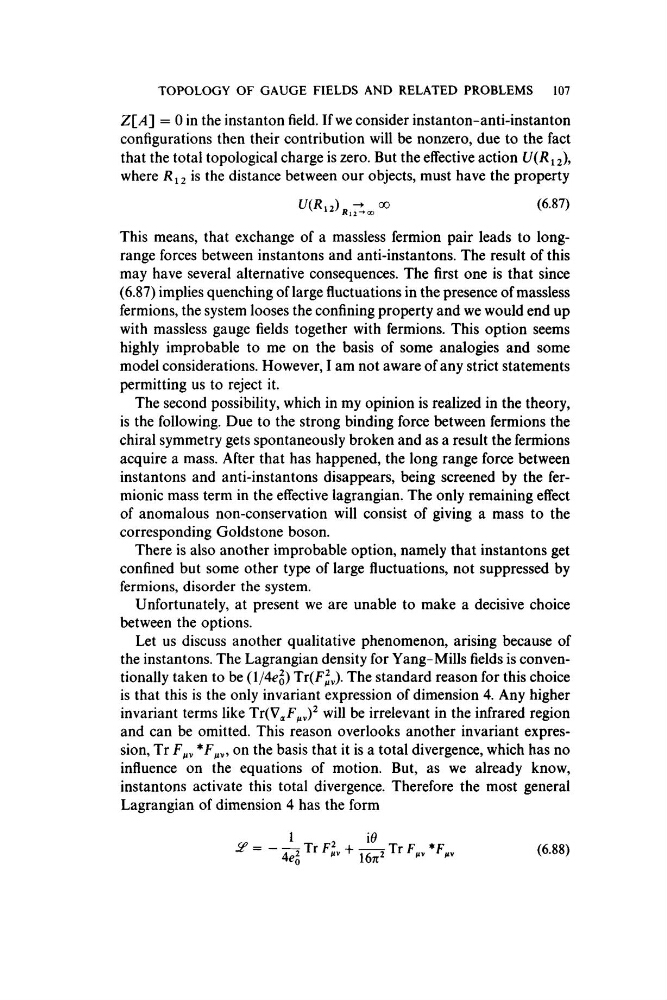
Lagrangian of dimension 4 has the form
= - 4e:
2 Tr F j,- f
W
16n^
Tr F *F
^ ^ I I \i ‘ *11
(6.88)
configurations then their contribution will be nonzero, due to the fact
that the total topological charge is zero. But the effective action U(R^2\
where K12 is the distance between our objects, must have the property
TOPOLOGY OF GAUGE FIELDS AND RELATED PROBLEMS
107
U(R,2),
00
(6.87)
This means, that exchange of a massless fermion pair leads to longrange forces between instantons and anti-instantons. The result of this
may have several alternative consequences. The first one is that since
(6.87) implies quenching of large fluctuations in the presence of massless
fermions, the system looses the confining property and we would end up
with massless gauge fields together with fermions. This option seems
highly improbable to me on the basis of some analogies and some
model considerations. However, I am not aware of any strict statements
permitting us to reject it.
The second possibility, which in my opinion is realized in the theory,
is the following. Due to the strong binding force between fermions the
chiral symmetry gets spontaneously broken and as a result the fermions
acquire a mass. After that has happened, the long range force between
instantons and anti-instantons disappears, being screened by the fermionic mass term in the effective lagrangian. The only remaining effect
of anomalous non-conservation will consist of giving a mass to the
corresponding Goldstone boson.
There is also another improbable option, namely that instantons get
confined but some other type of large fluctuations, not suppressed by
fermions, disorder the system.
Unfortunately, at present we are unable to make a decisive choice
between the options.
Let us discuss another qualitative phenomenon, arising because of
the instantons. The Lagrangian density for Yang-Mills fields is conventionally taken to be (l/4^o) Tr(F^^). The standard reason for this choice
is that this is the only invariant expression of dimension 4. Any higher
invariant terms like
will be irrelevant in the infrared region
and can be omitted. This reason overlooks another invariant expression, Tr
*F^y, on the basis that it is a total divergence, which has no
influence on the equations of motion. But, as we already know,
instantons activate this total divergence. Therefore the most general
Lagrangian of dimension 4 has the form
= - 4e:
2 Tr F j,- f
W
16n^
Tr F *F
^ ^ I I \i ‘ *11
(6.88)