

provide installation flexibility to aw ide range of temperatures, humidities,
and containments; encountered on mostconstruction sites.
Polyester formulations have limitations such as
1. Strong aromatic odor that can be offensive for certain indoor and
confined space applications
2. Shelf life limitationst hat can be controlled by low temperature
storage (below 608 F/158 C) of the resin component.
Table 10.9 provides the chemical resistance of chlorendic and bisphenol A
fumarate rosins in the presence of selected corrodents.
10.5.1V inyl Ester/Vinyl Ester Novolac Coatings
Vinyl ester resins are addition reactions of methacrylic acid and epoxy resin.
These resins have manyo ft he same properties as the epoxy,a crylic, and
bisphenol Af umarate resins.
The vinyl ester resins are the most corrosion resistant of any of the
monolithic surfacing systems, and they area lso the moste xpensive and
difficult to install.T hey areu sed when extremely corrosive conditions are
present. The finished flooringi sv ulnerable to hydrostatic pressure and
vapor moisture transmission. Refer to Table 10.5 for their resistance to
atmospheric corrosiona nd Table 10.10 fort heir resistance to
selected corrodents.
The majoradvantage of these resins are their resistance to most oxidizing
mediums and high concentrations of sulfuric acid, sodium hydroxide, and
manys olvents.
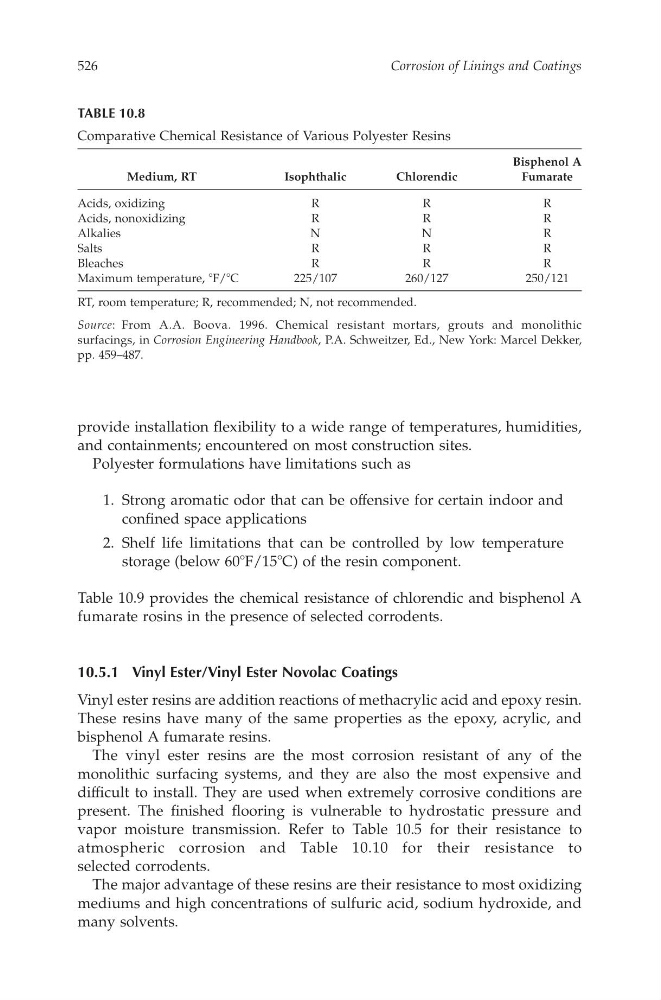
TABLE 10.8
Comparative Chemical Resistance of Various Polyester Resins
Medium,R TI sophthalic
Chlorendic
Bisphenol A
Fumarate
Acids, oxidizing
RR
R
Acids, nonoxidizing
RR
R
Alkalies
NN
R
Salts
RR
R
Bleaches
RR
R
Maximum temperature, 8 F/8 C2 25/107
260/127
250/121
RT,room temperature; R, recommended; N, not recommended.
Source:F romA .A.B oova.1 996. Chemicalr esistant mortars, groutsa nd monolithic
surfacings, in Corrosion Engineering Handbook,P .A. Schweitzer,E d., New York: Marcel Dekker,
pp. 459–487.
Corrosion of Linings and Coatings
526
CAT8247—CHAPTER 10—6/10/2006—12:52—SRIDHAR—XML MODEL B–pp. 515–532
and containments; encountered on mostconstruction sites.
Polyester formulations have limitations such as
1. Strong aromatic odor that can be offensive for certain indoor and
confined space applications
2. Shelf life limitationst hat can be controlled by low temperature
storage (below 608 F/158 C) of the resin component.
Table 10.9 provides the chemical resistance of chlorendic and bisphenol A
fumarate rosins in the presence of selected corrodents.
10.5.1V inyl Ester/Vinyl Ester Novolac Coatings
Vinyl ester resins are addition reactions of methacrylic acid and epoxy resin.
These resins have manyo ft he same properties as the epoxy,a crylic, and
bisphenol Af umarate resins.
The vinyl ester resins are the most corrosion resistant of any of the
monolithic surfacing systems, and they area lso the moste xpensive and
difficult to install.T hey areu sed when extremely corrosive conditions are
present. The finished flooringi sv ulnerable to hydrostatic pressure and
vapor moisture transmission. Refer to Table 10.5 for their resistance to
atmospheric corrosiona nd Table 10.10 fort heir resistance to
selected corrodents.
The majoradvantage of these resins are their resistance to most oxidizing
mediums and high concentrations of sulfuric acid, sodium hydroxide, and
manys olvents.
TABLE 10.8
Comparative Chemical Resistance of Various Polyester Resins
Medium,R TI sophthalic
Chlorendic
Bisphenol A
Fumarate
Acids, oxidizing
RR
R
Acids, nonoxidizing
RR
R
Alkalies
NN
R
Salts
RR
R
Bleaches
RR
R
Maximum temperature, 8 F/8 C2 25/107
260/127
250/121
RT,room temperature; R, recommended; N, not recommended.
Source:F romA .A.B oova.1 996. Chemicalr esistant mortars, groutsa nd monolithic
surfacings, in Corrosion Engineering Handbook,P .A. Schweitzer,E d., New York: Marcel Dekker,
pp. 459–487.
Corrosion of Linings and Coatings
526
CAT8247—CHAPTER 10—6/10/2006—12:52—SRIDHAR—XML MODEL B–pp. 515–532