

1. Isophthalic
2. Chlorendic acid
3. Bisplienol Af umarate
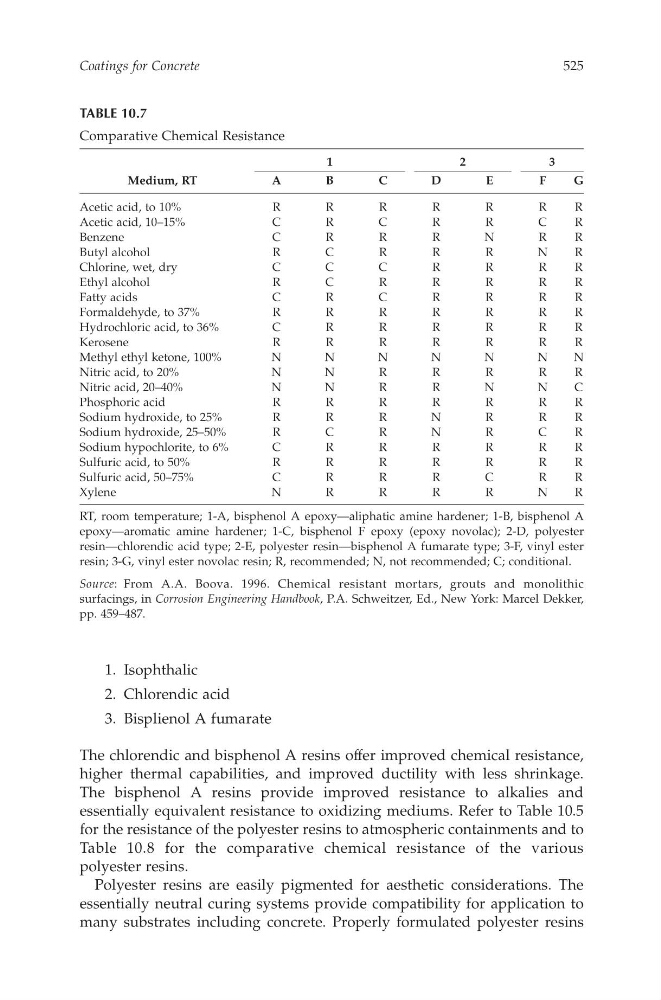
The chlorendic and bisphenolAresins offer improved chemical resistance,
higher thermal capabilities, and improved ductility with less shrinkage.
Theb isphenol Ar esinsp rovidei mproved resistance to alkalies and
essentially equivalent resistance to oxidizingm ediums. Refer to Table 10.5
for the resistance of the polyester resins to atmospheric containments and to
Table 10.8 fort he comparativec hemicalr esistanceo ft he various
polyester resins.
Polyester resins are easily pigmentedf or aesthetic considerations. The
essentially neutral curing systems provide compatibility for application to
manys ubstrates including concrete. Properly formulated polyester resins
TABLE 10.7
Comparative Chemical Resistance
12
3
Medium, RT
ABCDEF
G
Acetic acid, to 10%
RRRRRRR
Acetic acid, 10–15%
CRCRRC
R
Benzene
CRRRNR
R
Butyl alcohol
RCRRRNR
Chlorine, wet, dry
CCCRRR
R
Ethyl alcohol
RCRRRRR
Fatty acids
CRCRRR
R
Formaldehyde, to 37%
RRRRRRR
Hydrochloric acid, to 36%
CRRRRR
R
Kerosene
RRRRRRR
Methyl ethyl ketone, 100%
NNNNNNN
Nitric acid, to 20%
NNRRRR
R
Nitric acid, 20–40%
NNRRNN
C
Phosphoric acid
RRRRRRR
Sodium hydroxide, to 25%
RRRNRRR
Sodium hydroxide, 25–50%
RCRNRCR
Sodium hypochlorite, to 6%
CRRRRR
R
Sulfuric acid, to 50%
RRRRRRR
Sulfuric acid, 50–75%
CRRRCR
R
Xylene
NRRRRN
R
RT,r oom temperature; 1-A, bisphenolAe poxy—aliphatic amine hardener; 1-B, bisphenol A
epoxy—aromatic amine hardener; 1-C, bisphenolFepoxy (epoxy novolac); 2-D, polyester
resin—chlorendic acid type; 2-E, polyester resin—bisphenol Af umarate type; 3-F,v inyl ester
resin; 3-G, vinyl ester novolac resin; R, recommended; N, not recommended; C; conditional.
Source:F romA .A.B oova.1 996.C hemicalr esistantm ortars,g routsa nd monolithic
surfacings, in Corrosion Engineering Handbook,P .A. Schweitzer,E d., New York: Marcel Dekker,
pp. 459–487.
Coatings for Concrete
525
CAT8247—CHAPTER 10—6/10/2006—12:52—SRIDHAR—XML MODEL B–pp. 515–532
2. Chlorendic acid
3. Bisplienol Af umarate
The chlorendic and bisphenolAresins offer improved chemical resistance,
higher thermal capabilities, and improved ductility with less shrinkage.
Theb isphenol Ar esinsp rovidei mproved resistance to alkalies and
essentially equivalent resistance to oxidizingm ediums. Refer to Table 10.5
for the resistance of the polyester resins to atmospheric containments and to
Table 10.8 fort he comparativec hemicalr esistanceo ft he various
polyester resins.
Polyester resins are easily pigmentedf or aesthetic considerations. The
essentially neutral curing systems provide compatibility for application to
manys ubstrates including concrete. Properly formulated polyester resins
TABLE 10.7
Comparative Chemical Resistance
12
3
Medium, RT
ABCDEF
G
Acetic acid, to 10%
RRRRRRR
Acetic acid, 10–15%
CRCRRC
R
Benzene
CRRRNR
R
Butyl alcohol
RCRRRNR
Chlorine, wet, dry
CCCRRR
R
Ethyl alcohol
RCRRRRR
Fatty acids
CRCRRR
R
Formaldehyde, to 37%
RRRRRRR
Hydrochloric acid, to 36%
CRRRRR
R
Kerosene
RRRRRRR
Methyl ethyl ketone, 100%
NNNNNNN
Nitric acid, to 20%
NNRRRR
R
Nitric acid, 20–40%
NNRRNN
C
Phosphoric acid
RRRRRRR
Sodium hydroxide, to 25%
RRRNRRR
Sodium hydroxide, 25–50%
RCRNRCR
Sodium hypochlorite, to 6%
CRRRRR
R
Sulfuric acid, to 50%
RRRRRRR
Sulfuric acid, 50–75%
CRRRCR
R
Xylene
NRRRRN
R
RT,r oom temperature; 1-A, bisphenolAe poxy—aliphatic amine hardener; 1-B, bisphenol A
epoxy—aromatic amine hardener; 1-C, bisphenolFepoxy (epoxy novolac); 2-D, polyester
resin—chlorendic acid type; 2-E, polyester resin—bisphenol Af umarate type; 3-F,v inyl ester
resin; 3-G, vinyl ester novolac resin; R, recommended; N, not recommended; C; conditional.
Source:F romA .A.B oova.1 996.C hemicalr esistantm ortars,g routsa nd monolithic
surfacings, in Corrosion Engineering Handbook,P .A. Schweitzer,E d., New York: Marcel Dekker,
pp. 459–487.
Coatings for Concrete
525
CAT8247—CHAPTER 10—6/10/2006—12:52—SRIDHAR—XML MODEL B–pp. 515–532