

The bisphenol Fs (epoxy novolacs) are essentially premium grade epoxy
resins providing an increased chemical resistance. They are also available in
aw ide range of formulations and from manym anufacturers. The primary
advantages in the use of epoxy novolacs is in their improved resistance to
higherc oncentrationso fo xidizinga nd nonoxidizing acids, and aliphatic
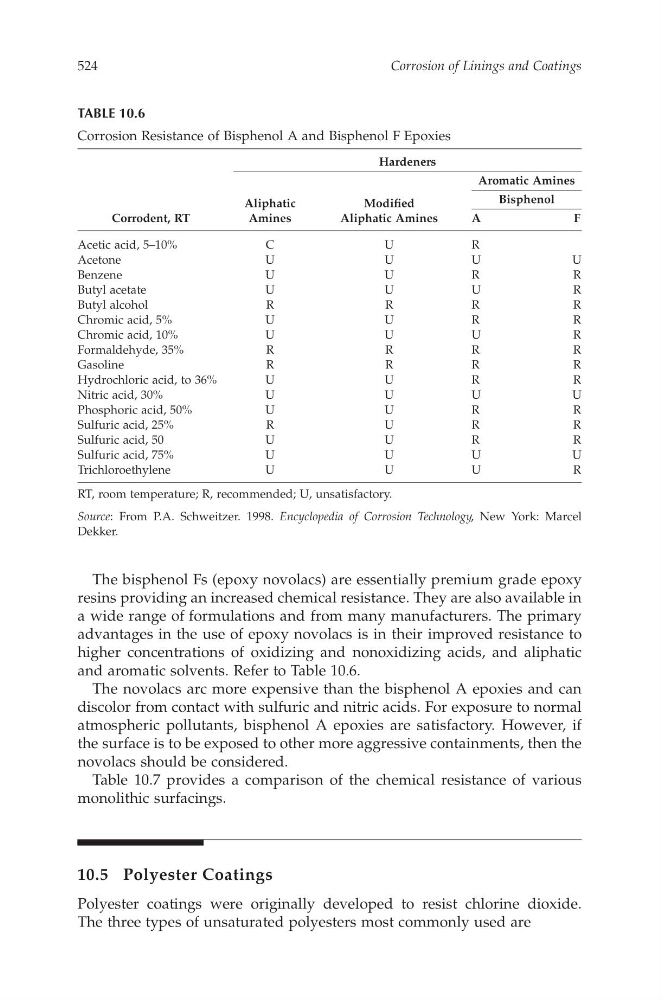
and aromatic solvents. Refer to Table10.6.
The novolacs arc more expensive than the bisphenol Ae poxies and can
discolor from contact with sulfuric andnitric acids. For exposure to normal
atmospheric pollutants, bisphenol Ae poxies ares atisfactory.H owever,i f
the surfaceistobeexposed to other more aggressive containments, then the
novolacs should be considered.
Table 10.7 provides ac omparisono ft he chemical resistance of various
monolithic surfacings.
10.5P olyesterC oatings
Polyester coatings were originally developed to resistc hlorined ioxide.
The three types of unsaturated polyesters most commonly used are
TABLE 10.6
Corrosion Resistance of Bisphenol Aa nd Bisphenol FE poxies
Hardeners
Aromatic Amines
Aliphatic
Amines
Modified
Aliphatic Amines
Bisphenol
Corrodent, RT
AF
Acetic acid, 5–10%
CU
R
Acetone
UU
UU
Benzene
UU
RR
Butyl acetate
UU
UR
Butyl alcohol
RR
RR
Chromic acid, 5%
UU
RR
Chromic acid, 10%
UU
UR
Formaldehyde,35%
RR
RR
Gasoline
RR
RR
Hydrochloric acid, to 36%
UU
RR
Nitric acid, 30%
UU
UU
Phosphoric acid, 50%
UU
RR
Sulfuric acid, 25%
RU
RR
Sulfuric acid, 50
UU
RR
Sulfuric acid, 75%
UU
UU
Trichloroethylene
UU
UR
RT,room temperature; R, recommended; U, unsatisfactory.
Source:F romP .A. Schweitzer.1 998. Encyclopedia of Corrosion Te chnology,N ew York: Marcel
Dekker.
Corrosion of Linings and Coatings
524
CAT8247—CHAPTER 10—6/10/2006—12:52—SRIDHAR—XML MODEL B–pp. 515–532
resins providing an increased chemical resistance. They are also available in
aw ide range of formulations and from manym anufacturers. The primary
advantages in the use of epoxy novolacs is in their improved resistance to
higherc oncentrationso fo xidizinga nd nonoxidizing acids, and aliphatic
and aromatic solvents. Refer to Table10.6.
The novolacs arc more expensive than the bisphenol Ae poxies and can
discolor from contact with sulfuric andnitric acids. For exposure to normal
atmospheric pollutants, bisphenol Ae poxies ares atisfactory.H owever,i f
the surfaceistobeexposed to other more aggressive containments, then the
novolacs should be considered.
Table 10.7 provides ac omparisono ft he chemical resistance of various
monolithic surfacings.
10.5P olyesterC oatings
Polyester coatings were originally developed to resistc hlorined ioxide.
The three types of unsaturated polyesters most commonly used are
TABLE 10.6
Corrosion Resistance of Bisphenol Aa nd Bisphenol FE poxies
Hardeners
Aromatic Amines
Aliphatic
Amines
Modified
Aliphatic Amines
Bisphenol
Corrodent, RT
AF
Acetic acid, 5–10%
CU
R
Acetone
UU
UU
Benzene
UU
RR
Butyl acetate
UU
UR
Butyl alcohol
RR
RR
Chromic acid, 5%
UU
RR
Chromic acid, 10%
UU
UR
Formaldehyde,35%
RR
RR
Gasoline
RR
RR
Hydrochloric acid, to 36%
UU
RR
Nitric acid, 30%
UU
UU
Phosphoric acid, 50%
UU
RR
Sulfuric acid, 25%
RU
RR
Sulfuric acid, 50
UU
RR
Sulfuric acid, 75%
UU
UU
Trichloroethylene
UU
UR
RT,room temperature; R, recommended; U, unsatisfactory.
Source:F romP .A. Schweitzer.1 998. Encyclopedia of Corrosion Te chnology,N ew York: Marcel
Dekker.
Corrosion of Linings and Coatings
524
CAT8247—CHAPTER 10—6/10/2006—12:52—SRIDHAR—XML MODEL B–pp. 515–532