

4. Differences in expansioncoefficients in multilayer coating systems
5. Poor adhesion of polymer to pigment
7.13.5S trength of Paint Film
Paintfi lms requireh ardness, flexibility,b rittlenessr esistance, abrasion
resistance, mar resistance, and sag resistance, Paintcoatings are formulated
providing abalance of these mechanical properties. The mechanical strength
of ap aint film is described by the words hardness and plasticity that correspondt ot he modulus of elasticity and to the elongation at break obtained
from the stress stress–strain curve of ap aint film. Typical paintfi lms have
tensile properties as follows:
Paints
Te nsile Strength
(g/mm)
Elongation at
Break (%)
Linseed oil
14–492
2–40
Alkyd resin varnish (16% PA)1 41–12663 0–50
Amino-alkyd resin varnish ( A / W Z 7/3)
2180–2602
—
NC lacquer
844–26222 –28
Methyl-n -butyl-meta-acrylic resin
1758–2532
19–49
Mechanical properties of paint coatings vary depending on the type of
pigment, baking temperatures, and aging times. As bakingt emperatures
rise, the curing of paintfi lms is promoted and elongation reduced. Tensile
strength is improved by curing and the elongation at breaks is reducedwith
increased drying time.
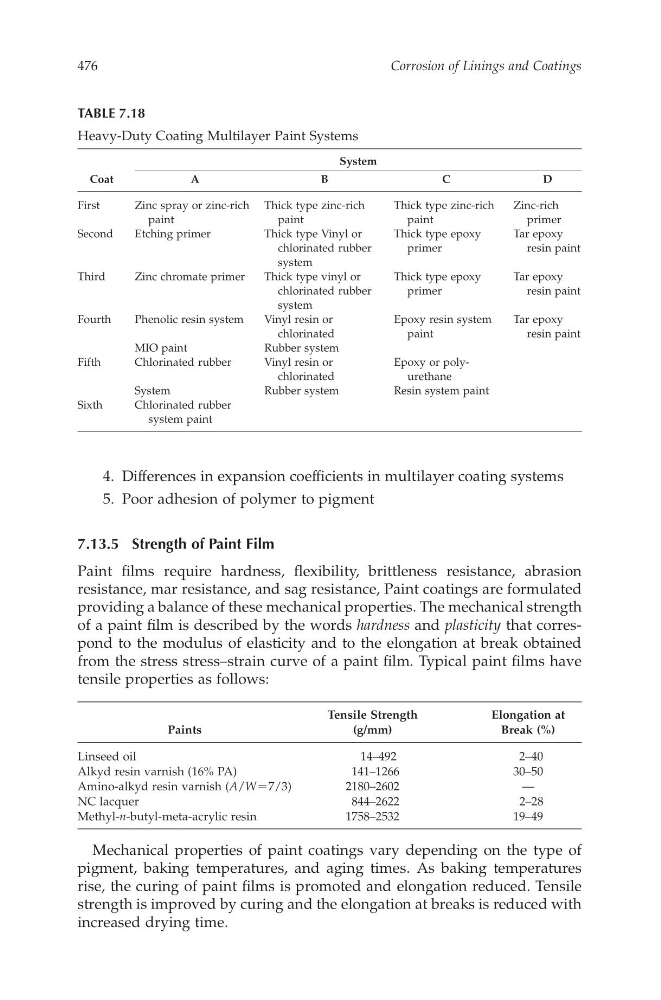
TABLE 7.18
Heavy-Duty Coating Multilayer Paint Systems
System
Coat
AB
CD
First
Zinc spray or zinc-rich
paint
Thick type zinc-rich
paint
Thick type zinc-rich
paint
Zinc-rich
primer
Second
Etching primer
Thick type Vinyl or
chlorinated rubber
system
Thick type epoxy
primer
Tarepoxy
resin paint
Third
Zinc chromate primer
Thick type vinyl or
chlorinated rubber
system
Thick type epoxy
primer
Tarepoxy
resin paint
Fourth
Phenolic resin system
Vinyl resin or
chlorinated
Epoxy resin system
paint
Tarepoxy
resin paint
MIOpaint
Rubber system
Fifth
Chlorinated rubber
Vinyl resin or
chlorinated
Epoxy or polyurethane
System
Rubber system
Resin system paint
Sixth
Chlorinated rubber
system paint
Corrosion of Linings and Coatings
476
CAT8247—CHAPTER 7—17/10/2006—15:04—TRGANESH—XMLM ODEL B–pp. 403–485
5. Poor adhesion of polymer to pigment
7.13.5S trength of Paint Film
Paintfi lms requireh ardness, flexibility,b rittlenessr esistance, abrasion
resistance, mar resistance, and sag resistance, Paintcoatings are formulated
providing abalance of these mechanical properties. The mechanical strength
of ap aint film is described by the words hardness and plasticity that correspondt ot he modulus of elasticity and to the elongation at break obtained
from the stress stress–strain curve of ap aint film. Typical paintfi lms have
tensile properties as follows:
Paints
Te nsile Strength
(g/mm)
Elongation at
Break (%)
Linseed oil
14–492
2–40
Alkyd resin varnish (16% PA)1 41–12663 0–50
Amino-alkyd resin varnish ( A / W Z 7/3)
2180–2602
—
NC lacquer
844–26222 –28
Methyl-n -butyl-meta-acrylic resin
1758–2532
19–49
Mechanical properties of paint coatings vary depending on the type of
pigment, baking temperatures, and aging times. As bakingt emperatures
rise, the curing of paintfi lms is promoted and elongation reduced. Tensile
strength is improved by curing and the elongation at breaks is reducedwith
increased drying time.
TABLE 7.18
Heavy-Duty Coating Multilayer Paint Systems
System
Coat
AB
CD
First
Zinc spray or zinc-rich
paint
Thick type zinc-rich
paint
Thick type zinc-rich
paint
Zinc-rich
primer
Second
Etching primer
Thick type Vinyl or
chlorinated rubber
system
Thick type epoxy
primer
Tarepoxy
resin paint
Third
Zinc chromate primer
Thick type vinyl or
chlorinated rubber
system
Thick type epoxy
primer
Tarepoxy
resin paint
Fourth
Phenolic resin system
Vinyl resin or
chlorinated
Epoxy resin system
paint
Tarepoxy
resin paint
MIOpaint
Rubber system
Fifth
Chlorinated rubber
Vinyl resin or
chlorinated
Epoxy or polyurethane
System
Rubber system
Resin system paint
Sixth
Chlorinated rubber
system paint
Corrosion of Linings and Coatings
476
CAT8247—CHAPTER 7—17/10/2006—15:04—TRGANESH—XMLM ODEL B–pp. 403–485