

Structural defects in ap aint film causes failures that are determined by
environmental conditions such as thermal reaction, oxidation, photooxidation, and photothermal reaction. An important factor in controlling the
physical properties of ap aintfi lm is the glass transition temperature T g .I n
the temperature range higher than T g ,t he motiono ft he resin molecules
becomem orea ctive so that hardness, plasticity,a nd the permeability of
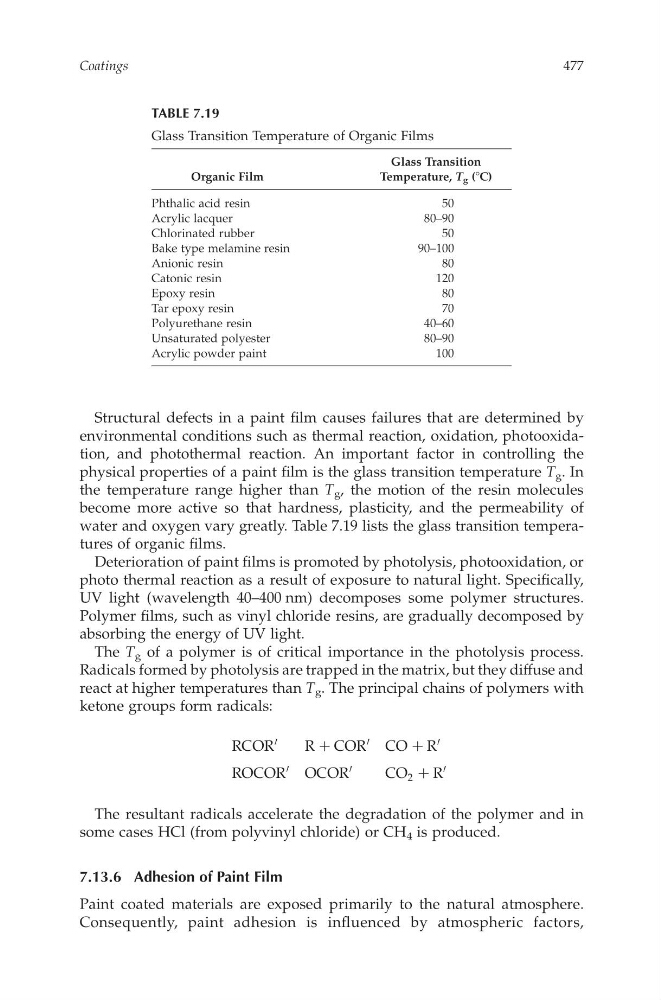
water and oxygenvary greatly.T able 7.19 lists the glass transition temperatures of organic films.
Deterioration of paintfilms is promoted by photolysis, photooxidation, or
photo thermal reaction as ar esult of exposure to natural light. Specifically,
UV light (wavelength 40–400 nm) decomposes some polymer structures.
Polymerfi lms, sucha sv inyl chloride resins, are gradually decomposed by
absorbing the energy of UV light.
The T g of ap olymer is of critical importance in the photolysisp rocess.
Radicals formed by photolysis are trappedinthe matrix, but they diffuse and
react at higher temperatures than T g .The principal chains of polymers with
ketone groups form radicals:
RCOR
0
R C COR
0
CO C R
0
ROCOR
0
OCOR
0
CO 2 C R
0
The resultant radicalsa ccelerate the degradation of the polymer and in
some cases HCl (from polyvinyl chloride) or CH 4 is produced.
7.13.6A dhesion of Paint Film
Paint coated materials are exposed primarily to the natural atmosphere.
Consequently, painta dhesion is influencedb ya tmospheric factors,
TABLE 7.19
Glass Transition Temperature of Organic Films
Organic Film
Glass Tr ansition
Te mperature, T g ( 8 C)
Phthalic acid resin
50
Acrylic lacquer
80–90
Chlorinated rubber
50
Bake type melamine resin9 0–100
Anionic resin
80
Catonic resin
120
Epoxy resin
80
Tarepoxy resin
70
Polyurethane resin4 0–60
Unsaturated polyester
80–90
Acrylic powder paint
100
Coatings
477
CAT8247—CHAPTER 7—17/10/2006—15:04—TRGANESH—XMLM ODEL B–pp. 403–485
environmental conditions such as thermal reaction, oxidation, photooxidation, and photothermal reaction. An important factor in controlling the
physical properties of ap aintfi lm is the glass transition temperature T g .I n
the temperature range higher than T g ,t he motiono ft he resin molecules
becomem orea ctive so that hardness, plasticity,a nd the permeability of
water and oxygenvary greatly.T able 7.19 lists the glass transition temperatures of organic films.
Deterioration of paintfilms is promoted by photolysis, photooxidation, or
photo thermal reaction as ar esult of exposure to natural light. Specifically,
UV light (wavelength 40–400 nm) decomposes some polymer structures.
Polymerfi lms, sucha sv inyl chloride resins, are gradually decomposed by
absorbing the energy of UV light.
The T g of ap olymer is of critical importance in the photolysisp rocess.
Radicals formed by photolysis are trappedinthe matrix, but they diffuse and
react at higher temperatures than T g .The principal chains of polymers with
ketone groups form radicals:
RCOR
0
R C COR
0
CO C R
0
ROCOR
0
OCOR
0
CO 2 C R
0
The resultant radicalsa ccelerate the degradation of the polymer and in
some cases HCl (from polyvinyl chloride) or CH 4 is produced.
7.13.6A dhesion of Paint Film
Paint coated materials are exposed primarily to the natural atmosphere.
Consequently, painta dhesion is influencedb ya tmospheric factors,
TABLE 7.19
Glass Transition Temperature of Organic Films
Organic Film
Glass Tr ansition
Te mperature, T g ( 8 C)
Phthalic acid resin
50
Acrylic lacquer
80–90
Chlorinated rubber
50
Bake type melamine resin9 0–100
Anionic resin
80
Catonic resin
120
Epoxy resin
80
Tarepoxy resin
70
Polyurethane resin4 0–60
Unsaturated polyester
80–90
Acrylic powder paint
100
Coatings
477
CAT8247—CHAPTER 7—17/10/2006—15:04—TRGANESH—XMLM ODEL B–pp. 403–485