

process areepoxy,and because epoxy resins provide good water and alkali
resistance as well as adhesion, cationic paint coatings are superiori n
corrosion protection to anodicpaintcoatings.
7.13.3.6 MultilayerC oatings
The protective ability of ac oating is also dependent upon its thickness.
Thickercoatings provide improved protection. However, single thick paint
films tend to crack because of internal stress. Whenl ong term protection is
required, multilayer paintcoating systems are applied.
The multilayers ystem to be used with as teel structure is determined
by the required service life and the environmental conditions that the steel
structure must exist under.Generalcoating systems are applied to structures
in mild environments, whereas, heavy-dutyc oating systems are applied
to these structures in severe environments. Typical general coating systems
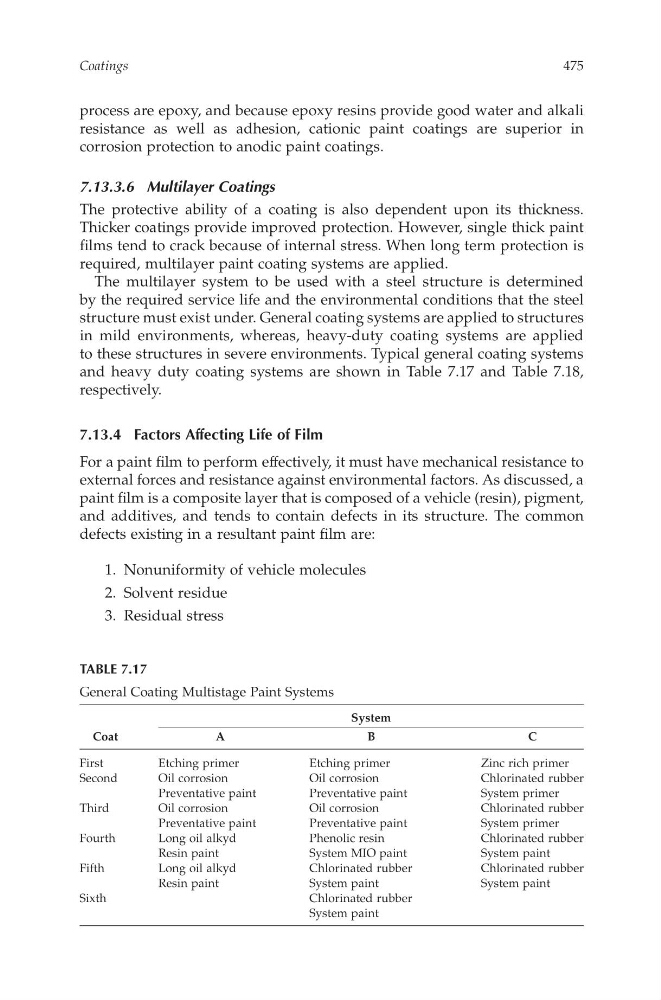
and heavy dutyc oating systems are shown in Table 7.17 and Table 7.18,
respectively.
7.13.4F actors Affecting Life of Film
For apaintfilm to perform effectively,itmusthave mechanical resistance to
external forces and resistance against environmental factors. As discussed, a
paint film is acomposite layer that is composed of avehicle (resin), pigment,
and additives, and tends to contain defects in its structure. The common
defects existing in ar esultant paint film are:
1. Nonuniformity of vehicle molecules
2. Solvent residue
3. Residual stress
TABLE 7.17
General Coating Multistage Paint Systems
System
Coat
AB
C
First
Etching primer
Etching primer
Zinc rich primer
Second
Oil corrosion
Oil corrosion
Chlorinated rubber
Preventative paint
Preventative paint
System primer
ThirdO il corrosion
Oil corrosion
Chlorinated rubber
Preventative paint
Preventative paint
System primer
Fourth
Long oil alkyd
Phenolic resin
Chlorinated rubber
Resin paint
System MIO paint
System paint
Fifth
Long oil alkyd
Chlorinated rubber
Chlorinated rubber
Resin paint
System paint
System paint
Sixth
Chlorinated rubber
System paint
Coatings
475
CAT8247—CHAPTER 7—17/10/2006—15:04—TRGANESH—XMLM ODEL B–pp. 403–485
resistance as well as adhesion, cationic paint coatings are superiori n
corrosion protection to anodicpaintcoatings.
7.13.3.6 MultilayerC oatings
The protective ability of ac oating is also dependent upon its thickness.
Thickercoatings provide improved protection. However, single thick paint
films tend to crack because of internal stress. Whenl ong term protection is
required, multilayer paintcoating systems are applied.
The multilayers ystem to be used with as teel structure is determined
by the required service life and the environmental conditions that the steel
structure must exist under.Generalcoating systems are applied to structures
in mild environments, whereas, heavy-dutyc oating systems are applied
to these structures in severe environments. Typical general coating systems
and heavy dutyc oating systems are shown in Table 7.17 and Table 7.18,
respectively.
7.13.4F actors Affecting Life of Film
For apaintfilm to perform effectively,itmusthave mechanical resistance to
external forces and resistance against environmental factors. As discussed, a
paint film is acomposite layer that is composed of avehicle (resin), pigment,
and additives, and tends to contain defects in its structure. The common
defects existing in ar esultant paint film are:
1. Nonuniformity of vehicle molecules
2. Solvent residue
3. Residual stress
TABLE 7.17
General Coating Multistage Paint Systems
System
Coat
AB
C
First
Etching primer
Etching primer
Zinc rich primer
Second
Oil corrosion
Oil corrosion
Chlorinated rubber
Preventative paint
Preventative paint
System primer
ThirdO il corrosion
Oil corrosion
Chlorinated rubber
Preventative paint
Preventative paint
System primer
Fourth
Long oil alkyd
Phenolic resin
Chlorinated rubber
Resin paint
System MIO paint
System paint
Fifth
Long oil alkyd
Chlorinated rubber
Chlorinated rubber
Resin paint
System paint
System paint
Sixth
Chlorinated rubber
System paint
Coatings
475
CAT8247—CHAPTER 7—17/10/2006—15:04—TRGANESH—XMLM ODEL B–pp. 403–485