

2. Development of an aqueousp hase at the coating/substrate
interface
3. Activation of the substrate surface fort he anodic and
cathodic reactions
4. Deterioration of the coating/substrate interfacial bond
7.13.1C omposition of Organic Coatings
The composition of ac oating (paint) determines the degree of corrosion
protection that will be supplied. Ap aintf ormulation is made up of four
general classes of ingredients: vehicle( binder,r esin component), pigment,
filler,and additive. It is the combination of these ingredients that impart the
protective properties to the coating.
7.13.1.1 Resin Component
The resin component is also known as the vehicle or binder,b ut resin
component is more descriptive. The resin is the film-forming ingredient of the
paint. It forms the matrix of the coating, the continuous polymeric phase that
all other components may be incorporated in. Its densitya nd composition
largely determine the permeability,c orrosion resistance, and UV resistance
of the coating.
The mostc ommon resins used are vinyls, chlorinated rubber, acrylics,
epoxies,u rethanes, polyester,a utooxidative cross-linking coatings, and
water soluble resins.
7.13.1.1.1 Vinyl Resins
Vinyli st he general term denoting any compound containing the vinyl
linkage (–CHa CH 2 )g roup.H owever,t here arem anyc ompounds
containing this linkage that are not considered as vinyl coatings such as
styrene and propylene.
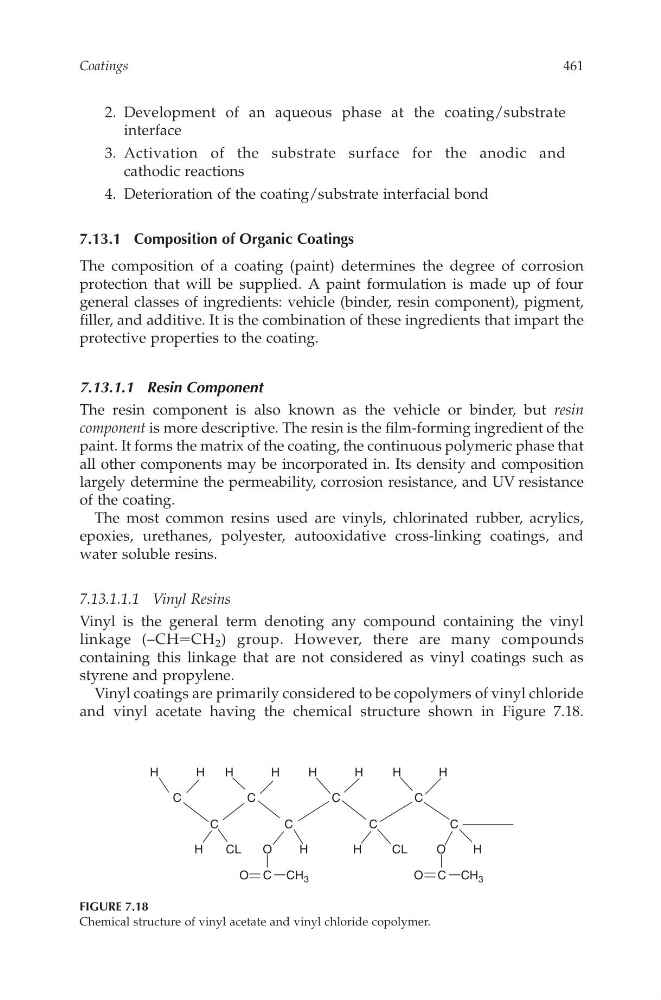
Vinyl coatings are primarilyconsidered to be copolymers of vinyl chloride
and vinyla cetate havingt he chemical structure shown in Figure 7.18.
HH
H
CC
CC
C
HC LO
CC H 3
OC CH 3
O
HH
CL
OH
CC
C
HH
HH
H
FIGURE 7.18
Chemical structureo fvinyl acetate and vinyl chloride copolymer.
Coatings
461
CAT8247—CHAPTER 7—17/10/2006—15:03—TRGANESH—XMLM ODEL B–pp. 403–485
interface
3. Activation of the substrate surface fort he anodic and
cathodic reactions
4. Deterioration of the coating/substrate interfacial bond
7.13.1C omposition of Organic Coatings
The composition of ac oating (paint) determines the degree of corrosion
protection that will be supplied. Ap aintf ormulation is made up of four
general classes of ingredients: vehicle( binder,r esin component), pigment,
filler,and additive. It is the combination of these ingredients that impart the
protective properties to the coating.
7.13.1.1 Resin Component
The resin component is also known as the vehicle or binder,b ut resin
component is more descriptive. The resin is the film-forming ingredient of the
paint. It forms the matrix of the coating, the continuous polymeric phase that
all other components may be incorporated in. Its densitya nd composition
largely determine the permeability,c orrosion resistance, and UV resistance
of the coating.
The mostc ommon resins used are vinyls, chlorinated rubber, acrylics,
epoxies,u rethanes, polyester,a utooxidative cross-linking coatings, and
water soluble resins.
7.13.1.1.1 Vinyl Resins
Vinyli st he general term denoting any compound containing the vinyl
linkage (–CHa CH 2 )g roup.H owever,t here arem anyc ompounds
containing this linkage that are not considered as vinyl coatings such as
styrene and propylene.
Vinyl coatings are primarilyconsidered to be copolymers of vinyl chloride
and vinyla cetate havingt he chemical structure shown in Figure 7.18.
HH
H
CC
CC
C
HC LO
CC H 3
OC CH 3
O
HH
CL
OH
CC
C
HH
HH
H
FIGURE 7.18
Chemical structureo fvinyl acetate and vinyl chloride copolymer.
Coatings
461
CAT8247—CHAPTER 7—17/10/2006—15:03—TRGANESH—XMLM ODEL B–pp. 403–485