

The electronicresistance may be increased by the formation of an oxide film
on the metal. This is the case for aluminumsubstrates.
Corrosion of asubstrate beneath an organic coating is an electrochemical
process that followst he same principles as corrosion of an uncoateds ubstrate. It differs from crevice corrosionbecause the reactants often reachthe
substrate through as olid. In addition, during the early stages of corrosion,
smallv olumes of liquid are present, resulting in extreme values of pH and
ion concentrations.
The total corrosion process takes place as follows:
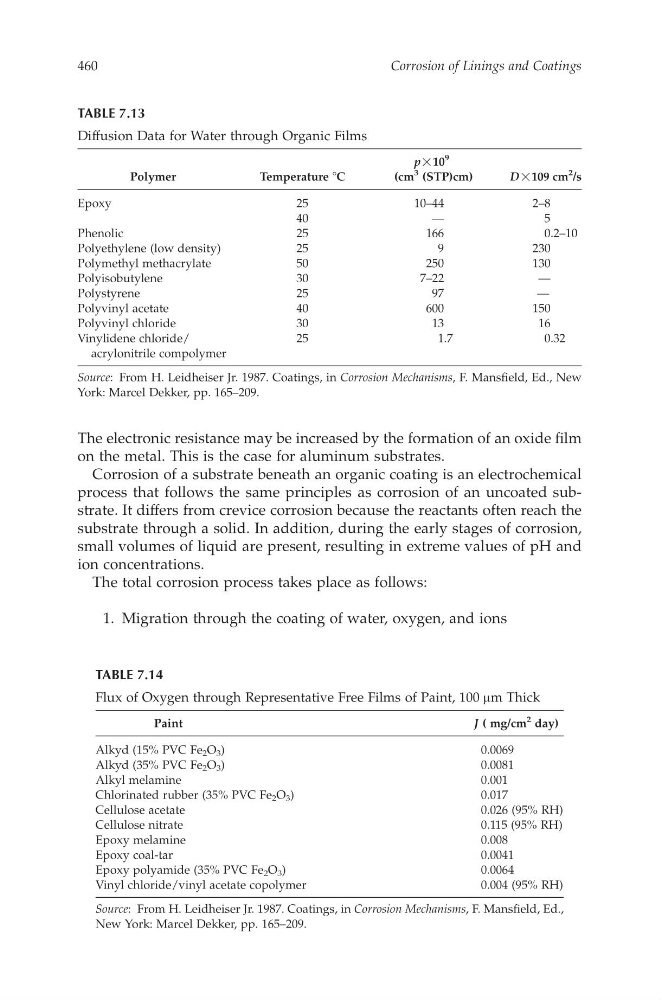
1. Migration through the coating of water,o xygen, and ions
TABLE 7.14
Flux of Oxygen through Representative Free Films of Paint, 100 m mThick
Paint
J (m g/cm
2 day)
Alkyd (15% PVC Fe 2 O 3 )0 .0069
Alkyd (35% PVC Fe 2 O 3 )0 .0081
Alkyl melamine
0.001
Chlorinated rubber (35% PVC Fe 2 O 3 )0 .017
Cellulose acetate
0.026 (95% RH)
Cellulose nitrate
0.115 (95% RH)
Epoxy melamine
0.008
Epoxy coal-tar
0.0041
Epoxy polyamide (35% PVC Fe 2 O 3 )0 .0064
Vinyl chloride/vinyl acetate copolymer
0.004 (95% RH)
Source:F romH.Leidheiser Jr.1987. Coatings, in Corrosion Mechanisms,F .Mansfield, Ed.,
New York: Marcel Dekker,p p. 165–209.
TABLE 7.13
Diffusion Data for Water through Organic Films
Polymer
Te mperature 8 C
p ! 10
9
(cm
3 (STP)cm)
D ! 109 cm
2 /s
Epoxy
25
10–44
2–8
40
—5
Phenolic
25
166
0.2–10
Polyethylene (low density)
25
92 30
Polymethyl methacrylate
50
250
130
Polyisobutylene
30
7–22
—
Polystyrene
25
97
—
Polyvinyl acetate
40
600
150
Polyvinyl chloride
30
13
16
Vinylidene chloride/
acrylonitrile compolymer
25
1.7
0.32
Source:F romH .L eidheiser Jr.1 987. Coatings, in Corrosion Mechanisms,F .M ansfield,E d., New
York: Marcel Dekker,p p. 165–209.
Corrosion of Linings and Coatings
460
CAT8247—CHAPTER 7—17/10/2006—15:03—TRGANESH—XMLM ODEL B–pp. 403–485
on the metal. This is the case for aluminumsubstrates.
Corrosion of asubstrate beneath an organic coating is an electrochemical
process that followst he same principles as corrosion of an uncoateds ubstrate. It differs from crevice corrosionbecause the reactants often reachthe
substrate through as olid. In addition, during the early stages of corrosion,
smallv olumes of liquid are present, resulting in extreme values of pH and
ion concentrations.
The total corrosion process takes place as follows:
1. Migration through the coating of water,o xygen, and ions
TABLE 7.14
Flux of Oxygen through Representative Free Films of Paint, 100 m mThick
Paint
J (m g/cm
2 day)
Alkyd (15% PVC Fe 2 O 3 )0 .0069
Alkyd (35% PVC Fe 2 O 3 )0 .0081
Alkyl melamine
0.001
Chlorinated rubber (35% PVC Fe 2 O 3 )0 .017
Cellulose acetate
0.026 (95% RH)
Cellulose nitrate
0.115 (95% RH)
Epoxy melamine
0.008
Epoxy coal-tar
0.0041
Epoxy polyamide (35% PVC Fe 2 O 3 )0 .0064
Vinyl chloride/vinyl acetate copolymer
0.004 (95% RH)
Source:F romH.Leidheiser Jr.1987. Coatings, in Corrosion Mechanisms,F .Mansfield, Ed.,
New York: Marcel Dekker,p p. 165–209.
TABLE 7.13
Diffusion Data for Water through Organic Films
Polymer
Te mperature 8 C
p ! 10
9
(cm
3 (STP)cm)
D ! 109 cm
2 /s
Epoxy
25
10–44
2–8
40
—5
Phenolic
25
166
0.2–10
Polyethylene (low density)
25
92 30
Polymethyl methacrylate
50
250
130
Polyisobutylene
30
7–22
—
Polystyrene
25
97
—
Polyvinyl acetate
40
600
150
Polyvinyl chloride
30
13
16
Vinylidene chloride/
acrylonitrile compolymer
25
1.7
0.32
Source:F romH .L eidheiser Jr.1 987. Coatings, in Corrosion Mechanisms,F .M ansfield,E d., New
York: Marcel Dekker,p p. 165–209.
Corrosion of Linings and Coatings
460
CAT8247—CHAPTER 7—17/10/2006—15:03—TRGANESH—XMLM ODEL B–pp. 403–485