

Ar elatively large amounto fs olvent is required to dissolve av inyl
copolymer high in vinyl chloride content. Because of this,t he volume of
solidsinthe solution is relatively low.Asaresult, mostvinyl coatings must
be applied in thin (1–1.5 mil) coats. Consequently,avinyl coating system
might requirefi ve or more coats. The system is considered highly labor
intensive, even thoughi nt he proper environment excellentp rotection
is provided.
Af ormulation has been developed that permits 2–2.5 mils to be applied
per coat, but this advantagecomes at the expense of reduced protection. The
thixotropes, fillers, and additives used to permit the greater thicknesses are
more susceptiblet oe nvironmental and moisture penetration.
7.13.1.1.2 Chlorinated Rubber
Chlorinated rubber resins include those resins produced by the chlorination
of both natural and synthetic rubbers. Chlorine is added to unsaturated
doubleb ondsu ntil the finalp roduct containsa pproximately 65% chlorine
with the chemical structure shown in Figure 7.19.Since the final product is a
hard, brittle material with poor adhesion and elasticity,aplasticizer must be
added. The volume of solidsofthe coating is somewhat higher than that of a
vinyl; therefore, as uitably protective chlorinated rubbers ystem often
consists of only three coats.
7.13.1.1.3 Acrylics
The acrylics can be formulated as thermoplastic resins, thermosetting resins,
and as aw ater-emulsion latex. The resins aref ormed from polymers of
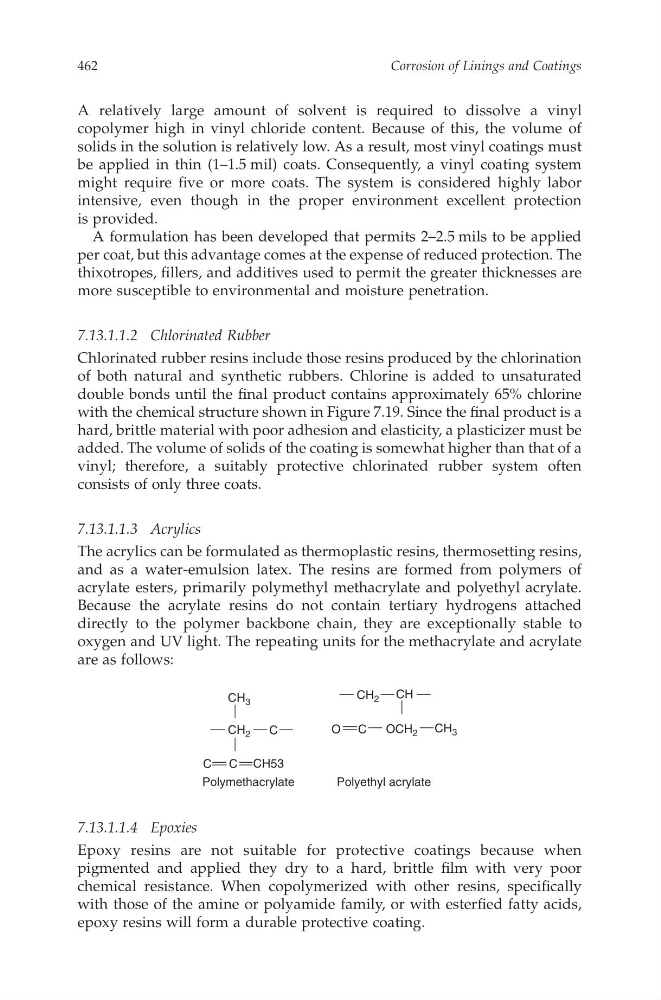
acrylate esters, primarilyp olymethyl methacrylate and polyethyl acrylate.
Because the acrylate resins do notc ontain tertiary hydrogens attached
directly to the polymer backbone chain,t hey are exceptionally stable to
oxygen and UV light.The repeating units forthe methacrylate and acrylate
are as follows:
CH 3
CH 2
CH 2
OCH 2
CH
CH 3
C
C
C CH53
C
O
Polymethacrylate
Polyethyl acrylate
7.13.1.1.4 Epoxies
Epoxyr esinsa re nots uitablef or protective coatings becausew hen
pigmented and applied they dry to ah ard, brittle film with very poor
chemical resistance. When copolymerized with other resins, specifically
with those of the amine or polyamide family,o rw ith esterfied fatty acids,
epoxy resins willf orm ad urablep rotective coating.
Corrosion of Linings and Coatings
462
CAT8247—CHAPTER 7—17/10/2006—15:03—TRGANESH—XMLM ODEL B–pp. 403–485
copolymer high in vinyl chloride content. Because of this,t he volume of
solidsinthe solution is relatively low.Asaresult, mostvinyl coatings must
be applied in thin (1–1.5 mil) coats. Consequently,avinyl coating system
might requirefi ve or more coats. The system is considered highly labor
intensive, even thoughi nt he proper environment excellentp rotection
is provided.
Af ormulation has been developed that permits 2–2.5 mils to be applied
per coat, but this advantagecomes at the expense of reduced protection. The
thixotropes, fillers, and additives used to permit the greater thicknesses are
more susceptiblet oe nvironmental and moisture penetration.
7.13.1.1.2 Chlorinated Rubber
Chlorinated rubber resins include those resins produced by the chlorination
of both natural and synthetic rubbers. Chlorine is added to unsaturated
doubleb ondsu ntil the finalp roduct containsa pproximately 65% chlorine
with the chemical structure shown in Figure 7.19.Since the final product is a
hard, brittle material with poor adhesion and elasticity,aplasticizer must be
added. The volume of solidsofthe coating is somewhat higher than that of a
vinyl; therefore, as uitably protective chlorinated rubbers ystem often
consists of only three coats.
7.13.1.1.3 Acrylics
The acrylics can be formulated as thermoplastic resins, thermosetting resins,
and as aw ater-emulsion latex. The resins aref ormed from polymers of
acrylate esters, primarilyp olymethyl methacrylate and polyethyl acrylate.
Because the acrylate resins do notc ontain tertiary hydrogens attached
directly to the polymer backbone chain,t hey are exceptionally stable to
oxygen and UV light.The repeating units forthe methacrylate and acrylate
are as follows:
CH 3
CH 2
CH 2
OCH 2
CH
CH 3
C
C
C CH53
C
O
Polymethacrylate
Polyethyl acrylate
7.13.1.1.4 Epoxies
Epoxyr esinsa re nots uitablef or protective coatings becausew hen
pigmented and applied they dry to ah ard, brittle film with very poor
chemical resistance. When copolymerized with other resins, specifically
with those of the amine or polyamide family,o rw ith esterfied fatty acids,
epoxy resins willf orm ad urablep rotective coating.
Corrosion of Linings and Coatings
462
CAT8247—CHAPTER 7—17/10/2006—15:03—TRGANESH—XMLM ODEL B–pp. 403–485