

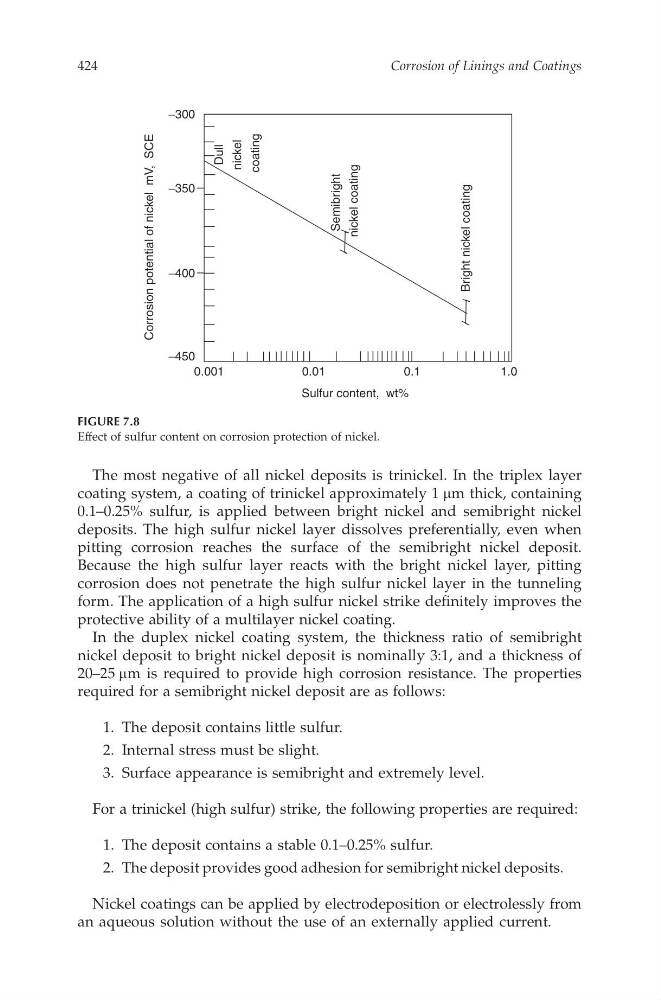
The most negative of all nickel deposits is trinickel. In the triplex layer
coating system, ac oating of trinickela pproximately 1 m mt hick, containing
0.1–0.25% sulfur,i sa pplied betweenb right nickela nd semibright nickel
deposits. The high sulfur nickel layer dissolves preferentially,e ven when
pitting corrosion reaches the surfaceo ft he semibright nickeld eposit.
Because the highs ulfur layer reacts with the bright nickel layer,p itting
corrosion does not penetrate the highs ulfur nickel layer in the tunneling
form.T he application of ah igh sulfur nickel strike definitely improves the
protective ability of am ultilayernickelc oating.
In the duplexn ickelc oating system, the thickness ratio of semibright
nickeld eposit to bright nickeld eposit is nominally 3:1, and at hickness of
20–25 m mi sr equired to provide high corrosion resistance. The properties
required for as emibright nickeld epositare as follows:
1. The deposit containsl ittle sulfur.
2. Internals tress mustbes light.
3. Surface appearance is semibright and extremely level.
For at rinickel (high sulfur) strike, the following properties are required:
1. The deposit containsas table 0.1–0.25% sulfur.
2. The deposit provides good adhesion for semibright nickel deposits.
Nickel coatings can be appliedb ye lectrodepositiono re lectrolessly from
an aqueous solutionw ithout the use of an externally applied current.
− 300
− 350
− 400
− 450
Dull nickel coating
Semibright nickel coating
Bright nickel
coating
0.001
0.01
0.1
1.0
Sulfur content, wt%
Corrosion potential of nickel
mV,
SCE
FIGURE 7.8
Effect of sulfur content on corrosion protection of nickel.
Corrosion of Linings and Coatings
424
CAT8247—CHAPTER 7—17/10/2006—15:02—TRGANESH—XMLM ODEL B–pp. 403–485
coating system, ac oating of trinickela pproximately 1 m mt hick, containing
0.1–0.25% sulfur,i sa pplied betweenb right nickela nd semibright nickel
deposits. The high sulfur nickel layer dissolves preferentially,e ven when
pitting corrosion reaches the surfaceo ft he semibright nickeld eposit.
Because the highs ulfur layer reacts with the bright nickel layer,p itting
corrosion does not penetrate the highs ulfur nickel layer in the tunneling
form.T he application of ah igh sulfur nickel strike definitely improves the
protective ability of am ultilayernickelc oating.
In the duplexn ickelc oating system, the thickness ratio of semibright
nickeld eposit to bright nickeld eposit is nominally 3:1, and at hickness of
20–25 m mi sr equired to provide high corrosion resistance. The properties
required for as emibright nickeld epositare as follows:
1. The deposit containsl ittle sulfur.
2. Internals tress mustbes light.
3. Surface appearance is semibright and extremely level.
For at rinickel (high sulfur) strike, the following properties are required:
1. The deposit containsas table 0.1–0.25% sulfur.
2. The deposit provides good adhesion for semibright nickel deposits.
Nickel coatings can be appliedb ye lectrodepositiono re lectrolessly from
an aqueous solutionw ithout the use of an externally applied current.
− 300
− 350
− 400
− 450
Dull nickel coating
Semibright nickel coating
Bright nickel
coating
0.001
0.01
0.1
1.0
Sulfur content, wt%
Corrosion potential of nickel
mV,
SCE
FIGURE 7.8
Effect of sulfur content on corrosion protection of nickel.
Corrosion of Linings and Coatings
424
CAT8247—CHAPTER 7—17/10/2006—15:02—TRGANESH—XMLM ODEL B–pp. 403–485