

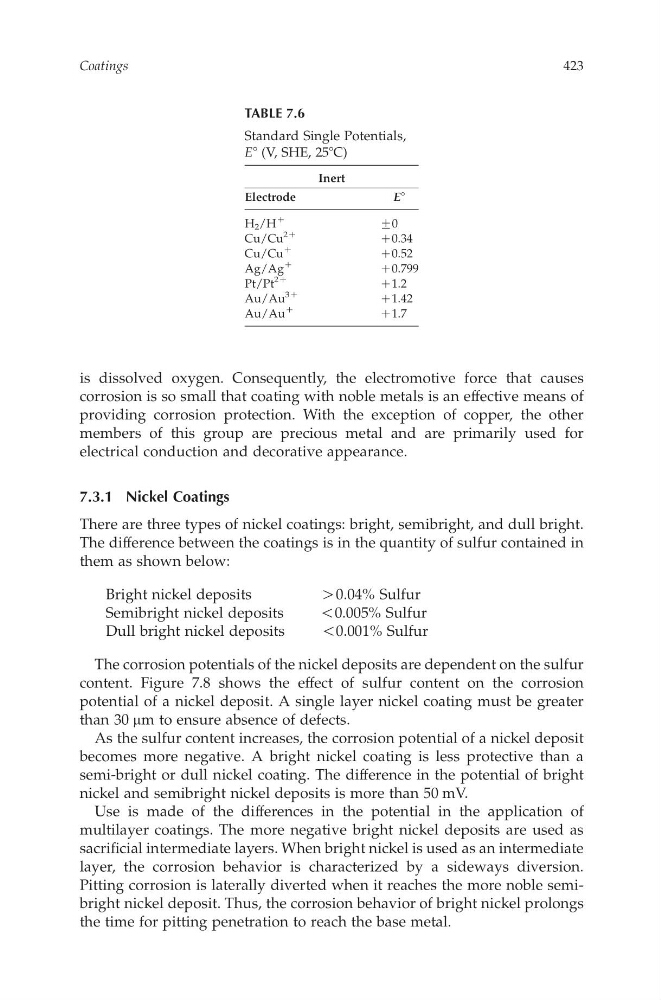
is dissolved oxygen. Consequently,t he electromotive force that causes
corrosion is so smallthat coating with noblemetals is an effective means of
providing corrosion protection. With the exception of copper,t he other
members of this group are precious metal and arep rimarilyu sed for
electrical conductionand decorative appearance.
7.3.1 Nickel Coatings
There arethree types of nickelcoatings: bright, semibright, and dull bright.
The difference between the coatings is in the quantity of sulfur containedin
them as shown below:
Bright nickeld eposits
O 0.04% Sulfur
Semibright nickel deposits
! 0.005% Sulfur
Dull bright nickel deposits
! 0.001% Sulfur
The corrosion potentials of the nickel deposits aredependentonthe sulfur
content. Figure 7.8 shows the effect of sulfur contento nt he corrosion
potential of an ickel deposit. As ingle layer nickel coating must be greater
than 30 m mt oe nsure absence of defects.
As the sulfur content increases, the corrosionpotential of anickel deposit
becomes more negative. Ab right nickelc oating is less protective than a
semi-bright or dull nickel coating. The difference in the potential of bright
nickel and semibright nickel deposits is more than 50 mV.
Use is made of the differences in the potential in the application of
multilayerc oatings. The more negative bright nickel deposits are used as
sacrificial intermediate layers. When bright nickel is used as an intermediate
layer,t he corrosion behavior is characterized by as ideways diversion.
Pitting corrosioni sl aterally diverted when it reaches the more nobles emibright nickel deposit. Thus, the corrosionbehavior of bright nickel prolongs
the time for pitting penetrationtor each the basem etal.
TABLE 7.6
Standard Single Potentials,
E 8 (V,S HE, 258 C)
Inert
Electrode
E 8
H 2 /H
C
G 0
Cu/Cu
2 C
C 0.34
Cu/Cu
C
C 0.52
Ag/Ag
C
C 0.799
Pt/Pt
2 C
C 1.2
Au/Au
3 C
C 1.42
Au/Au
C
C 1.7
Coatings
423
CAT8247—CHAPTER 7—17/10/2006—15:02—TRGANESH—XMLM ODEL B–pp. 403–485
corrosion is so smallthat coating with noblemetals is an effective means of
providing corrosion protection. With the exception of copper,t he other
members of this group are precious metal and arep rimarilyu sed for
electrical conductionand decorative appearance.
7.3.1 Nickel Coatings
There arethree types of nickelcoatings: bright, semibright, and dull bright.
The difference between the coatings is in the quantity of sulfur containedin
them as shown below:
Bright nickeld eposits
O 0.04% Sulfur
Semibright nickel deposits
! 0.005% Sulfur
Dull bright nickel deposits
! 0.001% Sulfur
The corrosion potentials of the nickel deposits aredependentonthe sulfur
content. Figure 7.8 shows the effect of sulfur contento nt he corrosion
potential of an ickel deposit. As ingle layer nickel coating must be greater
than 30 m mt oe nsure absence of defects.
As the sulfur content increases, the corrosionpotential of anickel deposit
becomes more negative. Ab right nickelc oating is less protective than a
semi-bright or dull nickel coating. The difference in the potential of bright
nickel and semibright nickel deposits is more than 50 mV.
Use is made of the differences in the potential in the application of
multilayerc oatings. The more negative bright nickel deposits are used as
sacrificial intermediate layers. When bright nickel is used as an intermediate
layer,t he corrosion behavior is characterized by as ideways diversion.
Pitting corrosioni sl aterally diverted when it reaches the more nobles emibright nickel deposit. Thus, the corrosionbehavior of bright nickel prolongs
the time for pitting penetrationtor each the basem etal.
TABLE 7.6
Standard Single Potentials,
E 8 (V,S HE, 258 C)
Inert
Electrode
E 8
H 2 /H
C
G 0
Cu/Cu
2 C
C 0.34
Cu/Cu
C
C 0.52
Ag/Ag
C
C 0.799
Pt/Pt
2 C
C 1.2
Au/Au
3 C
C 1.42
Au/Au
C
C 1.7
Coatings
423
CAT8247—CHAPTER 7—17/10/2006—15:02—TRGANESH—XMLM ODEL B–pp. 403–485