

374
17 Environmental Flow Definition and Management: A Case Study …
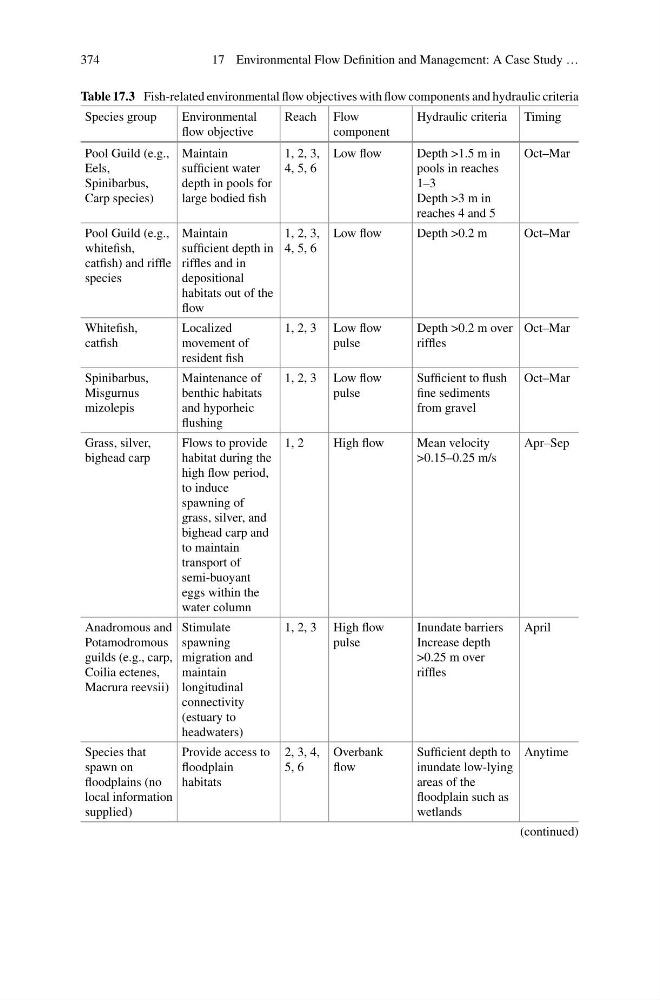
Table 17.3 Fish-related environmental flow objectives with flow components and hydraulic criteria
Species group
Environmental
flow objective
Reach Flow
component
Hydraulic criteria Timing
Pool Guild (e.g.,
Eels,
Spinibarbus,
Carp species)
Maintain
sufficient water
depth in pools for
large bodied fish
1, 2, 3,
4, 5, 6
Low flow
Depth >1.5 m in
pools in reaches
1–3
Depth >3 m in
reaches 4 and 5
Oct–Mar
Pool Guild (e.g.,
whitefish,
catfish) and riffle
species
Maintain
sufficient depth in
riffles and in
depositional
habitats out of the
flow
1, 2, 3,
4, 5, 6
Low flow
Depth >0.2 m
Oct–Mar
Whitefish,
catfish
Localized
movement of
resident fish
1, 2, 3 Low flow
pulse
Depth >0.2 m over
riffles
Oct–Mar
Spinibarbus,
Misgurnus
mizolepis
Maintenance of
benthic habitats
and hyporheic
flushing
1, 2, 3 Low flow
pulse
Sufficient to flush
fine sediments
from gravel
Oct–Mar
Grass, silver,
bighead carp
Flows to provide
habitat during the
high flow period,
to induce
spawning of
grass, silver, and
bighead carp and
to maintain
transport of
semi-buoyant
eggs within the
water column
1, 2
High flow
Mean velocity
>0.15–0.25 m/s
Apr–Sep
Anadromous and
Potamodromous
guilds (e.g., carp,
Coilia ectenes,
Macrura reevsii)
Stimulate
spawning
migration and
maintain
longitudinal
connectivity
(estuary to
headwaters)
1, 2, 3 High flow
pulse
Inundate barriers
Increase depth
>0.25 m over
riffles
April
Species that
spawn on
floodplains (no
local information
supplied)
Provide access to
floodplain
habitats
2, 3, 4,
5, 6
Overbank
flow
Sufficient depth to
inundate low-lying
areas of the
floodplain such as
wetlands
Anytime
(continued)
17 Environmental Flow Definition and Management: A Case Study …
Table 17.3 Fish-related environmental flow objectives with flow components and hydraulic criteria
Species group
Environmental
flow objective
Reach Flow
component
Hydraulic criteria Timing
Pool Guild (e.g.,
Eels,
Spinibarbus,
Carp species)
Maintain
sufficient water
depth in pools for
large bodied fish
1, 2, 3,
4, 5, 6
Low flow
Depth >1.5 m in
pools in reaches
1–3
Depth >3 m in
reaches 4 and 5
Oct–Mar
Pool Guild (e.g.,
whitefish,
catfish) and riffle
species
Maintain
sufficient depth in
riffles and in
depositional
habitats out of the
flow
1, 2, 3,
4, 5, 6
Low flow
Depth >0.2 m
Oct–Mar
Whitefish,
catfish
Localized
movement of
resident fish
1, 2, 3 Low flow
pulse
Depth >0.2 m over
riffles
Oct–Mar
Spinibarbus,
Misgurnus
mizolepis
Maintenance of
benthic habitats
and hyporheic
flushing
1, 2, 3 Low flow
pulse
Sufficient to flush
fine sediments
from gravel
Oct–Mar
Grass, silver,
bighead carp
Flows to provide
habitat during the
high flow period,
to induce
spawning of
grass, silver, and
bighead carp and
to maintain
transport of
semi-buoyant
eggs within the
water column
1, 2
High flow
Mean velocity
>0.15–0.25 m/s
Apr–Sep
Anadromous and
Potamodromous
guilds (e.g., carp,
Coilia ectenes,
Macrura reevsii)
Stimulate
spawning
migration and
maintain
longitudinal
connectivity
(estuary to
headwaters)
1, 2, 3 High flow
pulse
Inundate barriers
Increase depth
>0.25 m over
riffles
April
Species that
spawn on
floodplains (no
local information
supplied)
Provide access to
floodplain
habitats
2, 3, 4,
5, 6
Overbank
flow
Sufficient depth to
inundate low-lying
areas of the
floodplain such as
wetlands
Anytime
(continued)