

17.3 Environmental Flow Assessment and Water Resources…
375
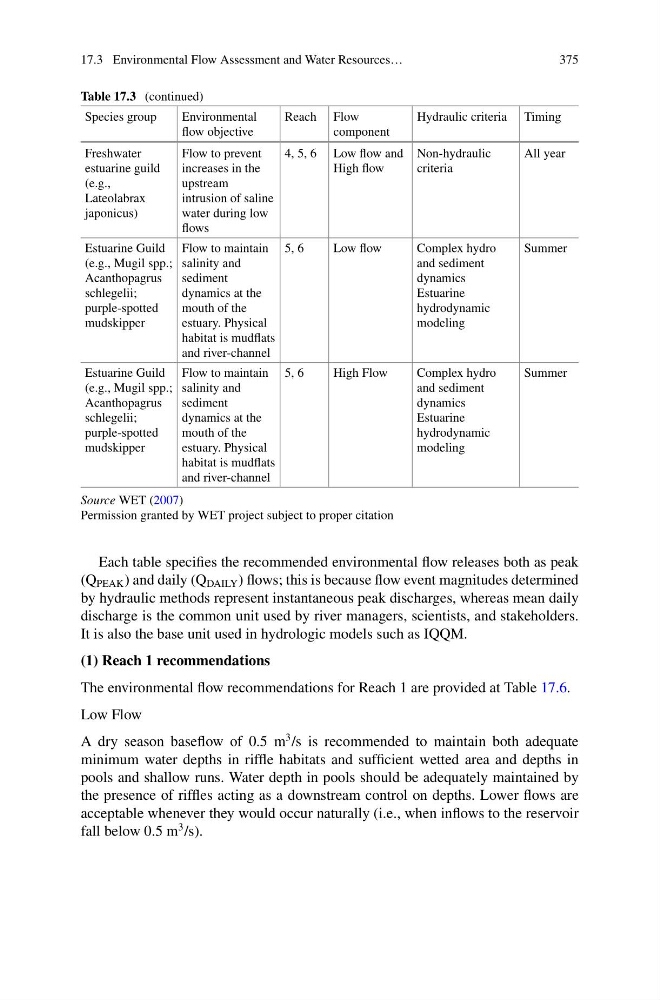
Table 17.3 (continued)
Species group
Environmental
flow objective
Reach Flow
component
Hydraulic criteria Timing
Freshwater
estuarine guild
(e.g.,
Lateolabrax
japonicus)
Flow to prevent
increases in the
upstream
intrusion of saline
water during low
flows
4, 5, 6 Low flow and
High flow
Non-hydraulic
criteria
All year
Estuarine Guild
(e.g., Mugil spp.;
Acanthopagrus
schlegelii;
purple-spotted
mudskipper
Flow to maintain
salinity and
sediment
dynamics at the
mouth of the
estuary. Physical
habitat is mudflats
and river-channel
5, 6
Low flow
Complex hydro
and sediment
dynamics
Estuarine
hydrodynamic
modeling
Summer
Estuarine Guild
(e.g., Mugil spp.;
Acanthopagrus
schlegelii;
purple-spotted
mudskipper
Flow to maintain
salinity and
sediment
dynamics at the
mouth of the
estuary. Physical
habitat is mudflats
and river-channel
5, 6
High Flow
Complex hydro
and sediment
dynamics
Estuarine
hydrodynamic
modeling
Summer
Source WET (2007)
Permission granted by WET project subject to proper citation
Each table specifies the recommended environmental flow releases both as peak
(Q PEAK ) and daily (Q DAILY ) flows; this is because flow event magnitudes determined
by hydraulic methods represent instantaneous peak discharges, whereas mean daily
discharge is the common unit used by river managers, scientists, and stakeholders.
It is also the base unit used in hydrologic models such as IQQM.
(1) Reach 1 recommendations
The environmental flow recommendations for Reach 1 are provided at Table 17.6.
Low Flow
A dry season baseflow of 0.5 m
3 /s is recommended to maintain both adequate
minimum water depths in riffle habitats and sufficient wetted area and depths in
pools and shallow runs. Water depth in pools should be adequately maintained by
the presence of riffles acting as a downstream control on depths. Lower flows are
acceptable whenever they would occur naturally (i.e., when inflows to the reservoir
fall below 0.5 m
3 /s).
375
Table 17.3 (continued)
Species group
Environmental
flow objective
Reach Flow
component
Hydraulic criteria Timing
Freshwater
estuarine guild
(e.g.,
Lateolabrax
japonicus)
Flow to prevent
increases in the
upstream
intrusion of saline
water during low
flows
4, 5, 6 Low flow and
High flow
Non-hydraulic
criteria
All year
Estuarine Guild
(e.g., Mugil spp.;
Acanthopagrus
schlegelii;
purple-spotted
mudskipper
Flow to maintain
salinity and
sediment
dynamics at the
mouth of the
estuary. Physical
habitat is mudflats
and river-channel
5, 6
Low flow
Complex hydro
and sediment
dynamics
Estuarine
hydrodynamic
modeling
Summer
Estuarine Guild
(e.g., Mugil spp.;
Acanthopagrus
schlegelii;
purple-spotted
mudskipper
Flow to maintain
salinity and
sediment
dynamics at the
mouth of the
estuary. Physical
habitat is mudflats
and river-channel
5, 6
High Flow
Complex hydro
and sediment
dynamics
Estuarine
hydrodynamic
modeling
Summer
Source WET (2007)
Permission granted by WET project subject to proper citation
Each table specifies the recommended environmental flow releases both as peak
(Q PEAK ) and daily (Q DAILY ) flows; this is because flow event magnitudes determined
by hydraulic methods represent instantaneous peak discharges, whereas mean daily
discharge is the common unit used by river managers, scientists, and stakeholders.
It is also the base unit used in hydrologic models such as IQQM.
(1) Reach 1 recommendations
The environmental flow recommendations for Reach 1 are provided at Table 17.6.
Low Flow
A dry season baseflow of 0.5 m
3 /s is recommended to maintain both adequate
minimum water depths in riffle habitats and sufficient wetted area and depths in
pools and shallow runs. Water depth in pools should be adequately maintained by
the presence of riffles acting as a downstream control on depths. Lower flows are
acceptable whenever they would occur naturally (i.e., when inflows to the reservoir
fall below 0.5 m
3 /s).