

17.3 Environmental Flow Assessment and Water Resources…
367
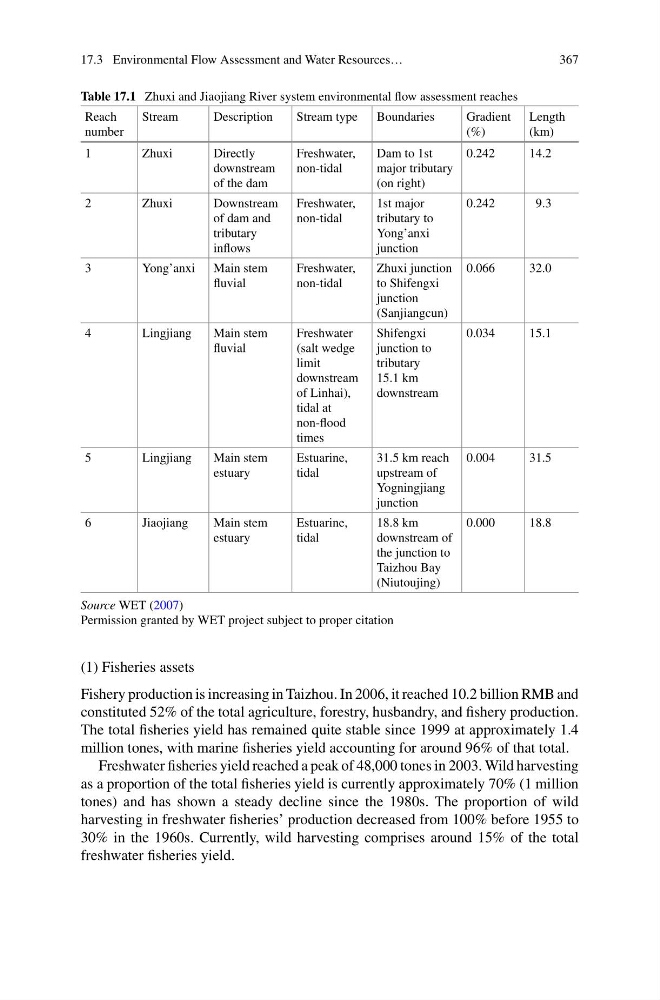
Table 17.1 Zhuxi and Jiaojiang River system environmental flow assessment reaches
Reach
number
Stream
Description
Stream type
Boundaries
Gradient
(%)
Length
(km)
1
Zhuxi
Directly
downstream
of the dam
Freshwater,
non-tidal
Dam to 1st
major tributary
(on right)
0.242
14.2
2
Zhuxi
Downstream
of dam and
tributary
inflows
Freshwater,
non-tidal
1st major
tributary to
Yong’anxi
junction
0.242
9.3
3
Yong’anxi Main stem
fluvial
Freshwater,
non-tidal
Zhuxi junction
to Shifengxi
junction
(Sanjiangcun)
0.066
32.0
4
Lingjiang
Main stem
fluvial
Freshwater
(salt wedge
limit
downstream
of Linhai),
tidal at
non-flood
times
Shifengxi
junction to
tributary
15.1 km
downstream
0.034
15.1
5
Lingjiang
Main stem
estuary
Estuarine,
tidal
31.5 km reach
upstream of
Yogningjiang
junction
0.004
31.5
6
Jiaojiang
Main stem
estuary
Estuarine,
tidal
18.8 km
downstream of
the junction to
Taizhou Bay
(Niutoujing)
0.000
18.8
Source WET (2007)
Permission granted by WET project subject to proper citation
(1) Fisheries assets
Fishery production is increasing in Taizhou. In 2006, it reached 10.2 billion RMB and
constituted 52% of the total agriculture, forestry, husbandry, and fishery production.
The total fisheries yield has remained quite stable since 1999 at approximately 1.4
million tones, with marine fisheries yield accounting for around 96% of that total.
Freshwater fisheries yield reached a peak of 48,000 tones in 2003. Wild harvesting
as a proportion of the total fisheries yield is currently approximately 70% (1 million
tones) and has shown a steady decline since the 1980s. The proportion of wild
harvesting in freshwater fisheries’ production decreased from 100% before 1955 to
30% in the 1960s. Currently, wild harvesting comprises around 15% of the total
freshwater fisheries yield.
367
Table 17.1 Zhuxi and Jiaojiang River system environmental flow assessment reaches
Reach
number
Stream
Description
Stream type
Boundaries
Gradient
(%)
Length
(km)
1
Zhuxi
Directly
downstream
of the dam
Freshwater,
non-tidal
Dam to 1st
major tributary
(on right)
0.242
14.2
2
Zhuxi
Downstream
of dam and
tributary
inflows
Freshwater,
non-tidal
1st major
tributary to
Yong’anxi
junction
0.242
9.3
3
Yong’anxi Main stem
fluvial
Freshwater,
non-tidal
Zhuxi junction
to Shifengxi
junction
(Sanjiangcun)
0.066
32.0
4
Lingjiang
Main stem
fluvial
Freshwater
(salt wedge
limit
downstream
of Linhai),
tidal at
non-flood
times
Shifengxi
junction to
tributary
15.1 km
downstream
0.034
15.1
5
Lingjiang
Main stem
estuary
Estuarine,
tidal
31.5 km reach
upstream of
Yogningjiang
junction
0.004
31.5
6
Jiaojiang
Main stem
estuary
Estuarine,
tidal
18.8 km
downstream of
the junction to
Taizhou Bay
(Niutoujing)
0.000
18.8
Source WET (2007)
Permission granted by WET project subject to proper citation
(1) Fisheries assets
Fishery production is increasing in Taizhou. In 2006, it reached 10.2 billion RMB and
constituted 52% of the total agriculture, forestry, husbandry, and fishery production.
The total fisheries yield has remained quite stable since 1999 at approximately 1.4
million tones, with marine fisheries yield accounting for around 96% of that total.
Freshwater fisheries yield reached a peak of 48,000 tones in 2003. Wild harvesting
as a proportion of the total fisheries yield is currently approximately 70% (1 million
tones) and has shown a steady decline since the 1980s. The proportion of wild
harvesting in freshwater fisheries’ production decreased from 100% before 1955 to
30% in the 1960s. Currently, wild harvesting comprises around 15% of the total
freshwater fisheries yield.