

368
17 Environmental Flow Definition and Management: A Case Study …
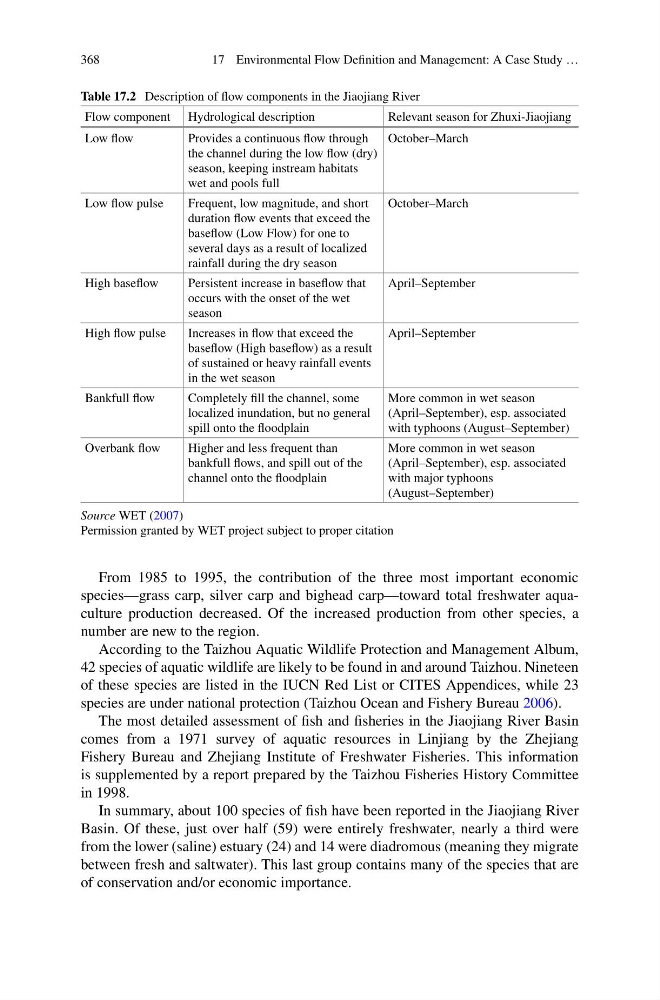
Table 17.2 Description of flow components in the Jiaojiang River
Flow component Hydrological description
Relevant season for Zhuxi-Jiaojiang
Low flow
Provides a continuous flow through
the channel during the low flow (dry)
season, keeping instream habitats
wet and pools full
October–March
Low flow pulse
Frequent, low magnitude, and short
duration flow events that exceed the
baseflow (Low Flow) for one to
several days as a result of localized
rainfall during the dry season
October–March
High baseflow
Persistent increase in baseflow that
occurs with the onset of the wet
season
April–September
High flow pulse
Increases in flow that exceed the
baseflow (High baseflow) as a result
of sustained or heavy rainfall events
in the wet season
April–September
Bankfull flow
Completely fill the channel, some
localized inundation, but no general
spill onto the floodplain
More common in wet season
(April–September), esp. associated
with typhoons (August–September)
Overbank flow
Higher and less frequent than
bankfull flows, and spill out of the
channel onto the floodplain
More common in wet season
(April–September), esp. associated
with major typhoons
(August–September)
Source WET (2007)
Permission granted by WET project subject to proper citation
From 1985 to 1995, the contribution of the three most important economic
species—grass carp, silver carp and bighead carp—toward total freshwater aquaculture production decreased. Of the increased production from other species, a
number are new to the region.
According to the Taizhou Aquatic Wildlife Protection and Management Album,
42 species of aquatic wildlife are likely to be found in and around Taizhou. Nineteen
of these species are listed in the IUCN Red List or CITES Appendices, while 23
species are under national protection (Taizhou Ocean and Fishery Bureau 2006).
The most detailed assessment of fish and fisheries in the Jiaojiang River Basin
comes from a 1971 survey of aquatic resources in Linjiang by the Zhejiang
Fishery Bureau and Zhejiang Institute of Freshwater Fisheries. This information
is supplemented by a report prepared by the Taizhou Fisheries History Committee
in 1998.
In summary, about 100 species of fish have been reported in the Jiaojiang River
Basin. Of these, just over half (59) were entirely freshwater, nearly a third were
from the lower (saline) estuary (24) and 14 were diadromous (meaning they migrate
between fresh and saltwater). This last group contains many of the species that are
of conservation and/or economic importance.
17 Environmental Flow Definition and Management: A Case Study …
Table 17.2 Description of flow components in the Jiaojiang River
Flow component Hydrological description
Relevant season for Zhuxi-Jiaojiang
Low flow
Provides a continuous flow through
the channel during the low flow (dry)
season, keeping instream habitats
wet and pools full
October–March
Low flow pulse
Frequent, low magnitude, and short
duration flow events that exceed the
baseflow (Low Flow) for one to
several days as a result of localized
rainfall during the dry season
October–March
High baseflow
Persistent increase in baseflow that
occurs with the onset of the wet
season
April–September
High flow pulse
Increases in flow that exceed the
baseflow (High baseflow) as a result
of sustained or heavy rainfall events
in the wet season
April–September
Bankfull flow
Completely fill the channel, some
localized inundation, but no general
spill onto the floodplain
More common in wet season
(April–September), esp. associated
with typhoons (August–September)
Overbank flow
Higher and less frequent than
bankfull flows, and spill out of the
channel onto the floodplain
More common in wet season
(April–September), esp. associated
with major typhoons
(August–September)
Source WET (2007)
Permission granted by WET project subject to proper citation
From 1985 to 1995, the contribution of the three most important economic
species—grass carp, silver carp and bighead carp—toward total freshwater aquaculture production decreased. Of the increased production from other species, a
number are new to the region.
According to the Taizhou Aquatic Wildlife Protection and Management Album,
42 species of aquatic wildlife are likely to be found in and around Taizhou. Nineteen
of these species are listed in the IUCN Red List or CITES Appendices, while 23
species are under national protection (Taizhou Ocean and Fishery Bureau 2006).
The most detailed assessment of fish and fisheries in the Jiaojiang River Basin
comes from a 1971 survey of aquatic resources in Linjiang by the Zhejiang
Fishery Bureau and Zhejiang Institute of Freshwater Fisheries. This information
is supplemented by a report prepared by the Taizhou Fisheries History Committee
in 1998.
In summary, about 100 species of fish have been reported in the Jiaojiang River
Basin. Of these, just over half (59) were entirely freshwater, nearly a third were
from the lower (saline) estuary (24) and 14 were diadromous (meaning they migrate
between fresh and saltwater). This last group contains many of the species that are
of conservation and/or economic importance.