

356
16 Integrated Urban and Rural Water Affair Management Reform …
0%
5%
10%
15%
20%
25%
30%
35%
0
0.2
0.4
0.6
0.8
1
1.2
1.4
2002 2003 2004 2005 2006 2007 2008 2009 2010 2011 2012 2013 2014 2015 2016 2017
recycled water supply (billion m3)
environmental water use(billion m3)
percentage of recycled water supply in total water supply
percentage of environmental use in total water use
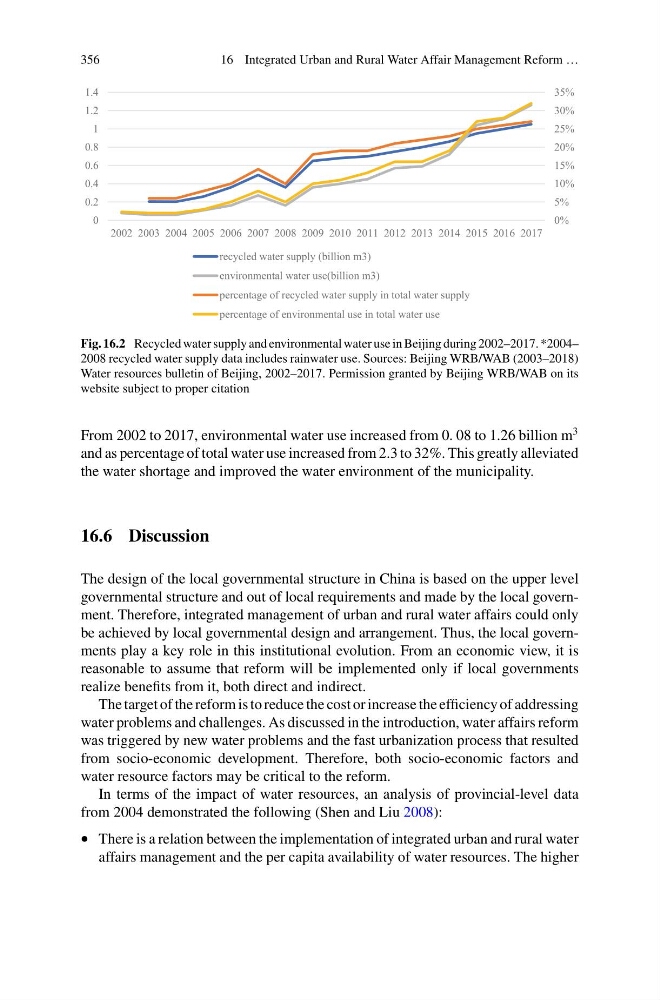
Fig. 16.2 Recycled water supply and environmental water use in Beijing during 2002–2017. *2004–
2008 recycled water supply data includes rainwater use. Sources: Beijing WRB/WAB (2003–2018)
Water resources bulletin of Beijing, 2002–2017. Permission granted by Beijing WRB/WAB on its
website subject to proper citation
From 2002 to 2017, environmental water use increased from 0. 08 to 1.26 billion m
3
and as percentage of total water use increased from 2.3 to 32%. This greatly alleviated
the water shortage and improved the water environment of the municipality.
16.6 Discussion
The design of the local governmental structure in China is based on the upper level
governmental structure and out of local requirements and made by the local government. Therefore, integrated management of urban and rural water affairs could only
be achieved by local governmental design and arrangement. Thus, the local governments play a key role in this institutional evolution. From an economic view, it is
reasonable to assume that reform will be implemented only if local governments
realize benefits from it, both direct and indirect.
The target of the reform is to reduce the cost or increase the efficiency of addressing
water problems and challenges. As discussed in the introduction, water affairs reform
was triggered by new water problems and the fast urbanization process that resulted
from socio-economic development. Therefore, both socio-economic factors and
water resource factors may be critical to the reform.
In terms of the impact of water resources, an analysis of provincial-level data
from 2004 demonstrated the following (Shen and Liu 2008):
• There is a relation between the implementation of integrated urban and rural water
affairs management and the per capita availability of water resources. The higher
16 Integrated Urban and Rural Water Affair Management Reform …
0%
5%
10%
15%
20%
25%
30%
35%
0
0.2
0.4
0.6
0.8
1
1.2
1.4
2002 2003 2004 2005 2006 2007 2008 2009 2010 2011 2012 2013 2014 2015 2016 2017
recycled water supply (billion m3)
environmental water use(billion m3)
percentage of recycled water supply in total water supply
percentage of environmental use in total water use
Fig. 16.2 Recycled water supply and environmental water use in Beijing during 2002–2017. *2004–
2008 recycled water supply data includes rainwater use. Sources: Beijing WRB/WAB (2003–2018)
Water resources bulletin of Beijing, 2002–2017. Permission granted by Beijing WRB/WAB on its
website subject to proper citation
From 2002 to 2017, environmental water use increased from 0. 08 to 1.26 billion m
3
and as percentage of total water use increased from 2.3 to 32%. This greatly alleviated
the water shortage and improved the water environment of the municipality.
16.6 Discussion
The design of the local governmental structure in China is based on the upper level
governmental structure and out of local requirements and made by the local government. Therefore, integrated management of urban and rural water affairs could only
be achieved by local governmental design and arrangement. Thus, the local governments play a key role in this institutional evolution. From an economic view, it is
reasonable to assume that reform will be implemented only if local governments
realize benefits from it, both direct and indirect.
The target of the reform is to reduce the cost or increase the efficiency of addressing
water problems and challenges. As discussed in the introduction, water affairs reform
was triggered by new water problems and the fast urbanization process that resulted
from socio-economic development. Therefore, both socio-economic factors and
water resource factors may be critical to the reform.
In terms of the impact of water resources, an analysis of provincial-level data
from 2004 demonstrated the following (Shen and Liu 2008):
• There is a relation between the implementation of integrated urban and rural water
affairs management and the per capita availability of water resources. The higher