

1.1 Geographical Aspects
5
Among the outflowing rivers, those originating on the Qinghai–Tibet Plateau,
including the Yangtze River, the Yellow River, the Lancang (Mekong) River, the
Nujiang River, and the Yarlung Zangbo River, are the main great rivers in Asia.
These rivers have distant sources and long courses with vast amounts of runoff and
tremendous potential for hydropower resources. The Helongjiang, Liao, Hai-Luan,
Huai, Pearl, and Yuanjiang Rivers, among others, initiate from the Inner Mongolia
Plateau, the Loess Plateau, the west Henan Mountains, or the Yunnan–Guizhou
Plateau. The common feature of the inland rivers is that the runoff is produced in
the mountains and drains in the hillside plains. Within the inland river basins, there
is about 1,600,000 km
2 of land without runoff (Dept. of Water Resources, MWR
1992).
China is also a country with a number of lakes. There are about 2,865 lakes with
water surface areas larger than 1 km
2 , for a total lake area of 78,000 km
2 . Among
them, 1,594 are freshwater lakes, 945 are saltwater lakes, and 166 are salt lakes, with
160 others (MWR, National Bureau of Statistics 2013).
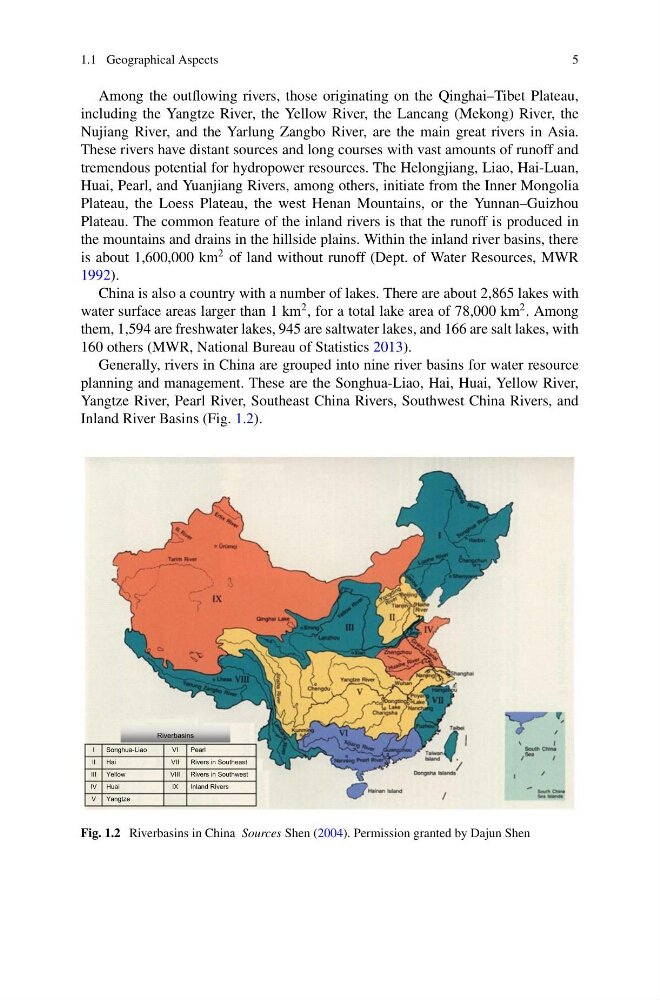
Generally, rivers in China are grouped into nine river basins for water resource
planning and management. These are the Songhua-Liao, Hai, Huai, Yellow River,
Yangtze River, Pearl River, Southeast China Rivers, Southwest China Rivers, and
Inland River Basins (Fig. 1.2).
Riverbasins
I
Songhua-Liao
VI
Pearl
II
Hai
VII
Rivers in Southeast
III
Yellow
VIII
Rivers in Southwest
IV Huai
IX
Inland Rivers
V
Yangtze
Fig. 1.2 Riverbasins in China Sources Shen (2004). Permission granted by Dajun Shen
5
Among the outflowing rivers, those originating on the Qinghai–Tibet Plateau,
including the Yangtze River, the Yellow River, the Lancang (Mekong) River, the
Nujiang River, and the Yarlung Zangbo River, are the main great rivers in Asia.
These rivers have distant sources and long courses with vast amounts of runoff and
tremendous potential for hydropower resources. The Helongjiang, Liao, Hai-Luan,
Huai, Pearl, and Yuanjiang Rivers, among others, initiate from the Inner Mongolia
Plateau, the Loess Plateau, the west Henan Mountains, or the Yunnan–Guizhou
Plateau. The common feature of the inland rivers is that the runoff is produced in
the mountains and drains in the hillside plains. Within the inland river basins, there
is about 1,600,000 km
2 of land without runoff (Dept. of Water Resources, MWR
1992).
China is also a country with a number of lakes. There are about 2,865 lakes with
water surface areas larger than 1 km
2 , for a total lake area of 78,000 km
2 . Among
them, 1,594 are freshwater lakes, 945 are saltwater lakes, and 166 are salt lakes, with
160 others (MWR, National Bureau of Statistics 2013).
Generally, rivers in China are grouped into nine river basins for water resource
planning and management. These are the Songhua-Liao, Hai, Huai, Yellow River,
Yangtze River, Pearl River, Southeast China Rivers, Southwest China Rivers, and
Inland River Basins (Fig. 1.2).
Riverbasins
I
Songhua-Liao
VI
Pearl
II
Hai
VII
Rivers in Southeast
III
Yellow
VIII
Rivers in Southwest
IV Huai
IX
Inland Rivers
V
Yangtze
Fig. 1.2 Riverbasins in China Sources Shen (2004). Permission granted by Dajun Shen