

4
1 Physical Settings and Water Challenges
individual catchment areas of more than 50 km
2 , and these have a combined length of
15,085,000 km. There are also 22,909 rivers with individual catchment areas of more
than 100 km
2 and a combined length of 1,114,600 km; 2,221 rivers with individual
catchment areas of more than 1,000 km
2 and a combined length of 386,500 km; and
228 rivers with individual catchment areas of more than 10,000 km
2 and a combined
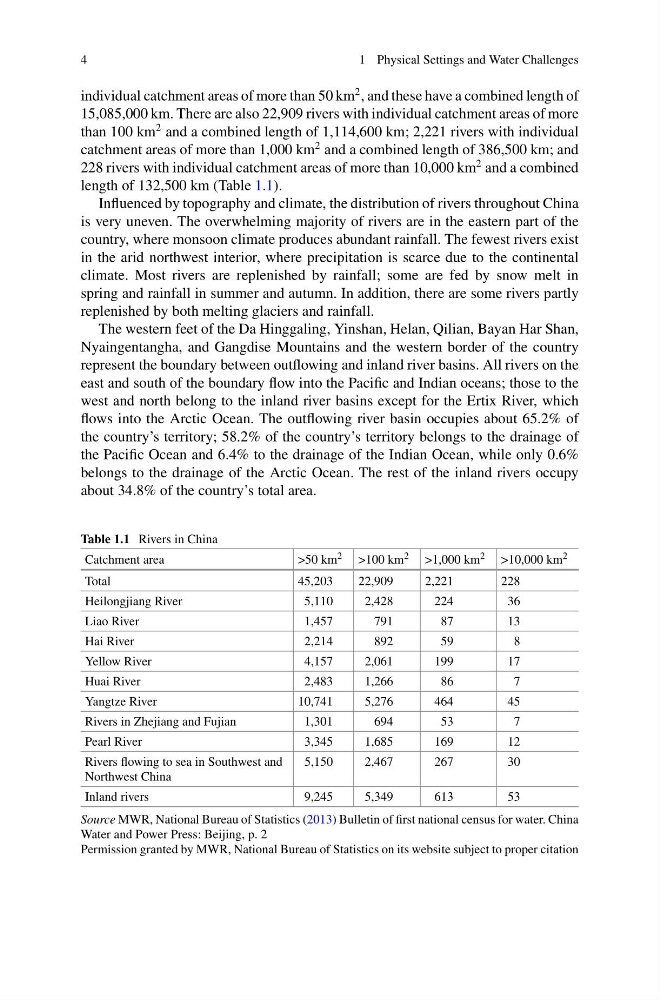
length of 132,500 km (Table 1.1).
Influenced by topography and climate, the distribution of rivers throughout China
is very uneven. The overwhelming majority of rivers are in the eastern part of the
country, where monsoon climate produces abundant rainfall. The fewest rivers exist
in the arid northwest interior, where precipitation is scarce due to the continental
climate. Most rivers are replenished by rainfall; some are fed by snow melt in
spring and rainfall in summer and autumn. In addition, there are some rivers partly
replenished by both melting glaciers and rainfall.
The western feet of the Da Hinggaling, Yinshan, Helan, Qilian, Bayan Har Shan,
Nyaingentangha, and Gangdise Mountains and the western border of the country
represent the boundary between outflowing and inland river basins. All rivers on the
east and south of the boundary flow into the Pacific and Indian oceans; those to the
west and north belong to the inland river basins except for the Ertix River, which
flows into the Arctic Ocean. The outflowing river basin occupies about 65.2% of
the country’s territory; 58.2% of the country’s territory belongs to the drainage of
the Pacific Ocean and 6.4% to the drainage of the Indian Ocean, while only 0.6%
belongs to the drainage of the Arctic Ocean. The rest of the inland rivers occupy
about 34.8% of the country’s total area.
Table 1.1 Rivers in China
Catchment area
>50 km 2 >100 km 2 >1,000 km 2 >10,000 km 2
Total
45,203
22,909
2,221
228
Heilongjiang River
5,110
2,428
224
36
Liao River
1,457
791
87
13
Hai River
2,214
892
59
8
Yellow River
4,157
2,061
199
17
Huai River
2,483
1,266
86
7
Yangtze River
10,741
5,276
464
45
Rivers in Zhejiang and Fujian
1,301
694
53
7
Pearl River
3,345
1,685
169
12
Rivers flowing to sea in Southwest and
Northwest China
5,150
2,467
267
30
Inland rivers
9,245
5,349
613
53
Source MWR, National Bureau of Statistics (2013) Bulletin of first national census for water. China
Water and Power Press: Beijing, p. 2
Permission granted by MWR, National Bureau of Statistics on its website subject to proper citation
1 Physical Settings and Water Challenges
individual catchment areas of more than 50 km
2 , and these have a combined length of
15,085,000 km. There are also 22,909 rivers with individual catchment areas of more
than 100 km
2 and a combined length of 1,114,600 km; 2,221 rivers with individual
catchment areas of more than 1,000 km
2 and a combined length of 386,500 km; and
228 rivers with individual catchment areas of more than 10,000 km
2 and a combined
length of 132,500 km (Table 1.1).
Influenced by topography and climate, the distribution of rivers throughout China
is very uneven. The overwhelming majority of rivers are in the eastern part of the
country, where monsoon climate produces abundant rainfall. The fewest rivers exist
in the arid northwest interior, where precipitation is scarce due to the continental
climate. Most rivers are replenished by rainfall; some are fed by snow melt in
spring and rainfall in summer and autumn. In addition, there are some rivers partly
replenished by both melting glaciers and rainfall.
The western feet of the Da Hinggaling, Yinshan, Helan, Qilian, Bayan Har Shan,
Nyaingentangha, and Gangdise Mountains and the western border of the country
represent the boundary between outflowing and inland river basins. All rivers on the
east and south of the boundary flow into the Pacific and Indian oceans; those to the
west and north belong to the inland river basins except for the Ertix River, which
flows into the Arctic Ocean. The outflowing river basin occupies about 65.2% of
the country’s territory; 58.2% of the country’s territory belongs to the drainage of
the Pacific Ocean and 6.4% to the drainage of the Indian Ocean, while only 0.6%
belongs to the drainage of the Arctic Ocean. The rest of the inland rivers occupy
about 34.8% of the country’s total area.
Table 1.1 Rivers in China
Catchment area
>50 km 2 >100 km 2 >1,000 km 2 >10,000 km 2
Total
45,203
22,909
2,221
228
Heilongjiang River
5,110
2,428
224
36
Liao River
1,457
791
87
13
Hai River
2,214
892
59
8
Yellow River
4,157
2,061
199
17
Huai River
2,483
1,266
86
7
Yangtze River
10,741
5,276
464
45
Rivers in Zhejiang and Fujian
1,301
694
53
7
Pearl River
3,345
1,685
169
12
Rivers flowing to sea in Southwest and
Northwest China
5,150
2,467
267
30
Inland rivers
9,245
5,349
613
53
Source MWR, National Bureau of Statistics (2013) Bulletin of first national census for water. China
Water and Power Press: Beijing, p. 2
Permission granted by MWR, National Bureau of Statistics on its website subject to proper citation