

68
– Discouragement of turtle nesting in illuminated area
– Flying pattern of birds
• Disruption of plants for seasonal variation
The circadian clock (24-hour day/night cycle) influences physiologic processes
in almost all organisms, which include the following (Chepesiuk 2009):
• Brain wave patterns
• Hormone production
• Cell regulation
• Other biologic activities
Circadian clock disruption is linked to many medical disorders in humans, which
includes the following (Chepesiuk 2009):
• Depression
• Sleep disorder
• Cardiovascular disease
• Cancer
The subsequent section provides fundamentals of optics that affect environment
and humans.
2.5.1 Basic Behavior of Light
Light can be explained in three ways, which seems to be mutually incompatible:
1. Photons: In photon theory, light is considered as minute particles of energy moving in space at high speeds. This explanation is useful when considering the
quantity of light received by a receptor or sensor.
2. Waves: In this theory, light is considered as ripples through space. This explanation is useful when explaining formation of spectrum of colors.
3. Rays: In this theory, light is considered as a path of motion of a single hypothetical photon. This explanation is helpful when defining the concept of visibility as
well as explaining lenses.
2.5.2 Frequency
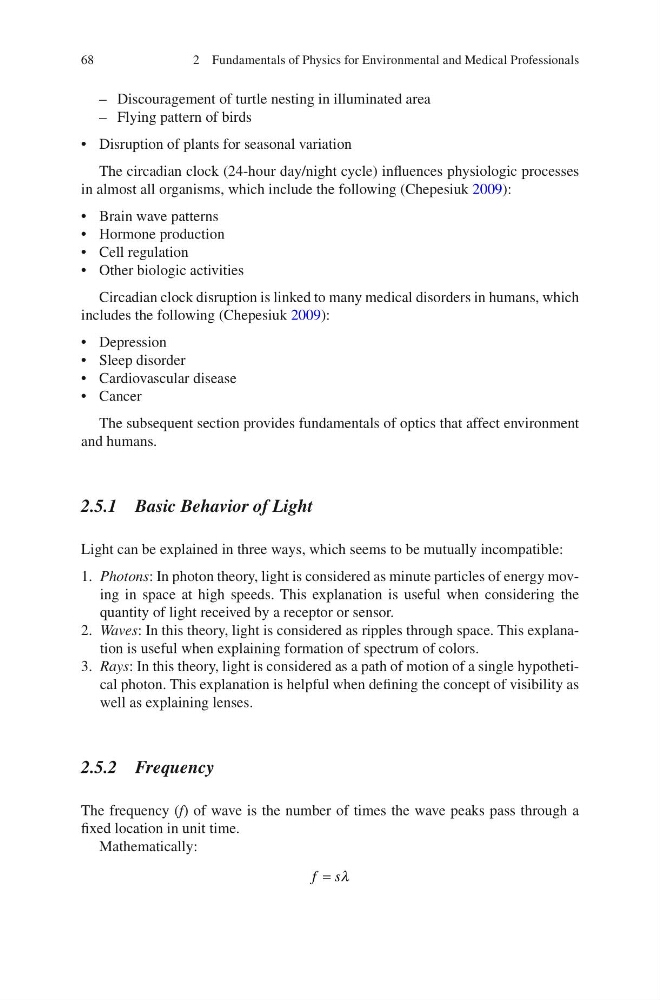
The frequency (f) of wave is the number of times the wave peaks pass through a
fixed location in unit time.
Mathematically:
f s
= λ
2 Fundamentals of Physics for Environmental and Medical Professionals
– Discouragement of turtle nesting in illuminated area
– Flying pattern of birds
• Disruption of plants for seasonal variation
The circadian clock (24-hour day/night cycle) influences physiologic processes
in almost all organisms, which include the following (Chepesiuk 2009):
• Brain wave patterns
• Hormone production
• Cell regulation
• Other biologic activities
Circadian clock disruption is linked to many medical disorders in humans, which
includes the following (Chepesiuk 2009):
• Depression
• Sleep disorder
• Cardiovascular disease
• Cancer
The subsequent section provides fundamentals of optics that affect environment
and humans.
2.5.1 Basic Behavior of Light
Light can be explained in three ways, which seems to be mutually incompatible:
1. Photons: In photon theory, light is considered as minute particles of energy moving in space at high speeds. This explanation is useful when considering the
quantity of light received by a receptor or sensor.
2. Waves: In this theory, light is considered as ripples through space. This explanation is useful when explaining formation of spectrum of colors.
3. Rays: In this theory, light is considered as a path of motion of a single hypothetical photon. This explanation is helpful when defining the concept of visibility as
well as explaining lenses.
2.5.2 Frequency
The frequency (f) of wave is the number of times the wave peaks pass through a
fixed location in unit time.
Mathematically:
f s
= λ
2 Fundamentals of Physics for Environmental and Medical Professionals