

69
Where
λ = wavelength
s = speed of wave
2.5.3 Wavelengths and Colors
Wavelength of light corresponds to a spectral color. Wavelengths from 700 to
1000 nm are called infrared, and wavelengths from 100 to 400 nm are called ultraviolet, which are not part of visible spectrum.
Visible light spectrum (range of wavelengths visible to humans) corresponds to
the range of electromagnetic waves with wavelengths ranging from 400 to 700 nm.
2.5.4 Angle of Incidence, and Refraction
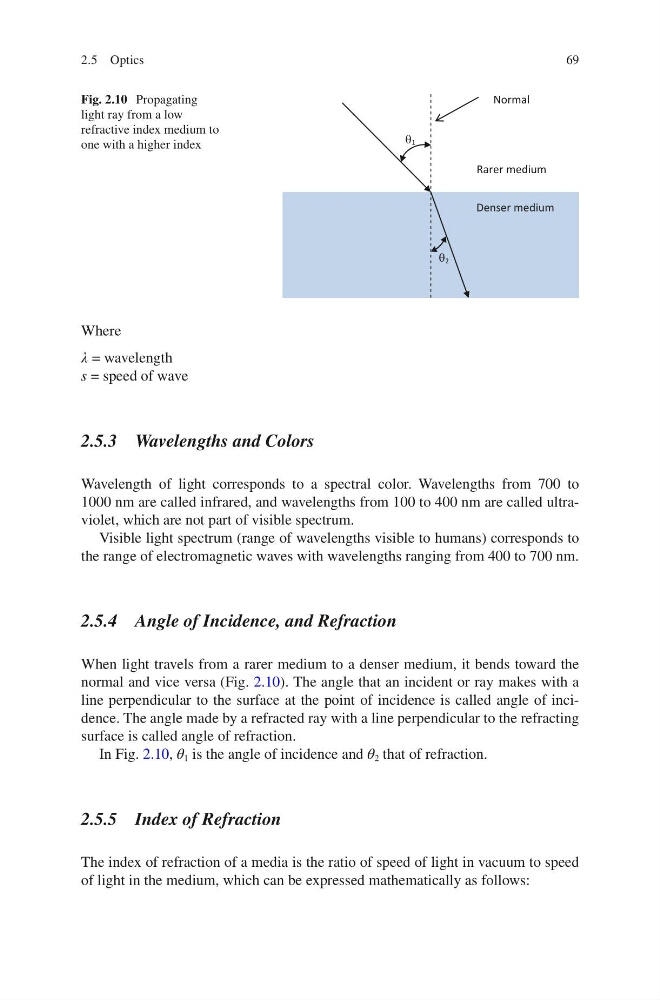
When light travels from a rarer medium to a denser medium, it bends toward the
normal and vice versa (Fig. 2.10). The angle that an incident or ray makes with a
line perpendicular to the surface at the point of incidence is called angle of incidence. The angle made by a refracted ray with a line perpendicular to the refracting
surface is called angle of refraction.
In Fig. 2.10, θ 1 is the angle of incidence and θ 2 that of refraction.
2.5.5 Index of Refraction
The index of refraction of a media is the ratio of speed of light in vacuum to speed
of light in the medium, which can be expressed mathematically as follows:
θ 1
θ 2
Rarer medium
Denser medium
Normal
Fig. 2.10 Propagating
light ray from a low
refractive index medium to
one with a higher index
2.5 Optics
Where
λ = wavelength
s = speed of wave
2.5.3 Wavelengths and Colors
Wavelength of light corresponds to a spectral color. Wavelengths from 700 to
1000 nm are called infrared, and wavelengths from 100 to 400 nm are called ultraviolet, which are not part of visible spectrum.
Visible light spectrum (range of wavelengths visible to humans) corresponds to
the range of electromagnetic waves with wavelengths ranging from 400 to 700 nm.
2.5.4 Angle of Incidence, and Refraction
When light travels from a rarer medium to a denser medium, it bends toward the
normal and vice versa (Fig. 2.10). The angle that an incident or ray makes with a
line perpendicular to the surface at the point of incidence is called angle of incidence. The angle made by a refracted ray with a line perpendicular to the refracting
surface is called angle of refraction.
In Fig. 2.10, θ 1 is the angle of incidence and θ 2 that of refraction.
2.5.5 Index of Refraction
The index of refraction of a media is the ratio of speed of light in vacuum to speed
of light in the medium, which can be expressed mathematically as follows:
θ 1
θ 2
Rarer medium
Denser medium
Normal
Fig. 2.10 Propagating
light ray from a low
refractive index medium to
one with a higher index
2.5 Optics