

58
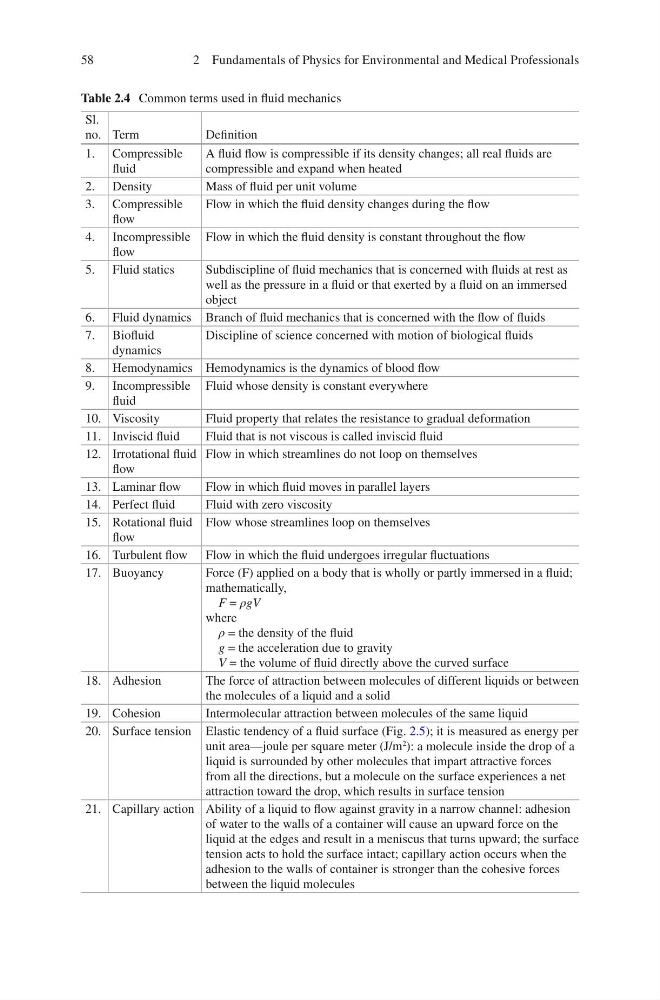
Table 2.4 Common terms used in fluid mechanics
Sl.
no. Term
Definition
1. Compressible
fluid
A fluid flow is compressible if its density changes; all real fluids are
compressible and expand when heated
2. Density
Mass of fluid per unit volume
3. Compressible
flow
Flow in which the fluid density changes during the flow
4. Incompressible
flow
Flow in which the fluid density is constant throughout the flow
5. Fluid statics
Subdiscipline of fluid mechanics that is concerned with fluids at rest as
well as the pressure in a fluid or that exerted by a fluid on an immersed
object
6. Fluid dynamics Branch of fluid mechanics that is concerned with the flow of fluids
7. Biofluid
dynamics
Discipline of science concerned with motion of biological fluids
8. Hemodynamics Hemodynamics is the dynamics of blood flow
9. Incompressible
fluid
Fluid whose density is constant everywhere
10. Viscosity
Fluid property that relates the resistance to gradual deformation
11. Inviscid fluid
Fluid that is not viscous is called inviscid fluid
12. Irrotational fluid
flow
Flow in which streamlines do not loop on themselves
13. Laminar flow
Flow in which fluid moves in parallel layers
14. Perfect fluid
Fluid with zero viscosity
15. Rotational fluid
flow
Flow whose streamlines loop on themselves
16. Turbulent flow Flow in which the fluid undergoes irregular fluctuations
17. Buoyancy
Force (F) applied on a body that is wholly or partly immersed in a fluid;
mathematically,
F = ρgV
where
ρ = the density of the fluid
g = the acceleration due to gravity
V = the volume of fluid directly above the curved surface
18. Adhesion
The force of attraction between molecules of different liquids or between
the molecules of a liquid and a solid
19. Cohesion
Intermolecular attraction between molecules of the same liquid
20. Surface tension Elastic tendency of a fluid surface (Fig. 2.5); it is measured as energy per
unit area—joule per square meter (J/m
2
): a molecule inside the drop of a
liquid is surrounded by other molecules that impart attractive forces
from all the directions, but a molecule on the surface experiences a net
attraction toward the drop, which results in surface tension
21. Capillary action Ability of a liquid to flow against gravity in a narrow channel: adhesion
of water to the walls of a container will cause an upward force on the
liquid at the edges and result in a meniscus that turns upward; the surface
tension acts to hold the surface intact; capillary action occurs when the
adhesion to the walls of container is stronger than the cohesive forces
between the liquid molecules
2 Fundamentals of Physics for Environmental and Medical Professionals
Table 2.4 Common terms used in fluid mechanics
Sl.
no. Term
Definition
1. Compressible
fluid
A fluid flow is compressible if its density changes; all real fluids are
compressible and expand when heated
2. Density
Mass of fluid per unit volume
3. Compressible
flow
Flow in which the fluid density changes during the flow
4. Incompressible
flow
Flow in which the fluid density is constant throughout the flow
5. Fluid statics
Subdiscipline of fluid mechanics that is concerned with fluids at rest as
well as the pressure in a fluid or that exerted by a fluid on an immersed
object
6. Fluid dynamics Branch of fluid mechanics that is concerned with the flow of fluids
7. Biofluid
dynamics
Discipline of science concerned with motion of biological fluids
8. Hemodynamics Hemodynamics is the dynamics of blood flow
9. Incompressible
fluid
Fluid whose density is constant everywhere
10. Viscosity
Fluid property that relates the resistance to gradual deformation
11. Inviscid fluid
Fluid that is not viscous is called inviscid fluid
12. Irrotational fluid
flow
Flow in which streamlines do not loop on themselves
13. Laminar flow
Flow in which fluid moves in parallel layers
14. Perfect fluid
Fluid with zero viscosity
15. Rotational fluid
flow
Flow whose streamlines loop on themselves
16. Turbulent flow Flow in which the fluid undergoes irregular fluctuations
17. Buoyancy
Force (F) applied on a body that is wholly or partly immersed in a fluid;
mathematically,
F = ρgV
where
ρ = the density of the fluid
g = the acceleration due to gravity
V = the volume of fluid directly above the curved surface
18. Adhesion
The force of attraction between molecules of different liquids or between
the molecules of a liquid and a solid
19. Cohesion
Intermolecular attraction between molecules of the same liquid
20. Surface tension Elastic tendency of a fluid surface (Fig. 2.5); it is measured as energy per
unit area—joule per square meter (J/m
2
): a molecule inside the drop of a
liquid is surrounded by other molecules that impart attractive forces
from all the directions, but a molecule on the surface experiences a net
attraction toward the drop, which results in surface tension
21. Capillary action Ability of a liquid to flow against gravity in a narrow channel: adhesion
of water to the walls of a container will cause an upward force on the
liquid at the edges and result in a meniscus that turns upward; the surface
tension acts to hold the surface intact; capillary action occurs when the
adhesion to the walls of container is stronger than the cohesive forces
between the liquid molecules
2 Fundamentals of Physics for Environmental and Medical Professionals