

57
2.3 Solid Mechanics
Human body and the environment are made up of solid and fluid. The behaviors of
body fluids to force such as movement or deformation depend on established theory
of mechanics. Explanation to the behavior of movement of polluting particles in
gases and liquid requires knowledge of fluid mechanics. Treatment and disposal of
waste need knowledge of solid mechanics.
Application of the mechanics can be mainly divided into fluid mechanics and
solid mechanics. Solid mechanics deals with stressing and deformation, besides
failure of solid materials. The common terms used in solid mechanics are given in
Table 2.3.
All living organisms, including humans, are subjected to forces within and surrounding the body. Human movement is achieved through a highly coordinated and
complex mechanical interactions between ligaments, muscles, bones, and joints
within the musculoskeletal system (Lu and Chang 2012).
Climate change and pollution will impact material properties and biomechanics
of living organisms, including human beings. Climate changes are likely to result in
altered wind speeds, acidification, ocean circulation, wave action, as well as
increased frequency of hypoxic events (the depletion of oxygen in the bottom waters
of coastal areas). These environmental drivers affect neural control and muscle
function. Altered environmental conditions such as ocean acidification coupled with
increased temperatures affect byssal threads of mussels as well as shells and
Force
Force
X
X
Longitudinal Strain ( ) = X / X
ε ∆
∆
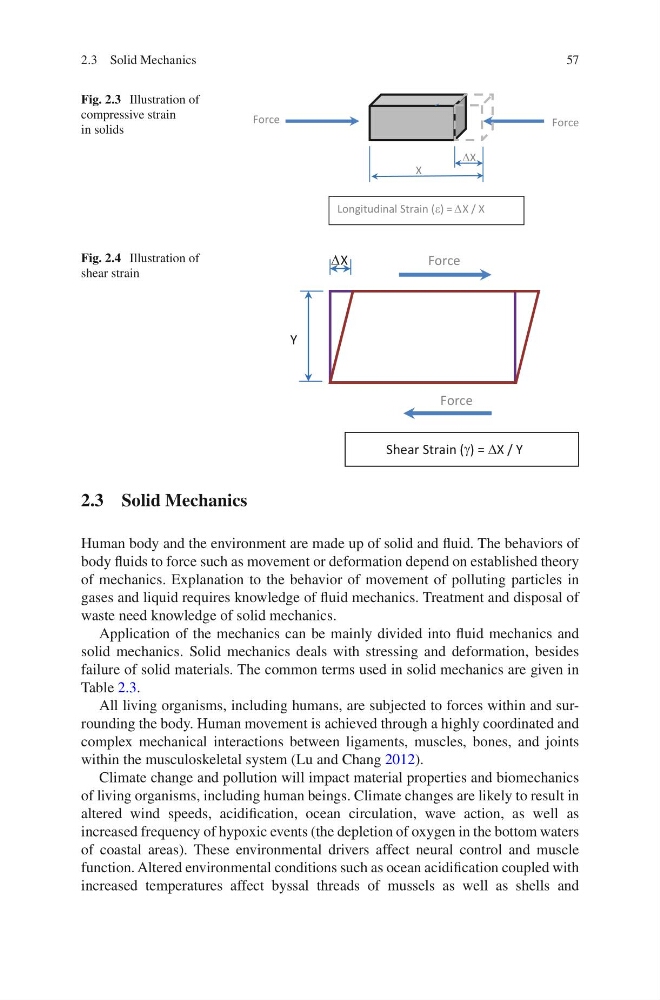
Fig. 2.3 Illustration of
compressive strain
in solids
Y
Force
Force
Shear Strain ( ) = X / Y
X
∆
∆
γ
Fig. 2.4 Illustration of
shear strain
2.3 Solid Mechanics
2.3 Solid Mechanics
Human body and the environment are made up of solid and fluid. The behaviors of
body fluids to force such as movement or deformation depend on established theory
of mechanics. Explanation to the behavior of movement of polluting particles in
gases and liquid requires knowledge of fluid mechanics. Treatment and disposal of
waste need knowledge of solid mechanics.
Application of the mechanics can be mainly divided into fluid mechanics and
solid mechanics. Solid mechanics deals with stressing and deformation, besides
failure of solid materials. The common terms used in solid mechanics are given in
Table 2.3.
All living organisms, including humans, are subjected to forces within and surrounding the body. Human movement is achieved through a highly coordinated and
complex mechanical interactions between ligaments, muscles, bones, and joints
within the musculoskeletal system (Lu and Chang 2012).
Climate change and pollution will impact material properties and biomechanics
of living organisms, including human beings. Climate changes are likely to result in
altered wind speeds, acidification, ocean circulation, wave action, as well as
increased frequency of hypoxic events (the depletion of oxygen in the bottom waters
of coastal areas). These environmental drivers affect neural control and muscle
function. Altered environmental conditions such as ocean acidification coupled with
increased temperatures affect byssal threads of mussels as well as shells and
Force
Force
X
X
Longitudinal Strain ( ) = X / X
ε ∆
∆
Fig. 2.3 Illustration of
compressive strain
in solids
Y
Force
Force
Shear Strain ( ) = X / Y
X
∆
∆
γ
Fig. 2.4 Illustration of
shear strain
2.3 Solid Mechanics