

44
Any nucleus that decays spontaneously is said to be radioactive. Radioactive
decay happens due to emitting of subatomic particles as well as electromagnetic
radiation. The process of emitting these particles is collectively termed as radioactivity. Isotopes that emit radiation are known as radioisotopes.
The decline in the number of radioactive nuclei per unit time is known as the rate
of radioactive decay. Radioactive decay reactions are known to be first-order reactions. The time required for decay of half of the initial number of nuclei (plural of
nucleus) present is called half-life, which can vary from the fractions of a second to
billions of years.
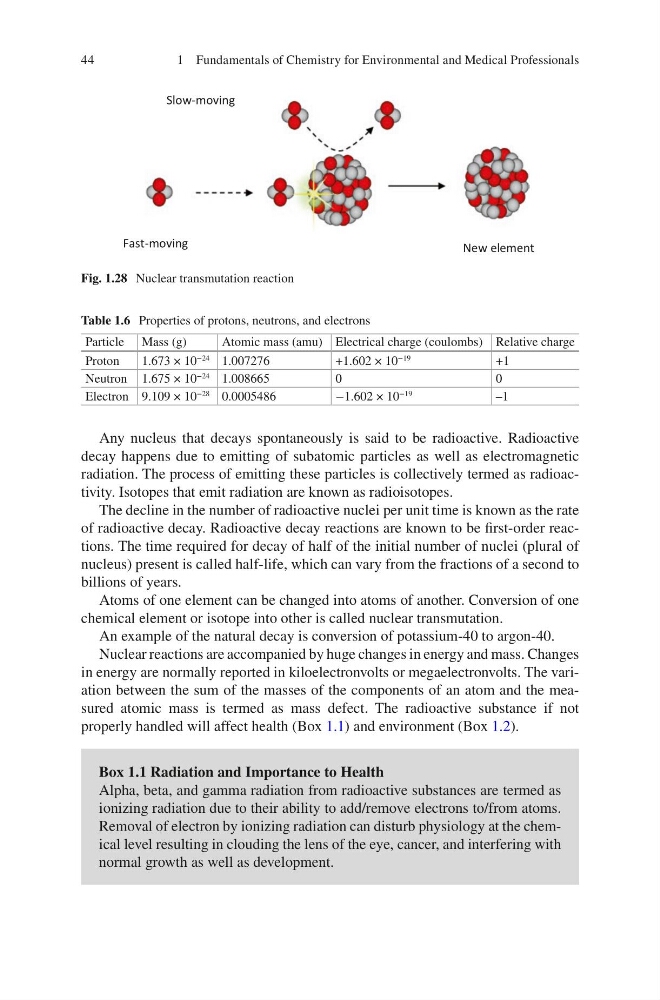
Atoms of one element can be changed into atoms of another. Conversion of one
chemical element or isotope into other is called nuclear transmutation.
An example of the natural decay is conversion of potassium-40 to argon-40.
Nuclear reactions are accompanied by huge changes in energy and mass. Changes
in energy are normally reported in kiloelectronvolts or megaelectronvolts. The variation between the sum of the masses of the components of an atom and the measured atomic mass is termed as mass defect. The radioactive substance if not
properly handled will affect health (Box 1.1) and environment (Box 1.2).
Fast-moving
New element
Slow-moving
Fig. 1.28 Nuclear transmutation reaction
Table 1.6 Properties of protons, neutrons, and electrons
Particle Mass (g)
Atomic mass (amu) Electrical charge (coulombs) Relative charge
Proton
1.673 × 10
−24
1.007276
+1.602 × 10
−19
+1
Neutron 1.675 × 10
−24
1.008665
0
0
Electron 9.109 × 10
−28
0.0005486
−1.602 × 10
−19
–1
Box 1.1 Radiation and Importance to Health
Alpha, beta, and gamma radiation from radioactive substances are termed as
ionizing radiation due to their ability to add/remove electrons to/from atoms.
Removal of electron by ionizing radiation can disturb physiology at the chemical level resulting in clouding the lens of the eye, cancer, and interfering with
normal growth as well as development.
1 Fundamentals of Chemistry for Environmental and Medical Professionals
Any nucleus that decays spontaneously is said to be radioactive. Radioactive
decay happens due to emitting of subatomic particles as well as electromagnetic
radiation. The process of emitting these particles is collectively termed as radioactivity. Isotopes that emit radiation are known as radioisotopes.
The decline in the number of radioactive nuclei per unit time is known as the rate
of radioactive decay. Radioactive decay reactions are known to be first-order reactions. The time required for decay of half of the initial number of nuclei (plural of
nucleus) present is called half-life, which can vary from the fractions of a second to
billions of years.
Atoms of one element can be changed into atoms of another. Conversion of one
chemical element or isotope into other is called nuclear transmutation.
An example of the natural decay is conversion of potassium-40 to argon-40.
Nuclear reactions are accompanied by huge changes in energy and mass. Changes
in energy are normally reported in kiloelectronvolts or megaelectronvolts. The variation between the sum of the masses of the components of an atom and the measured atomic mass is termed as mass defect. The radioactive substance if not
properly handled will affect health (Box 1.1) and environment (Box 1.2).
Fast-moving
New element
Slow-moving
Fig. 1.28 Nuclear transmutation reaction
Table 1.6 Properties of protons, neutrons, and electrons
Particle Mass (g)
Atomic mass (amu) Electrical charge (coulombs) Relative charge
Proton
1.673 × 10
−24
1.007276
+1.602 × 10
−19
+1
Neutron 1.675 × 10
−24
1.008665
0
0
Electron 9.109 × 10
−28
0.0005486
−1.602 × 10
−19
–1
Box 1.1 Radiation and Importance to Health
Alpha, beta, and gamma radiation from radioactive substances are termed as
ionizing radiation due to their ability to add/remove electrons to/from atoms.
Removal of electron by ionizing radiation can disturb physiology at the chemical level resulting in clouding the lens of the eye, cancer, and interfering with
normal growth as well as development.
1 Fundamentals of Chemistry for Environmental and Medical Professionals