

43
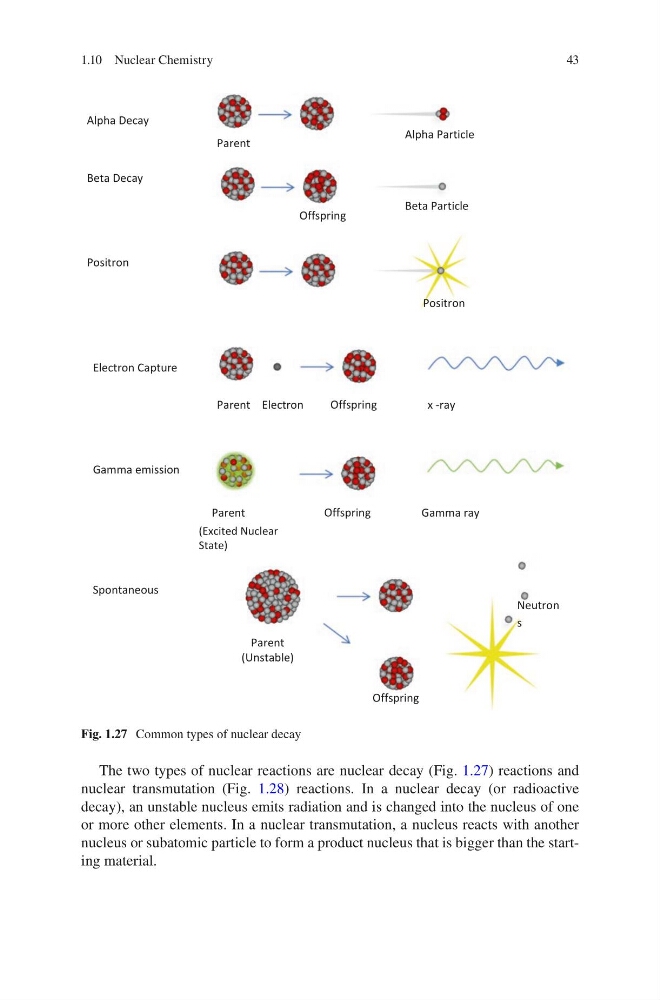
The two types of nuclear reactions are nuclear decay (Fig. 1.27) reactions and
nuclear transmutation (Fig. 1.28) reactions. In a nuclear decay (or radioactive
decay), an unstable nucleus emits radiation and is changed into the nucleus of one
or more other elements. In a nuclear transmutation, a nucleus reacts with another
nucleus or subatomic particle to form a product nucleus that is bigger than the starting material.
Alpha Decay
Parent
Alpha Particle
Beta Decay
Offspring
Beta Particle
Positron
Positron
Electron Capture
Parent
Offspring
Electron
x -ray
Gamma emission
Parent
Offspring
Gamma ray
Parent
(Unstable)
Offspring
Neutron
s
Spontaneous
(Excited Nuclear
State)
Fig. 1.27 Common types of nuclear decay
1.10 Nuclear Chemistry
The two types of nuclear reactions are nuclear decay (Fig. 1.27) reactions and
nuclear transmutation (Fig. 1.28) reactions. In a nuclear decay (or radioactive
decay), an unstable nucleus emits radiation and is changed into the nucleus of one
or more other elements. In a nuclear transmutation, a nucleus reacts with another
nucleus or subatomic particle to form a product nucleus that is bigger than the starting material.
Alpha Decay
Parent
Alpha Particle
Beta Decay
Offspring
Beta Particle
Positron
Positron
Electron Capture
Parent
Offspring
Electron
x -ray
Gamma emission
Parent
Offspring
Gamma ray
Parent
(Unstable)
Offspring
Neutron
s
Spontaneous
(Excited Nuclear
State)
Fig. 1.27 Common types of nuclear decay
1.10 Nuclear Chemistry