

45
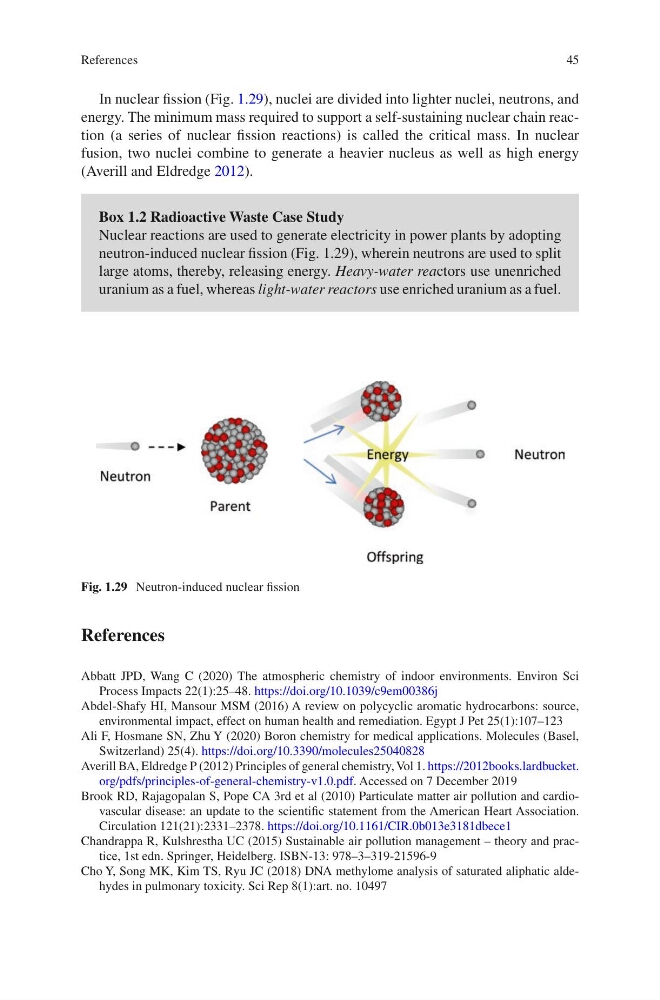
In nuclear fission (Fig. 1.29), nuclei are divided into lighter nuclei, neutrons, and
energy. The minimum mass required to support a self-sustaining nuclear chain reaction (a series of nuclear fission reactions) is called the critical mass. In nuclear
fusion, two nuclei combine to generate a heavier nucleus as well as high energy
(Averill and Eldredge 2012).
References
Abbatt JPD, Wang C (2020) The atmospheric chemistry of indoor environments. Environ Sci
Process Impacts 22(1):25–48. https://doi.org/10.1039/c9em00386j
Abdel-Shafy HI, Mansour MSM (2016) A review on polycyclic aromatic hydrocarbons: source,
environmental impact, effect on human health and remediation. Egypt J Pet 25(1):107–123
Ali F, Hosmane SN, Zhu Y (2020) Boron chemistry for medical applications. Molecules (Basel,
Switzerland) 25(4). https://doi.org/10.3390/molecules25040828
Averill BA, Eldredge P (2012) Principles of general chemistry, Vol 1. https://2012books.lardbucket.
org/pdfs/principles- of- general- chemistry- v1.0.pdf. Accessed on 7 December 2019
Brook RD, Rajagopalan S, Pope CA 3rd et al (2010) Particulate matter air pollution and cardiovascular disease: an update to the scientific statement from the American Heart Association.
Circulation 121(21):2331–2378. https://doi.org/10.1161/CIR.0b013e3181dbece1
Chandrappa R, Kulshrestha UC (2015) Sustainable air pollution management – theory and practice, 1st edn. Springer, Heidelberg. ISBN-13: 978–3–319-21596-9
Cho Y, Song MK, Kim TS, Ryu JC (2018) DNA methylome analysis of saturated aliphatic aldehydes in pulmonary toxicity. Sci Rep 8(1):art. no. 10497
Fig. 1.29 Neutron-induced nuclear fission
Box 1.2 Radioactive Waste Case Study
Nuclear reactions are used to generate electricity in power plants by adopting
neutron-induced nuclear fission (Fig. 1.29), wherein neutrons are used to split
large atoms, thereby, releasing energy. Heavy-water reactors use unenriched
uranium as a fuel, whereas light-water reactors use enriched uranium as a fuel.
References
In nuclear fission (Fig. 1.29), nuclei are divided into lighter nuclei, neutrons, and
energy. The minimum mass required to support a self-sustaining nuclear chain reaction (a series of nuclear fission reactions) is called the critical mass. In nuclear
fusion, two nuclei combine to generate a heavier nucleus as well as high energy
(Averill and Eldredge 2012).
References
Abbatt JPD, Wang C (2020) The atmospheric chemistry of indoor environments. Environ Sci
Process Impacts 22(1):25–48. https://doi.org/10.1039/c9em00386j
Abdel-Shafy HI, Mansour MSM (2016) A review on polycyclic aromatic hydrocarbons: source,
environmental impact, effect on human health and remediation. Egypt J Pet 25(1):107–123
Ali F, Hosmane SN, Zhu Y (2020) Boron chemistry for medical applications. Molecules (Basel,
Switzerland) 25(4). https://doi.org/10.3390/molecules25040828
Averill BA, Eldredge P (2012) Principles of general chemistry, Vol 1. https://2012books.lardbucket.
org/pdfs/principles- of- general- chemistry- v1.0.pdf. Accessed on 7 December 2019
Brook RD, Rajagopalan S, Pope CA 3rd et al (2010) Particulate matter air pollution and cardiovascular disease: an update to the scientific statement from the American Heart Association.
Circulation 121(21):2331–2378. https://doi.org/10.1161/CIR.0b013e3181dbece1
Chandrappa R, Kulshrestha UC (2015) Sustainable air pollution management – theory and practice, 1st edn. Springer, Heidelberg. ISBN-13: 978–3–319-21596-9
Cho Y, Song MK, Kim TS, Ryu JC (2018) DNA methylome analysis of saturated aliphatic aldehydes in pulmonary toxicity. Sci Rep 8(1):art. no. 10497
Fig. 1.29 Neutron-induced nuclear fission
Box 1.2 Radioactive Waste Case Study
Nuclear reactions are used to generate electricity in power plants by adopting
neutron-induced nuclear fission (Fig. 1.29), wherein neutrons are used to split
large atoms, thereby, releasing energy. Heavy-water reactors use unenriched
uranium as a fuel, whereas light-water reactors use enriched uranium as a fuel.
References