

40
2
4
2
2
H O
H O
Energe
→
+
2
4
2
2
N O
N O
Energe
→
+
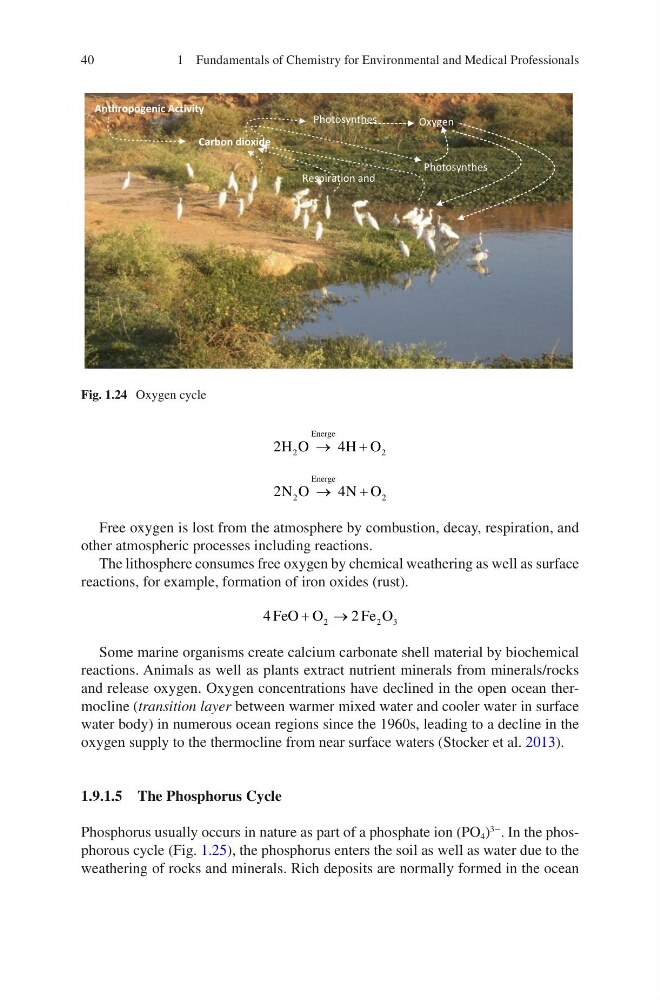
Free oxygen is lost from the atmosphere by combustion, decay, respiration, and
other atmospheric processes including reactions.
The lithosphere consumes free oxygen by chemical weathering as well as surface
reactions, for example, formation of iron oxides (rust).
4
2
2
2 3
FeO O
Fe O
+
→
Some marine organisms create calcium carbonate shell material by biochemical
reactions. Animals as well as plants extract nutrient minerals from minerals/rocks
and release oxygen. Oxygen concentrations have declined in the open ocean thermocline (transition layer between warmer mixed water and cooler water in surface
water body) in numerous ocean regions since the 1960s, leading to a decline in the
oxygen supply to the thermocline from near surface waters (Stocker et al. 2013).
1.9.1.5 The Phosphorus Cycle
Phosphorus usually occurs in nature as part of a phosphate ion (PO 4 )
3−
. In the phosphorous cycle (Fig. 1.25), the phosphorus enters the soil as well as water due to the
weathering of rocks and minerals. Rich deposits are normally formed in the ocean
Oxygen
Carbon dioxide
Photosynthes
Photosynthes
Respiration and
Anthropogenic Activity
Fig. 1.24 Oxygen cycle
1 Fundamentals of Chemistry for Environmental and Medical Professionals
2
4
2
2
H O
H O
Energe
→
+
2
4
2
2
N O
N O
Energe
→
+
Free oxygen is lost from the atmosphere by combustion, decay, respiration, and
other atmospheric processes including reactions.
The lithosphere consumes free oxygen by chemical weathering as well as surface
reactions, for example, formation of iron oxides (rust).
4
2
2
2 3
FeO O
Fe O
+
→
Some marine organisms create calcium carbonate shell material by biochemical
reactions. Animals as well as plants extract nutrient minerals from minerals/rocks
and release oxygen. Oxygen concentrations have declined in the open ocean thermocline (transition layer between warmer mixed water and cooler water in surface
water body) in numerous ocean regions since the 1960s, leading to a decline in the
oxygen supply to the thermocline from near surface waters (Stocker et al. 2013).
1.9.1.5 The Phosphorus Cycle
Phosphorus usually occurs in nature as part of a phosphate ion (PO 4 )
3−
. In the phosphorous cycle (Fig. 1.25), the phosphorus enters the soil as well as water due to the
weathering of rocks and minerals. Rich deposits are normally formed in the ocean
Oxygen
Carbon dioxide
Photosynthes
Photosynthes
Respiration and
Anthropogenic Activity
Fig. 1.24 Oxygen cycle
1 Fundamentals of Chemistry for Environmental and Medical Professionals