

39
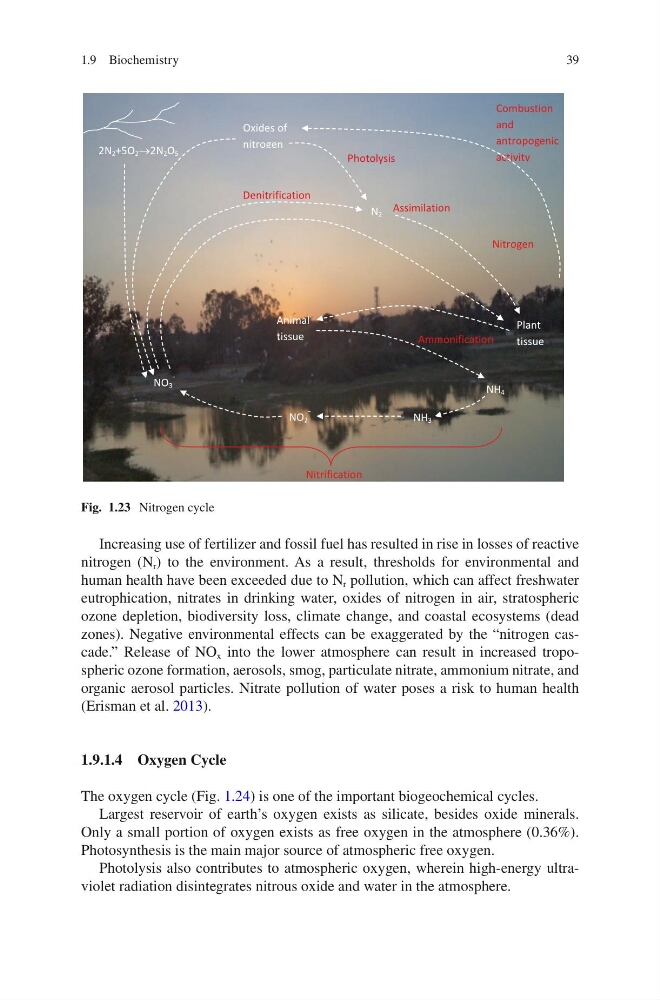
Increasing use of fertilizer and fossil fuel has resulted in rise in losses of reactive
nitrogen (N r ) to the environment. As a result, thresholds for environmental and
human health have been exceeded due to N r pollution, which can affect freshwater
eutrophication, nitrates in drinking water, oxides of nitrogen in air, stratospheric
ozone depletion, biodiversity loss, climate change, and coastal ecosystems (dead
zones). Negative environmental effects can be exaggerated by the “nitrogen cascade.” Release of NO x into the lower atmosphere can result in increased tropospheric ozone formation, aerosols, smog, particulate nitrate, ammonium nitrate, and
organic aerosol particles. Nitrate pollution of water poses a risk to human health
(Erisman et al. 2013).
1.9.1.4 Oxygen Cycle
The oxygen cycle (Fig. 1.24) is one of the important biogeochemical cycles.
Largest reservoir of earth’s oxygen exists as silicate, besides oxide minerals.
Only a small portion of oxygen exists as free oxygen in the atmosphere (0.36%).
Photosynthesis is the main major source of atmospheric free oxygen.
Photolysis also contributes to atmospheric oxygen, wherein high-energy ultraviolet radiation disintegrates nitrous oxide and water in the atmosphere.
Nitrification
Assimilation
Ammonification
2N 2 +5O 2 →2N 2 O 5
Oxides of
nitrogen
Combustion
and
antropogenic
activity
N 2
NO 3
-
NO 2
-
NH 3
NH 4
Plant
tissue
Animal
tissue
Nitrogen
Denitrification
Photolysis
Fig. 1.23 Nitrogen cycle
1.9 Biochemistry
Increasing use of fertilizer and fossil fuel has resulted in rise in losses of reactive
nitrogen (N r ) to the environment. As a result, thresholds for environmental and
human health have been exceeded due to N r pollution, which can affect freshwater
eutrophication, nitrates in drinking water, oxides of nitrogen in air, stratospheric
ozone depletion, biodiversity loss, climate change, and coastal ecosystems (dead
zones). Negative environmental effects can be exaggerated by the “nitrogen cascade.” Release of NO x into the lower atmosphere can result in increased tropospheric ozone formation, aerosols, smog, particulate nitrate, ammonium nitrate, and
organic aerosol particles. Nitrate pollution of water poses a risk to human health
(Erisman et al. 2013).
1.9.1.4 Oxygen Cycle
The oxygen cycle (Fig. 1.24) is one of the important biogeochemical cycles.
Largest reservoir of earth’s oxygen exists as silicate, besides oxide minerals.
Only a small portion of oxygen exists as free oxygen in the atmosphere (0.36%).
Photosynthesis is the main major source of atmospheric free oxygen.
Photolysis also contributes to atmospheric oxygen, wherein high-energy ultraviolet radiation disintegrates nitrous oxide and water in the atmosphere.
Nitrification
Assimilation
Ammonification
2N 2 +5O 2 →2N 2 O 5
Oxides of
nitrogen
Combustion
and
antropogenic
activity
N 2
NO 3
-
NO 2
-
NH 3
NH 4
Plant
tissue
Animal
tissue
Nitrogen
Denitrification
Photolysis
Fig. 1.23 Nitrogen cycle
1.9 Biochemistry